1 month ago
51
1 month ago
51
On the night that Spain won their first World Cup in 2010, Rodrigo Hernández was on camp somewhere lost in the woods of Connecticut. He had been canoeing when the selección beat Germany in the semi-final, upset to have missed it, and for the final he convinced one of the supervisors to let him watch, alone, on a mini-laptop in the hut where the staff slept. When Andrés Iniesta scored the winning goal in the 116th minute, he ran off screaming, doing laps of the lake. He was 14.
On the night that Spain won their second World Cup 16 years later, Rodrigo Hernández was back in the US, not so far from there. When Ferran Torres scored the winning goal in the 106th minute, he ran off screaming in a straighter line and accompanied this time: towards the corner where his other family were. And then, when it ended, when the fighting finished too, he collected the trophy, pausing just long enough for Donald Trump to leave centre stage before lifting it, his timing perfect even here.
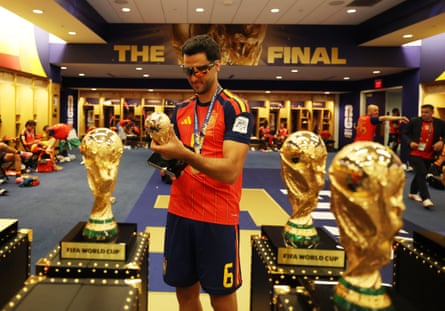
It wasn’t the only trophy he had, but those could be handed over and this could not. By the time Rodri departed at 9.38pm eastern time, the last man out of the dressing room at the New Jersey New York Stadium, he couldn’t carry them all: walking with him, just ahead, Ladis had to lend a hand. A football team is never just the players, nor even just the coaches. When he departed the dressing room nine minutes earlier, the same happened for Pau Cubarsí. Nuria helped him, their boy: just 19, looking like a kid down here in the stadium in real life but not on the pitch where he’s a leader. Luis de la Fuente was accompanied by Paloma.
Rodri came with the trophy for the tournament’s best player too. Cubarsí had the young player award, Unai Simón the Golden Glove. They also had two World Cups, every Spain player did: a replica of their own in a black Louis Vuitton trophy trunk, not easy to fit under an arm, and another in Lego. Rodri had three: both of those and the cup. They departed laden down, great big plastic bags full, pieces of the history they made. Shirts, in red and yellow and blue and white. Balls, boots. They had cut the net and taken pieces of that too. They had been given rings, NBA style.
Before the final began, Marc Cucurella had sneaked off towards the touchline and buried a coin in the pitch, like that other left-back Joan Capdevila had done in 2010. Iniesta had been out there, his name chanted, as he showed the cup to the stands. After it, Sergio Ramos brought it back again. Dashing out, excitedly kissing it, he placed it on the plinth for this new generation, achieving the impossible in emulating them, to go and collect. One by one they passed, Borja Iglesias and Lamine Yamal among the most evasive in shaking Trump’s hand, until Rodri took the trophy and lifted it to the sky.
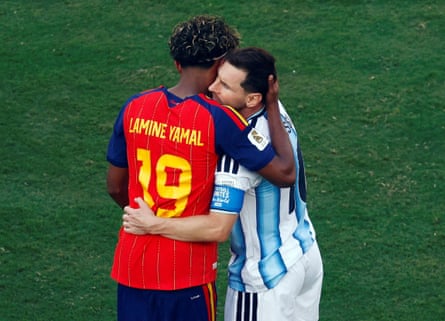
Nico Williams went to find his mum in the front row and handed over his medal. Lamine Yamal had made his way across to Lionel Messi, who was sitting but who stood for him, embracing the boy in the bath, the successor: a rite of passage, an image that will be for ever. The actor Javier Bardem was hugging Iglesias, his new friend and idol. Ferran Torres was talking about a “great liberation”: he had suffered, felt how cruel this game could be, how people could be too, but he said: “Destiny is written: God gives to those who deserve.” And Keyne was, well, Keyne. In the dressing room – the same one, Cucurella noted, where he had been at last year’s Club World Cup – the champagne was cracked open.
It was brief – the flight to Spain was scheduled for 11pm and they wanted to get back – and soon they were on their way again. Behind the screen, along the corridor they came, way down in the depths and the half-light of the stadium. The president, the staff, all the players; the many, many people who made this so. Iglesias carried a bag so big it was like he was a student taking his washing home, and he was struggling to stop that box slipping. In the other hand he wheeled a big red speaker. Now playing: Dirty Cash (Money Talks) by PAWSA & Adventures of Stevie V. Lamine Yamal came, via the anti-doping room, in orange sunglasses, four chains, black cap on backwards. He didn’t wear his medal, but most did, thick discs round their necks. And commemorative shirts, ordered up in case.
Back in Dallas, at a celebration after the semi-final victory, someone had joked to the federation president, Rafael Louzán, that the shirts should say world champions on one side and Finalissima winners on the other, two trophies in one. Tempting, but these bore just the one trophy, “Spain 26” on the back. The war in the Middle East had prevented the Finalissima from going ahead in Doha as scheduled in March and every time another option was offered, Argentina said no, the impression that of a team, a federation, running scared. “Good job we didn’t play,” Emi Martínez had said then, after they scraped past Mauritania in a hastily arranged friendly that filled the hole. “If we had played [Spain] like this …”
Something like this might have happened. Not just because Argentina played like this but because Spain made them play like this. “We gave them a battering,” came the verdict from one of those heading out of the dressing room. This wasn’t just a win; this was more. Has a 1-0 ever been as dominant? There was a moment late in the game, still at 0-0, when the Spain fans chanted: “Look at them! Look at them! How they shit themselves!” and they weren’t wrong. Argentina could not get out all game; as Spain turned the screw, still less, the goal seemingly inevitable; the surprise was that it hadn’t come yet, that there would be just one. When it did it came as a liberation but also an act of irresistible logic.
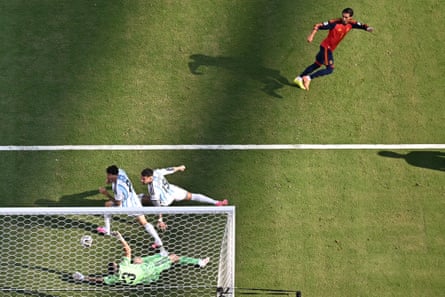
Torres’s shot was Spain’s 20th. Argentina didn’t manage one until the 115th minute. They didn’t manage any on target, all game. Across 900 World Cup games for which Opta has the stats, it is only the third time that a team has failed to shoot. And this in the final. They had done to Argentina what they did to France and to everyone, choking them. For the whole tournament Spain had an xG against of 0.3 per game. “If my gloves could talk, they would say they didn’t have much work to do,” Simón said. “Many teams depend too much on the back line,” Aymeric Laporte said, but not Spain.
This was the triumph of a collective, of a group; it ended in New York, but it was built in Chattanooga and beyond, over 51 days. It is the triumph of an idea, a conviction and of a coach too: a victory for De la Fuente and the system he leads and the system that made him. He began his coaching career at Deportivo Alavés in the third tier, where he lasted just 11 games. It was November 2011 when he left and he has not had a club job since. For months, no one returned his calls. He was on the dole for a year and a half until he saw an advert for a job: the Spanish federation was looking for a coach for the youth system. He started in the under-17s. He won the European Championship with the under-19s and the under-21s. Then he won it with the senior side; now he has won the World Cup.
“They asked me what there is left to win; we said the next game in September because they’re insatiable,” he insisted afterwards. Simón said: “The manager is outstanding; he has been our leader.” Cucurella, meanwhile, was in trouble. He had promised that if Spain won the World Cup, he would get a tattoo of De la Fuente’s face and now he had to decide where to put it to minimise the damage, the flight home an opportunity to think. Not least to think what a fool he had been.
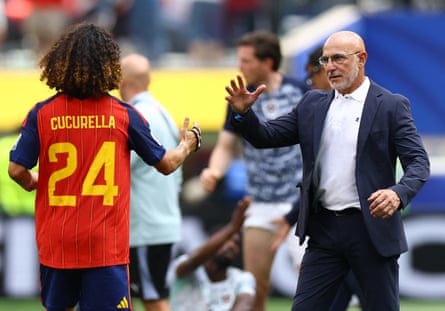
“I said: ‘You made a bad mistake’,” the coach joked. “But it’s not like I am so horrendously ugly that you have to put it somewhere it can’t be seen. And they are men of their word.” For all the laughs, that final line really mattered, and he knows: 10 of them played with him at junior level. The first title he ever won was the Under-19 Euros in 2015. In the middle of his midfield that day was Rodrigo Hernández.
Eleven years on, 16 since he watched Spain’s first World Cup win, motivation sought and identification found in what they achieved, Rodri was back in the US. The embodiment of that idea, a player who approached perfection here, no one played more passes nor made more tackles than him. No one had his weight either, the captain leading Spain out and leading them back too. Like so many of his teammates at a tournament that was an expression of justice and vindication too, he had suffered for this, a torn cruciate ligament overcome.
“It doesn’t matter if you fall, there’s always a reason to get up again,” he said and now he had it right here in his hands. It was 9.40pm when he boarded the bus bound for the airport, carrying the actual World Cup.