3 months ago
68
3 months ago
68
In 1916, Daher Nassar, a Christian Palestinian farmer living south of Bethlehem, made a move considered more than unusual at the time. He bought a 42-hectare stretch of farmland on the slopes and valleys of Wadi Salem, and formally registered the purchase with the Ottoman authorities, who then ruled the region.
A few years later, after transferring the title to his son, Nassar did something even more extraordinary. He re-registered the deed under each successive administration – the British mandate, then the Jordanian government, and finally, after 1967, under Israeli occupation.
Today, that ageing, yellowing document is one of the family’s few shields against the loss of their land – a plot that lies near the town of Nahalin in the so-called Area C of the Israeli-occupied West Bank, coveted by settlers and by far-right Israeli ministers eager to see it annexed. In 1991, the Israeli authorities began a legal battle to declare the Nassar family’s farm Israeli “state land”, a precursor to claiming it for occupation.
“I received this land as a gift,” says Daoud Nassar, 55, Daher’s grandchild, who now owns the farm with his family. “My grandfather gave it to my father, who gave it to me and to my brothers and sisters, and we intend to pass it on to our children, and to their children after them. For us Palestinians, the land is a gift – and a gift cannot be sold or given away.”
Nestled in the olive-clad hills of the Judean desert, the Nassar farm survives without direct access to water or electricity – both were cut off by Israeli settlers in 1991 – with the family living partly in underground natural caves. It is the only place they are able to live, because since 1967 when the land was designed part of Area C, under full Israeli military and civil control, any structure – permanent or temporary – requires an Israeli permit. Almost none are granted.
In this way, the family resists Israeli occupation while hemmed in by five illegal settler outposts – one built right up against its boundary – and locked in a 34-year legal battle with the army, forced to water each olive tree by hand, carrying two glasses of water at a time.
To date, the legal battle between the Nassar family and the Israeli government is one of the longest-running cases in the history of the West Bank, and the longest among those still pending.
“Under Ottoman reign, Palestinian farmers and land owners did not register many of the lands, or reported reduced areas in order to avoid taxes, relying instead on oral traditions and local village records,” says Sliman Shaheen, a legal expert in land-related and demolition cases in the West Bank, who provides consultations to human rights organisations.
“The central regime was not very strict in supervising the accuracy of the reported areas and was interested mainly in collecting tax by expanding agricultural land thus allowing for more tax collection.”
As a result, Israel used the absence of such continuous registration to classify land as “state land” and take control of it, especially in Area C of the West Bank.
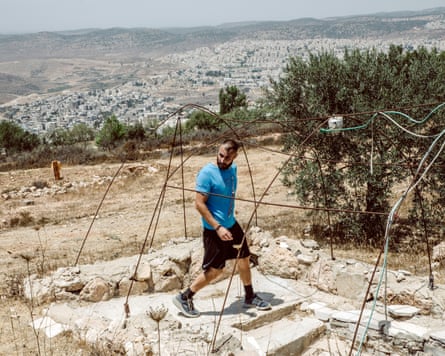
“In the start of the 1980s the Israeli authorities started to use ‘state land’ declarations, in which above 900,000 donams (about 900 sq km) of lands were confiscated as state lands, under the commissioner of the governmental property,” says Shaheen. “Official data obtained from the Civil Administration through freedom of information requests, show that only 0.7% from state lands were allocated to Palestinians, while 37% of these lands were allocated to settlers.”
Shaheen says the few Palestinians who brought cases before the objections committee – a military-run body that hears appeals against planning decisions – encountered an unfair process, with hearings conducted by IDF judges and no Palestinian representation.
Although the Nassar family had duly registered their land, in 1991 they were served with a notice from Israeli authorities declaring the farmland “state land”, making it vulnerable to occupation.
“Since then, we started a legal battle, which is still ongoing,” says Nassar. “We spent decades in front of a military court and years in front of the supreme court. We have registration documents from 1916 during the British mandate period. And then the Jordanian period and then even after 1967, after Israel occupied the West Bank. And ruling after ruling, the Israeli army is still appealing and asking us to re-register the land year after year.”
“Daoud’s case is unique,” says Shaheen. “If someone has a Jordanian tabu [title deed] his ownership rights are considered definite even under Israeli occupation.”
Despite the Israeli supreme court ruling on at least two separate occasions that the Nassar family’s land could not be expropriated, the Israeli military has continued to appeal in an effort to strip the family of the farm, which lies in an area deemed strategic by Israel.
Since the Hamas attack on 7 October 2023, Israel has accelerated the seizure of land in the West Bank and established a record number of new settlements. In response, dozens of Palestinian lawyers, acting on behalf of their clients, have travelled to Turkey in search of land ownership documents dating back to the Ottoman era.
“Many of these title deeds were lost and retrieving them involved travelling to Turkey and searching the archives by a geographical area, but it is very costly and impractical for the majority of Palestinians,” says Shaheen.
As now happens almost daily across the West Bank, alongside demolition orders, confiscations and military seizures, settlers also operate in a grey zone encouraged and protected by the Israeli authorities. They attack and vandalise Palestinian villages in an effort to force residents off their land.
“The settlers attack us constantly,” says Nassar. “They destroy our water tanks where we store rainwater, build roads across our land, block access to the main gate, and uproot our olive trees and crops.”
In 2002, a group of Israeli settlers uprooted more than 250 olive trees from the Nassar family’s farm. In 2014, the entire apricot harvest was destroyed.
Farming the land in occupied Palestine is not only a source of livelihood for thousands of families, but often an obligation: without continuous cultivation, land can be seized by the Israeli government and reclassified as “state land”.
“If cultivation stops for a certain period, then the lease can expire since the land is uncultivated and if so and the land is reverted to the state,” says Shaheen.
For this reason, since 2000 hundreds of volunteers from around the world have come to help the Nassar family farm their land as part of a project known as the Tent of Nations. Volunteers from Italy, the UK, France, Spain and the US are not only a visible presence and a form of protection against settler violence; they are also a vital workforce, without which it would be virtually impossible for the Palestinian family to care for their crops without access to water and electricity.
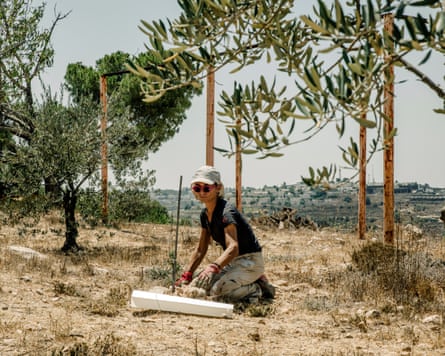
Last August, Gloria Ghetti, a schoolteacher from Faenza in northern Italy, travelled to the Nassar family’s farm to help water their struggling olive trees. What might sound like simple agricultural labour has proved gruelling: reliant solely on rainwater tanks, the family must irrigate hundreds of trees by hand, carrying water in 2-litre buckets to each individual tree under an unforgiving sun.
“When I read about the attacks by settlers on Palestinian communities, I felt I had to do something,” Ghetti says. “I realised that if I wanted to stand against this injustice, I couldn’t just read about it from afar – I had to get my hands dirty.”
The volunteers, together with members of the family, sleep in the natural caves where the Nassars lived for decades. One has been converted into a small chapel, where every Sunday a local parish priest celebrates mass.
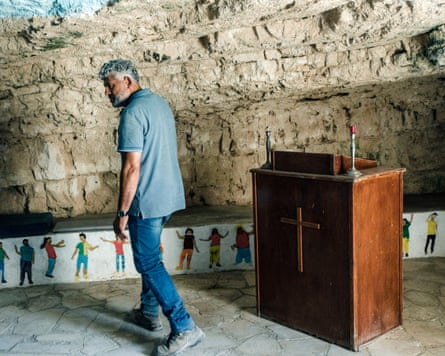
“At first, sleeping in the caves was a tradition,” says Nassar. “They offered shelter from the heat and symbolised our attachment to the land. Now, however, it has also become a necessity, because Israel prevents us from building homes or even small structures on our own land.”
A few months ago, Israeli settlers built an illegal outpost literally pressed up against the farm’s boundary fence – a clear provocation intended to push the family to breaking point and lure them into a misstep. If the Palestinians were to react, the Israeli military would have the pretext to lock them out of their land.
“Faced with the settlers’ provocations, we had the option of responding with violence or presenting ourselves as victims,” says Nassar. “We refused to do either. Responding with violence is not part of our principles. Hatred is not part of who we are. But we could not simply stand by and watch. We chose to believe in justice.
“They cut off our electricity, so we installed a solar system. They deny us access to water, and we rely instead on rainwater tanks.”
The IDF did not reply to a request for comment regarding the attempts to confiscate the family’s land.
Israel has consistently rejected accusations of ethnic cleansing from Israeli and international human rights organisations, including UN rapporteurs, dismissing them as fabricated propaganda. It also denies the colonisation of occupied territory by settlers is illegal under international law.