3 months ago
57
3 months ago
57
As you enter the living room at the Stories That Made Us exhibition, a stereo plays the Hindi anthem Yeh Dosti Hum Nahi Todenge. It’s a ballad celebrating friendship and love from the epic film Sholay. Beside the stereo, sits a bottle of Johnnie Walker and a red glass decanter. On the table are copies of the Punjabi newspaper Des Pardes, which translates as “home abroad”.
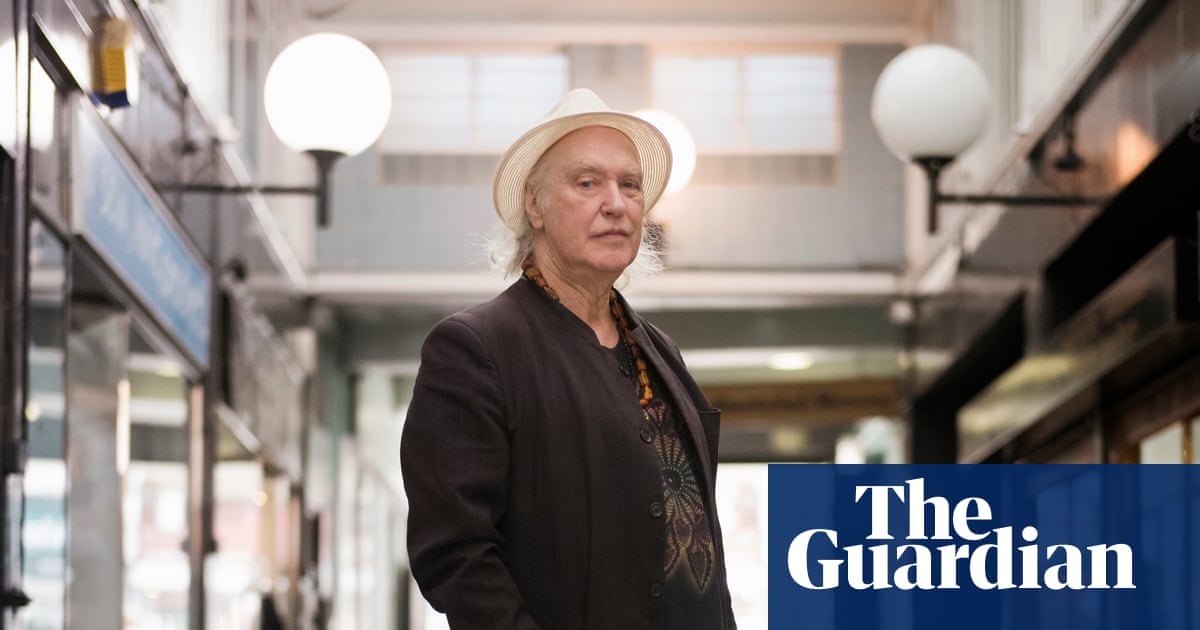
The scene, which depicts the childhood home of Coventry-born curator and artist Hardish Virk, is one of several spaces in an immersive exhibition at the city’s Herbert Art Gallery & Museum. It traces four decades of the experiences of south Asians as they arrived and adapted to the social, political and cultural changes in modern Britain.
“The original concept came from this idea of a living museum of south Asian stories,” says Virk, 54. “Somewhere our stories could be told through different generations and different decades.”
A sign written by Virk for visitors entering the gallery reads: “My family story is part of a tapestry of stories that exist throughout Coventry and beyond – stories of migration, home, family, friendship, community and culture.”
The exhibition, which contains photographs, music and oral histories from Virk and his family’s personal archive, begins in a space depicting border control at an airport, where footage is shown of south Asian communities arriving in the UK in the 1960s.
Although this marks the beginning of the Virk family story in the UK, the curator was keen to highlight historic ties with south Asia, including the founding of the East India Company in 1600 and two centuries of British colonial rule.
Visitors are taken on a journey through Virk’s childhood living room at his home on St George’s Road, Coventry. Pamphlets and books owned by Virk’s late father, Harbhajan Singh Virk, pay homage to his anti-racism as a member of the Indian Workers’ Association, the Indian Youth Association and the UK’s Communist party in the 1970s. Among the leaflets is one calling for protests after the racist murder of teenager Satnam Singh Gill in Coventry in 1981.
For Virk, the activism of south Asian communities during this period is particularly relevant in the Midlands after a spate of religiously motivated incidents, including two rapes of Sikh women.
“Recently we’ve had a lot of conversations around migration, hotels, flags. That’s heightened racist attacks,” he says. “That’s what I present in the passport control [space] that, actually, this is what people of my parents’ generation experienced – this hostile environment. That’s exactly the same hostile environment that we’re talking about today.”
Although Virk says his parents would be disappointed by what he describes as the “normalisation of racism” in recent years, he stresses that their struggles were not in vain. “They still set the foundation on which we are able to do this,” he says. “There was a time when I would never have been able to put this exhibition on.”
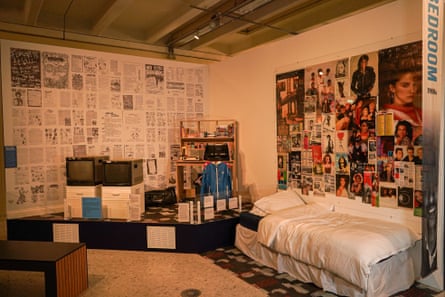
The recreation of Virk’s teenage bedrooom offers a glimpse into the lives of south Asians growing up in the UK in the 1980s – with posters of Michael Jackson and Madonna alongside a newspaper showcasing bhangra talent.
“If you’re born in this country, you have this whole new identity, an identity which is very intersectional,” says Virk. “Friends, relationships, music, fashion, movies – all of that. I wanted to encapsulate that as well.”
after newsletter promotion
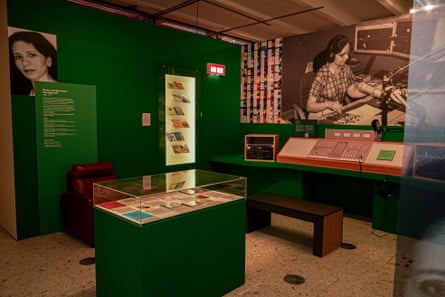
Also included in the exhibition is a radio studio space where his late mother, the poet Jasvir Kang, broadcast her Punjabi show in the 1990s. Virk said his mother’s poems regularly touched on domestic violence and abuse and it was important that the exhibition contained a dedicated space to reflect the stories of south Asian women.
“Often the story around the south Asian mother or the woman tends to be – particularly of that era – in the kitchen, looking after the children, working in the shop with the husband,” says Virk. “But I’m also saying that those women had a really important role, not only within the family or the community, but also wider society. There were women like my mother who were going against the status quo.”
The exhibition ends with a reflection space, which Virk describes as essential to process challenging memories that may arise from the stories on display. Visitors can also reflect by sharing their own stories.
In a note left at the end of exhibition, one wrote: “We had P*** graffitied on to our car. It happened when I was young and only now have I realised I’ve been carrying that around with me.”
Another said the exhibition had “cathartically taken me on a joyous, emotional, beautiful journey”.
“Never has a museum moved me so much,” it said. “The racism, the domestic violence, the 80s music, fashion, fun – the everything in our story’.
-
Stories That Made Us: Roots, Resilience, Representation is at the Herbert Art Gallery & Museum until 25 May 2026