3 months ago
66
3 months ago
66
I met Chris in the college bar in 1997. I was part of a group of visiting American students visiting the University of Oxford – we kept ourselves to ourselves in the first few weeks of term – and he leaned over from the next table to talk to me. I saw his one-dimpled smile and the cocky way he tipped his chair back on two legs and I thought: “Uh-oh, here’s trouble.”
Despite the fact that I was only at Oxford for one term, we quickly became a couple – and stayed together. When he finished university and started working in London, I returned to North Carolina to finish my English degree. We visited each other when we could. He made a surprise appearance at my 21st birthday party; we spent a New Year’s Eve in Paris.
After graduation, I moved to London to do an MA and also – mostly – to be near Chris. Then I moved to New York to work in publishing, and a year later he joined me to work for an American bank. We rented a place together and lived the life of childless twentysomethings in Manhattan: long working hours, long drinking hours, long summer weekends in a shared house on Fire Island.
It was love, for sure. But we were still figuring things out: I wear my heart on my sleeve, while he is the strong, silent type. I come from a middle-class midwestern American family; he was raised outside Manchester by a single mother who sometimes struggled to make ends meet. I was, truth be told, kind of spoiled. He could, on occasion, be a little dour. Were we too different? I wanted to analyse, to discuss – but, typically, he didn’t.
On the morning of 11 September 2001, I was in our Flatiron apartment, getting ready to work at a magazine. I was half-listening to the NY1 news channel when a story broke: there had been an explosion at the World Trade Center. The slow replay of the footage revealed the first plane. I perched on the arm of the sofa with my coffee and blamed the crowded airspace around LaGuardia.
Fifty blocks downtown, papers that had blown out of the World Trade Center had been falling from the sky outside the windows of Chris’s office on Wall Street. In the aftermath of the plane striking the North Tower, he and some colleagues went out to see for themselves what was happening. He had only made it a couple of blocks west when, at 9.03am, the South Tower exploded two blocks in front of him. The building itself seemed to bend in his direction, and he turned and ran.
For several hours, I couldn’t reach him. I watched the towers collapse on TV knowing that he worked just four blocks away. I went up to the roof of our apartment building and saw the smoke billowing up from downtown. I fielded calls from both of our mothers. Finally, Chris made contact: he was OK, just being held back inside his office building until it was safe enough to leave.
He arrived home mid-afternoon, in the stream of survivors trickling out of lower Manhattan. He was covered in dust and smelled like burning metal. We hugged. We watched the news. Then at some point we realised we hadn’t eaten, so we went to watch more news in a pizza shop on Third Avenue. The guy behind the counter saw the dust, and probably the shock, and wouldn’t let us pay.
It wasn’t until that night, when the focus of the coverage shifted on to who was responsible for the attacks, that I realised that I was overcome with a fierce, possessive anger: how dare they try to take him from me? In my rage, I got a glimpse of the void. But for the difference of two city blocks, I could have missed out on all of Chris, the good and the bad: that perfectly placed dimple, and his tendency towards bossiness; his goofy sweet side, and his grumpy aversion to fancy dress. My instinct was to grab him tightly and hold on for dear life, before the world came at us again.
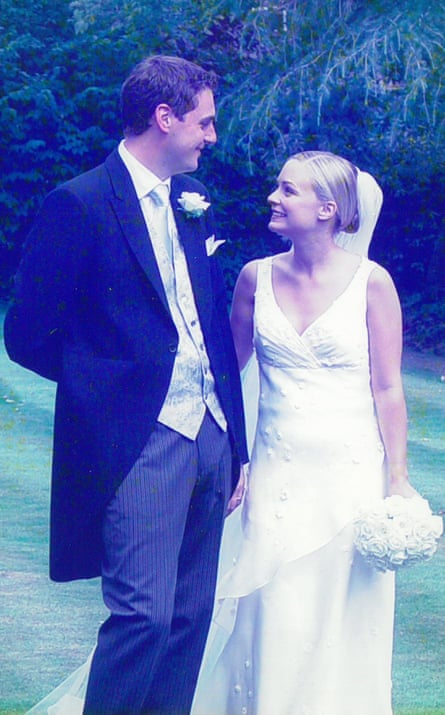
This feeling, mixed in with the grief over what was taken from so many people that day, fossilised over the weeks and months that followed. To my surprise, it left behind something that is hard and unwavering. It made me realise that love can be primitive and visceral. We married in 2003. I keep no tally of how our relationship is going, of what’s fair or how our marriage could be stronger. When things have gone wrong for us, in the face of grave illness and financial stress and all the pressures of 25 years of modern life, it’s just a given: he’s mine, and I will always hold on.