3 months ago
59
3 months ago
59
When Edgar Rosales Jr uses the word “home” he isn’t referring to the house he plans to buy after becoming a nurse or getting a job in public health. Rather, the second-year student at Long Beach City college is talking about the parking lot he slept in every night for more than a year.
With Oprah-esque enthusiasm, Rosales calls the other students who use LBCC’s Safe Parking Program his “roommates” or “neighbors”.
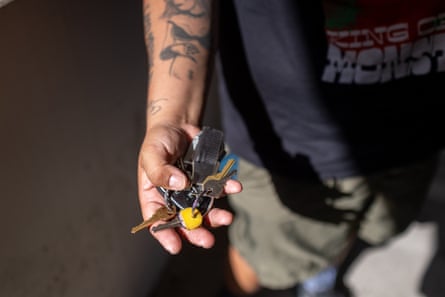
Between 8 and 1030pm, those neighbors drive onto the lot, where staff park during the day. Nearby showers open at 6am. Sleeping in a car may not sound like a step up, but for Rosales – who dropped out of a Compton high school more than 20 years ago to become a truck driver – being handed a key fob to a bathroom stocked with toilet paper and hand soap was life-altering. He kept the plastic tab on his key ring, even though he was supposed to place it in a drop box each morning, because the sight of it brought comfort; the sense of it between his fingers, hard and slick, felt like peace.
When Rosales and his son’s mother called it off again in the fall of 2024, just after he’d finished a GED program and enrolled at LBCC, he stayed with his brother for a week or so. But he didn’t want to be a burden. So one day after work at the trucking company – he’d gone part-time since enrolling, though he would still regularly clock 40 hours a week – he circled the block in his beat-up sedan and parked on the side of the road, near some RVs and an encampment.
The scariest part of sleeping in his car was the noises, Rosales said: “I heard a dog barking or I heard somebody running around or you see cop lights going down the street, you see people looking in your car.” He couldn’t sleep, let alone focus. Without the ability to bathe regularly, he began to avoid people to spare them the smell. The car became his sanctuary, he said, but also, a prison: “It starts messing with your mental health.”
First, Rosales dropped a class. A few weeks later, he told his LBCC peer navigator he couldn’t do it anymore and needed to withdraw. Instead, she helped Rosales sign up for the college’s Safe Parking Program, and everything flipped on its head.
With the LBCC lot’s outlets and WiFi, the back seat of his car morphed into a study carrel. Campus security was there to watch over him, not threaten him like the police had, telling him to move along or issuing a citation that cost him a day’s pay. For the first time in a month, Rosales said, “I could just sleep with my eyes closed the whole night.”
Stopgap solutions to a national problem
Forty-eight per cent of college students in the US experience housing insecurity, meaning “challenges that prevent them from having a safe, affordable, and consistent place to live”, suggests the most recent Student Basic Needs Survey Report from the Hope Center at Temple University. Fourteen per cent of the nearly 75,000 students surveyed experienced homelessness, the most severe form of housing insecurity.
That’s partly because of a national housing supply shortage and the fact that eligibility rules for affordable housing programs often exclude students; and it’s partly because the cost of college has risen nationwide as government investment in higher education and the purchasing power of financial aid have fallen over the decades. The second Trump administration’s threatened and actual changes to Pell Grants, the largest federal student aid program, haven’t helped, nor have its cuts to the social safety net generally and erosion of laws meant to ensure equitable access to housing.
For years, colleges have primarily referred homeless students to shelters, nonprofits and other external organizations, but “there’s kind of a shift that’s happening”, said Jillian Sitjar, director of higher education for the non-profit SchoolHouse Connection. “Institutions are starting to look internally, being like, ‘OK, we need to do more.’”
LBCC’s Safe Parking Program is one of the most visible of a new crop of programs addressing student housing insecurity by giving students unorthodox places to sleep: cars, hotels, napping pods, homes of alumni and even an assisted living facility.
What sets these stopgap efforts apart from longer-term strategies – such as initiatives to reduce rents, build housing (including out of shipping containers), rapidly rehouse students, cover housing gaps (like summer and holidays) and provide students with more financial aid – is that they’re designed to be flawed. College administrators know full well that Band-Aid programs are insufficient, that they’re catching blood rather than addressing the source of the bleeding. And yet, while long-term projects are underway, what’s woefully inadequate can be quite a bit better than nothing.
An oversize sink sure was for Mike Muñoz. Decades before becoming the president of LBCC, Muñoz was a community college student who worked at a portrait studio in a mall. After coming out as gay, he couldn’t go home, and then the family lost their house to foreclosure so “there wasn’t a home to go back to”, he said.
Feeling hopeless, Muñoz would park overnight near the mall and deal with the exact same stressors Rosales would endure years later. In the morning, he’d take a sponge bath in the oversize sink the studio used to develop film. His biggest concern, after survival, he said, was keeping anyone from finding out about his homelessness.
Muñoz wants students using the Safe Parking Program to feel safe bringing their full selves to college, in a way he didn’t until transferring to a four-year school and moving into student housing. “The mental load that I was carrying, I was able to set that down,” he said, “and I was able to then really focus that energy” on classes, on who he wanted to be.
Indeed, research suggests that asking a student to thrive in college without a reliable place to sleep is no more reasonable than asking them to ace a test without access to books or lectures. Multiple studies have found that housing insecurity is associated with significantly lower grades and well-being. Lacking a stable housing arrangement has also been shown to negatively affect class attendance, full-time enrollment and the odds of getting a degree.
When a pandemic-era survey revealed at least 70 LBCC students living in their cars, Muñoz asked the college’s board to support him in implementing a safe parking program. They agreed something had to be done, but legal liability concerned some LBCC staff, as did the risk of sending a message that it’s OK for students to have to sleep in cars. After Muñoz pressed, addressing those concerns and “the sky is falling kind of stuff” – visions of drugs, sex, trash, urine – the school piloted a program with 13 students and a startup budget of $200,000 from pandemic relief funds in 2021.
That money covered private overnight security and paid for the non-profit Safe Parking LA to train LBCC staff and help develop an application, liability waiver and more. The school’s facilities team installed security cameras and scheduled more cleaning and the extra opening of the lot’s gates.
After the federal tap ran dry post-pandemic, the school moved the program from its original location to the lot Rosales would call home, which has a clear line of sight from the campus security office. One extra security position replaced the private company. In other words, Muñoz made it work.
Other schools have swung different hammers at the same nail. Some colleges and universities with dorms maintain “in-and-out rooms”, beds set aside for short-term, emergency use. Others offer year-round housing for specific student populations, like former foster youth.
Some community colleges, which mostly don’t have dorms that allow for these options, have teamed up with four-year institutions to house students at a discounted rate or contracted directly with hotels. Airbnb also has a program to house students short term.
Some students at colleges in Minnesota even live in a nursing home in exchange for a very low monthly rent and volunteering to help senior citizens do things like troubleshoot tech and go shopping. At Howard Community college in Maryland, they curl into sleeping pods during the day.
No one, though, believes Band-Aids are really the answer.
‘I’m moving ahead’
Rosales has leg issues and a bad back. “I’m a big guy,” he said as he folded himself into the back seat of his car in an origami-like series of steps in early September. The wifi on the lot is spotty, one bathroom for more than a dozen people often means a line, there’s no fridge or microwave, and Safe Parking Program users aren’t able to sleep in or get to bed early.
Yet despite its limitations, the program let Rosales “breathe, relax, continue on”, he said. And the lot offered a chance to build community. “Trust me, we’ll help you,” Rosales would say to new arrivals. And they do often require assistance. Even when campus resources exist, two-thirds of students in need lack awareness about available supports, Hope Center researchers concluded.
Stigma is part of the problem. “We’re scared that we’re going to get judged or someone’s going to give us pity,” said Rosales, “like, ‘Oh, there goes the homeless one.’” He didn’t even tell his family about his homelessness. In fact, Rosales’ peer navigator was the first to know – and he only had one of those because of LBCC’s targeted outreach.
Recently, Rosales organized a free breakfast to connect his “roommates and neighbors” with campus resources and each other. He felt terrible that he still couldn’t do much for the son he’d barely seen since moving out, especially after being laid off by the trucking company on Christmas Eve. But now he could add value to someone.

And he felt valued by LBCC, having been given comprehensive support and case management meant to find an on-ramp to stable housing, as well as money for car repairs. Rosales felt like he mattered at LBCC, even after bringing his whole self to campus, just as Muñoz had hoped.
Efforts to equalize opportunity in higher education over the decades have been insufficient, and yet, they’ve made it possible for someone like Muñoz to graduate and then rise through the ranks. They’ve made it possible for his days of rationing gas and sink-bathing to open an institution’s eyes to the need for a net to catch students who are slipping off its ivory tower, and for Muñoz to push to create one, even if it must be stitched together from imperfect materials.
But the reality is that the majority of schools have massive holes in their nets. For the most part, colleges and universities still just create a list of resources and refer students out, suggesting they try their luck with local shelters and Craigslist.
When LBCC told Rosales in September that he had been offered housing through a rapid rehousing program called Jovenes – a two-bedroom, two-bath to be shared with three roommates – he began to cry, from relief but also from fear.
“I never thought I was going to get out of here,” he said of the Safe Parking Program. “This is my home, this is where I live, this is where I’ve been – holidays, weekends, a birthday.”
He finds comfort in knowing that the lot is always an option, as it is for the dozens of LBCC students living on the brink who have signed up for the program just in case. But he doesn’t sleep there anymore. “I’m not going back,” Rosales said, and for the first time, he believes in his ability to make that happen.
He can feel in his truck-weary bones that he’ll graduate, that he’ll get that house he’s been dreaming about: “I’m moving ahead.”
Contact editor Caroline Preston at 212-870-8965, via Signal at CarolineP.83 or on email at [email protected].
This story about solutions to student homelessness was produced by The Hechinger Report, a non-profit, independent news organization focused on inequality and innovation in education. Sign up for the Hechinger newsletter.