3 months ago
60
3 months ago
60
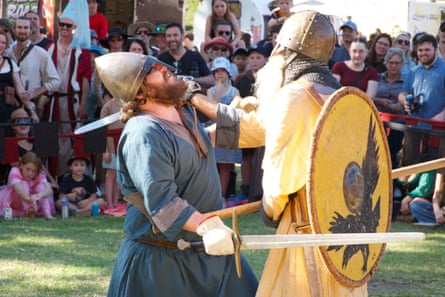
“I dunno what to tell ya, mate,” a young knight once told me through his helm’s lifted visor. “Gettin’ shield bashed just feels good.”
For the knaves among thee, a “shield bash” is what it sounds like: to bash, or be bashed, with a shield. It’s simple and to the point, like a mace to the face or an arrow to the knee. Witnessing a shield bash, you understand the “haha yesss” that the basher must feel upon bashing, just as you empathetically presume a long “oh noooooo” on behalf of the bashee. So I was surprised to learn being bashed was, in itself, just as fun.
“When it’s ya bro doin’ the bashin’ it just feels good,” the knight continued, after a muddy melee at Balingup’s 2017 medieval fair. “Like, mate earned it. We’re bonded in mud.”
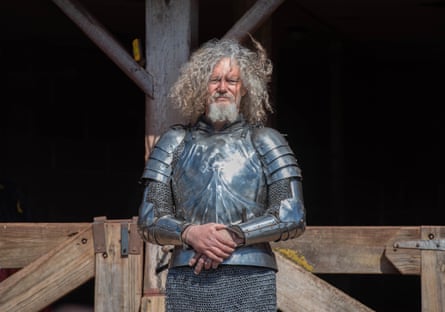
For close to 10 years, I have been speaking with knights, rogues, wizards, petty lords and bandits of all stripes, ostensibly for “literary” reasons. I am not a Larper (live action role player), nor am I particularly fascinated by the ins-and-outs of historical re-enactments or the low hum of horniness that runs through all renaissance fairs. I am, however, fascinated by stories and characters, especially those we forge to make life and loneliness bearable in this particularly lonely and unbearable epoch we find ourselves living in. Be it the artificial selves we construct on social media, or a warlock with lore as dense as a Warhammer codex, everyone is striving to find themselves, and others like them, through their personal mythopias.
“I have always known I am a dragon,” a Dragonkin once told me during a chance encounter at a bar in Williamsburg, New York. “My dragon self is my true self, not … whatever this is.”
It’s an encounter that stuck with me. In an age where identity is everything, why settle for the default character presets? If life is one long role play anyway, you might as well lean in.
You find variations of this epiphany among the dedicated lifers of Australia’s many medieval and renaissance fairs, which range in scope, scale and grandeur and encompass varying levels of verisimilitude, self-seriousness and mace-related injuries.

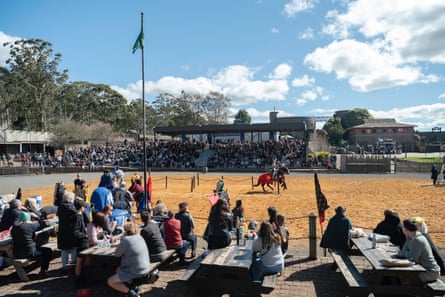
If the scene can be said to have a hub – a Minas Tirith, if you will – then it is Kryal Castle, a literal castle 15 minutes drive from Ballarat, which hosts the largest ren fairs in Australia. Built in the early 70s by a refrigerator salesman, Kryal Castle epitomises the heady mix of historical accuracy and anachronism that makes this scene so fascinating: the sort of place where you’ll witness a big bloke in full plate mail chugging on a vape, or two girls in handmaiden garb filming K-pop dances for their TikTok.
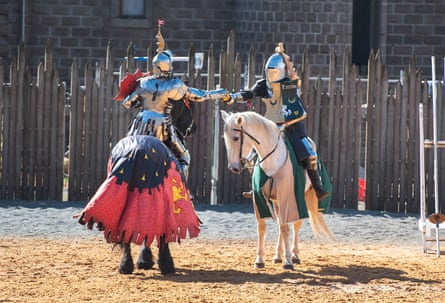
I find myself there in September, sitting among the lords and ladies in the royal box watching the national jousting tournament, muttering “ah jeez” and “fuck me dead” to myself at every tilt, charge and collision. I watch a heavily armoured knight and their squire lean in for a selfie together, before turning to see Lady Tamsen, who I’ve bet a Coke on, square up against her opponent. An hour earlier, I spoke to her and her squire (the knight’s equivalent of a PA) in the stables. “There’s different companies that are, like, just jousting groups,” she says, her silver helmet tucked under her arm. “It’s kind of like your local footy club.”
Lady Tamsen’s squire tightens the straps on her breastplate as she explains how she fell into charging at people in armour on horseback wielding very long sticks. “I started going to the local medieval festival. My family would take me there as a little family outing. It took me about 10 years before I found [senior knight and champion jouster Sir Andrew McKinnon] and messaged him on Facebook and said ‘please train me.’”
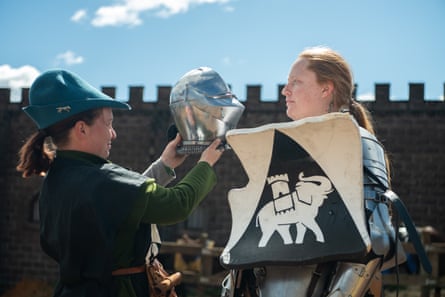
She paints a portrait of a vast network of diehards, enthusiasts and acolytes, spread across Australia. She is from The Company of the Hound, based out of Tarago, New South Wales, but she lists a few others: the Company of the Black Spur in Victoria; The Company of the Griffin in Queensland; and my home town team, The Grey Company from Perth, of which my young shield-basher was a proud member. Each of these offer up intimate communities, all nestled within the vaster one surrounding the hobby itself. It is a fellowship, where shared interest fosters friendships that become something closer to family.
“I am completely dependent on my squire,” Tamsen laughs, and her squire laughs in turn: “She’s basically a big metal toddler.” Between them, you get the sense of a sisterhood, as long and well balanced as the lance clutched in Tamsen’s armoured fist.
after newsletter promotion
Within these re-enacted histories, real histories form. Simulacrums of traditions become tradition in their own right, similarly transformed by changing trends, tastes and tolerances. Brendan Crawford, who runs Keipa’s Carpentry – making bespoke wooden swords and more – has a history with Kryal Castle as long as his wizard-appropriate beard. He lived there back in the days when that was not uncommon for the more hardcore re-enactors, and speaks fondly of its wilder early years, reminiscing wistfully about certain things that have fallen by the wayside, such as “Naughty Night”, where kids threw (sponge) stones at a knight locked in a pillory for public drunkenness or “farting before the queen”. He cackles remembering a three-year-old girl solemnly approaching the pun-spewing lout knight, squaring him up and striking him between the eyes with a sponge.
This isn’t a hobby for Crawford, but a way of life. You can see this in the quality of his work – wooden training swords and daggers made from ironbark, weighted like the real thing, the kind that young lordlings would have been trained with by a castle’s master at arms in the Ye Olde Days.
“They had a way of doing things back then that demands your full attention,” he intones, after spouting off a history of the great swordsmiths throughout the ages. “They’re reaching through the past, sitting besides you as you hone your craft as they did. It’s calming. I find it very peaceful … and fun!”
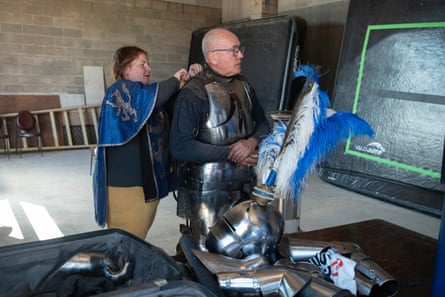
As Australia’s loneliness epidemic worsens, people are spending more and more time online, atomised and disconnected, locked in the pillory of isolation. But visiting ren fairs, I’ve met so many young people, especially those from marginalised communities, who’ve found regeneration through re-enactments and reinventions of centuries-old culture and customs; found a sense of purpose and connectedness that contemporary life – which has locked so many of us into a digital serfdom – has otherwise cut us off from.
“I joined the community as a depressed uni student,” musician and artist Elise Josephine tells me. “Everyone welcomed me with the joke that ‘It’s cheaper than therapy.’ I was apprehensive, thinking that I would be infected by some higher form of cringe every time I put on a bit more armour or rp’ed [roleplayed] a death, until I found out that the more you try to act aloof, the less you get out of it, and in turn, life itself.
“Truly no other hobby in my life has taught me to reject the pursuit of being a main character. Being a scrubby squire is where it is at … sometimes there really isn’t anything as good as getting a large sword and pelting some good friends.”
-
Patrick Marlborough is the author of Nock Loose (A$34.99, Fremantle Press) a postmodern novel revolving around a hyper-violent medieval fair in Western Australia’s South West.
-
The Victorian Medieval festival takes over Kryal Castle on 22 and 23 November