2 months ago
69
2 months ago
69
There are two ways to look at this. Either Alex de Minaur is not good enough to beat Carlos Alcaraz – and Jannik Sinner, for that matter – or the world’s top two players are in a class of their own. Sadly, for Australia’s top-ranked player, both things are true.
De Minaur’s 7-5, 6-2, 6-1 quarter-final defeat by Alcaraz on a hot, breezy evening at the Australian Open on Tuesday was a humbling experience. The manner of his performances in the opening four rounds suggested that he was ready to push the world No 1. But as the evening unfolded, De Minaur’s chances faded in all-to-familiar fashion.
Shortly afterwards, while Alcaraz was conducting his on-court interview with Jim Courier, all smiles, De Minaur was in the cool-down room, surrounded by his coaching team and mentor Lleyton Hewitt. His face obscured, all you could see of De Minaur was his arms, thrust out to each side, palms facing up. The sentiment was obvious. What was he supposed to do?
De Minaur has now lost all six of his matches with Alcaraz and – an even more brutal statistic – all 13 of his matches against Sinner, winning just two sets against the Italian. One of those came in Beijing last September, an indication, De Minaur felt, that he was getting closer. He pushed Alcaraz to a first-set tiebreak when they played at the ATP Finals last year and here at Melbourne Park, he was close to forcing another in the opener. But in the final cold, cruel analysis, he fell a distance short. By the end, he looked helpless, while Alcaraz laughed and joked with his team, trying out new shots, enjoying himself.
De Minaur knows that he can beat everyone else. Of the rest of the world’s top 10, he has wins over all of them, except for Ben Shelton, who won their only encounter to date. But a closer look at the head-to-heads should be concerning. Of those eight players, De Minaur leads against just two; 6-5 on Taylor Fritz and 3-2 on Alexander Bublik, the current No 9 and No 10 respectively.
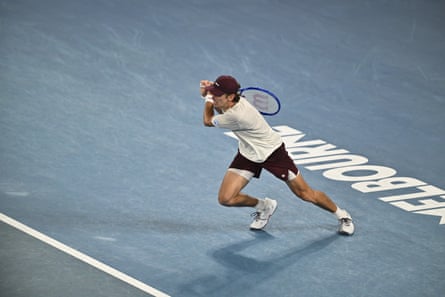
This was De Minaur’s seventh loss in a grand slam quarter-final from seven attempts. There is no doubt that he is a fine player, who continues to improve every year. No one is faster than him. But he also lacks natural power. He doesn’t have the serve of a Nick Kyrgios and when he plays the top two, he tends to press too much. For the third time in a row against Alcaraz, his first serve percentage was below 60% (at 55%), leaving his second serve vulnerable. De Minaur won just 38% of points on his second serve and even when he did make the first, he won just 59%. By contrast, Alcaraz only found the mark 57% of the time on first serve, but he won 77% of points on his first and 54% on his second.
De Minaur has no margin for error, his flat groundstrokes constantly flirting with the net. The first set against Alcaraz, in which he competed brilliantly, ended when his forehand caught the tape and flew wide. Alcaraz boasts huge natural power but when he needs to, he can hit almost as hard, with at least a foot of margin over the net, a massive advantage. Sinner can do the same. On Tuesday, De Minaur ended up hitting almost twice as many forced errors than Alcaraz.
The good thing is De Minaur knows it. “There’s a whole lot of risk for me to play at a very high ball speed and Jannik or Carlos, they have so many revolutions on the ball that they’re able to not only play at a higher speed but also have their consistency, because they’re able to get that spin that helps the ball come down and create different angles as well,” he said.
Alcaraz and Sinner have split the past eight slams and are playing tennis on a different level to everyone else. But Australian men’s tennis is not in the rudest of health, either. Lleyton Hewitt remains the last Australian man to win a grand slam, at Wimbledon in 2002, while Kyrgios is the only one to have made a final since 2005. At the end of 2024, Australia had nine men in the top 100; now it’s just six and come Monday, De Minaur will be the only one in the top 50. More worryingly, none of Australia’s 18 entrants in the junior singles events here made it past the third round.
De Minaur can’t suddenly come out with a big topspin forehand, so instead he will continue to tweak, to tinker and improve, hoping that one of the top two slips up somewhere and he can capitalise. For now, it remains a slim prospect.