3 months ago
58
3 months ago
58
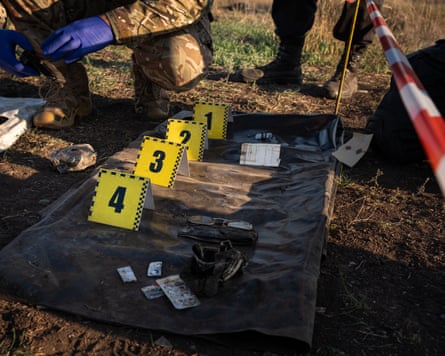
Alexei clears his throat without showing the slightest expression on his face. Squatting and wearing gloves, he shakes the military uniform that once belonged to a man. The jacket and trousers still hold their shape, but inside there is nothing. Just air.
Alexei pulls out a worn, stained piece of paper from one of the pockets. “Andrei. Moscow,” he reads aloud. “There’s a phone number written here. Good. It helps us trace his origin.” Whoever he was, he was a Russian soldier.
Alexei and his group of Ukrainian search volunteers face a complex, delicate task. They must identify the four bodies they have recovered from the front in the Donbas region. “If I were to die, I would want someone to search for me. To bring me home,” he says.
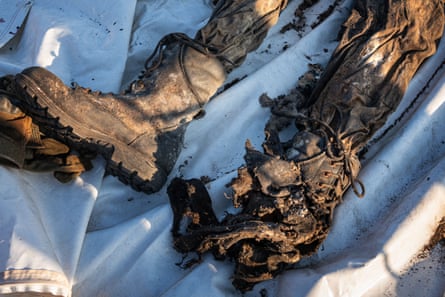
Aside from the note, a rusty belt and a pair of blackened boots partly blown apart by a mine, everything else of the man has vanished. “Vlad, please,” Alexei calls to his fellow volunteer, who approaches with a small whiteboard on which to write the extracted information with a marker.
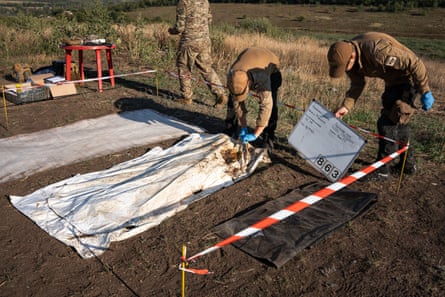
Alexei lists the details. Vlad writes them down and a third volunteer photographs the sections of the remains valuable for identification, illuminating them with a flash. For now, the identity of the corpse is reduced to a handful of scattered words and a card assigning it a number. The number of fallen soldiers recovered by the search group has now passed 1,500.
-
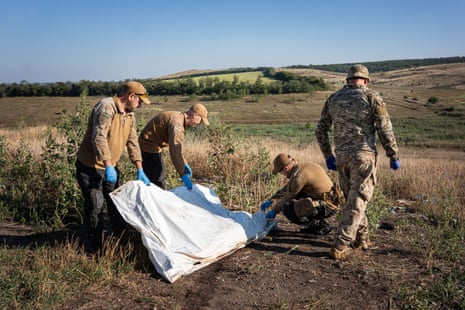
Finding bodies from both sides is common at the front – the remains pile up after a battle
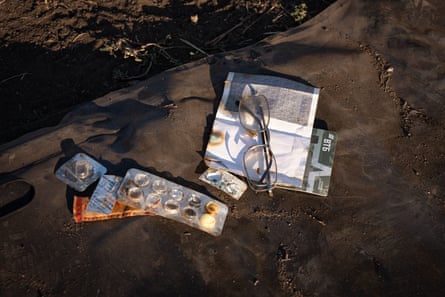
The other three bodies, somewhat more intact, also belong to Russian soldiers. A pack of ibuprofen, a pair of glasses missing the left lens, a credit card, a tattoo on the back, a grimy St George’s ribbon – nostalgically symbolising the patriotism of “Mother Russia” – reveal their origins.
Still, doubt always plays a key role. The feet of the last corpse are still covered in socks from the Ukrainian army. Alexei whispers something to his partner in Ukrainian, and they exchange thoughts until they partially solve the puzzle: “Yes, he’s Russian. He must have been part of a sabotage team. He probably occupied a military base and put those on,” he says.
Sometimes, if they’re not sure, they write “unknown” so DNA testing can be backed up with further checks. It is common for both Russian and Ukrainian soldiers “to disguise themselves to gain ground”, says Alexei.
Finding bodies from both sides is common at the front. The remains pile up after a battle. “Before identification,” says Alexei, “our job is to clear the combat perimeter – woods or barren land where their lines and ours become entangled. We comb the area from the first tree to the last.”
His worst experience was in the village of Klishchiivka, in eastern Ukraine. “I had never seen anything like it. So many bodies scattered everywhere. I’ve seen a lot, but never this. The entire hillside was covered with corpses. There wasn’t even space to set a foot down. Bodies of fighters from 2022, 2023 and 2024, accumulated.”
-
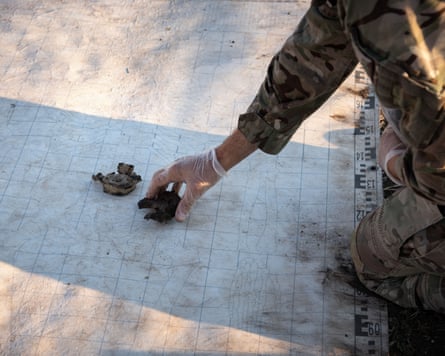
Search volunteers face a complex, delicate task in recovering the bodies, and everything is meticulously detailed; recovered items are photographed and recorded to help with identification, left; bones are placed on a diagram of a skeleton to help piece a body together, right
The search group, Platzdarm, goes where no one else goes, carrying the bodies of fallen soldiers for miles under the lethal dome that envelops the war front, guarded by legions of executioner drones. The so-called kill zone covers more and more ground, says Alexei, and there are barely any safe areas left. They now rely on fog to work, as it somewhat hinders the drones’ visibility. Almost making a pact with the haze, waiting for a moment to go in and retrieve the bodies, he says.
-
A pair of blackened boots, one blown apart by a mine, belonging to a Russian soldier recovered by the Platzdarm search team
Alexei and his team file away their anguish and shock into a deep compartment of their minds – one they only open when alone with their thoughts. That is what has kept them going. “For me, it’s very important that all these souls have a final dignified rest. That their families can say goodbye at a funeral, speaking the words they may never have been able to express in life, and that they can visit a sacred place to honour their memory,” Alexei says.
Alexei has spent more than two decades as a “body seeker”, starting out as a 20-year-old doing something, he says, he has always felt a duty to do. “Until 2014, we dedicated ourselves to searching for those who fell in the first and second world wars and the victims of political repression,” he recalls. “We found mass graves where people had been shot by the Nazis or by the NKVD, the USSR’s secret police. They were Soviet, German and allied soldiers. We buried them, sent their remains to funeral associations, or repatriated them if we managed to contact their families. We brought them home,” he says.
It is no easy task, says Alexei. “It is very painful. To see a destroyed destiny. A human destiny. You feel something for the dead that you never thought you could feel. It’s hard to explain and also depends on who the deceased is – especially if you’re the one who finds him after having direct contact with his parents and having known that person’s path from the beginning to their last breath. The grief passes through you, because you become part of that family.”
-
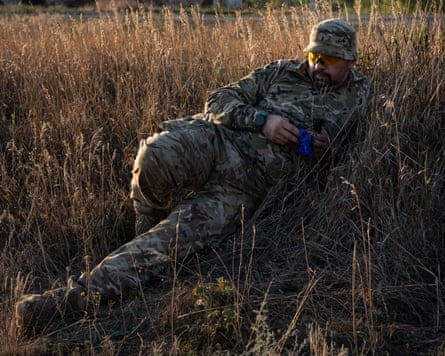
A member of the Platzdarm team takes a break from his painstaking work
-
Belongings recovered from a dead Russian soldier
Alexei says he and his team feel like a link between life and death. “You are the bearer of misfortune – of a terrible truth that families will have to live with for ever. They will have to understand that they will never again see or embrace the person who is gone.”
But over the years, Alexei says he has managed to find some solace. “It’s an honour for us if we can return someone’s son, husband, brother or father to their family. It means the effort was worth it.” Nationality does not matter, he says, nor the side on which they fought. Whether Ukrainian or Russian, all souls are the same.
Above all, Alexei defends the importance of keeping their humanity intact, for that is something taken away by wars. “War has taught me to what extent a person can become a non-human. Something worse than an animal. Because in war, human life is worth nothing. War shows black and white, without shades.”
Perhaps, he says, “I’m too stupid. And I don’t fully understand it, or I don’t want to. But until people realise that we are all inhabitants of the same planet, nothing will change.” His dream, he says, is that “it all ends. For everyone. The consequences are terrible. The physical and psychological wounds will last for ever. And many – far too many – will never return.”