2 months ago
72
2 months ago
72
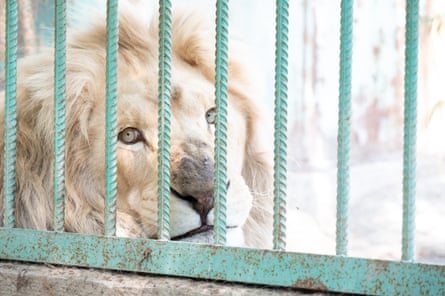
Behind the walls of a sprawling estate on the outskirts of Yerevan, six tigers prowl behind a fence, three lions pace their enclosures, and alligators bask in the afternoon heat.
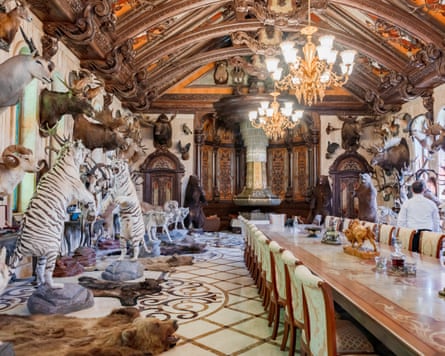
Further into the compound, more animals appear. Beneath a gilded, hand-painted ceiling, a dining hall houses a taxidermy menagerie: white tigers reared on their hind legs, a stuffed eagle perched atop a table, bear and wolf pelts spread across the floor. All of these, the owner proudly said, had been shot by him.
The scene offers a glimpse into the tastes of Gagik Tsarukyan, Armenia’s most flamboyant business tycoon and opposition politician, whose displays of wealth have long been the stuff of local folklore.
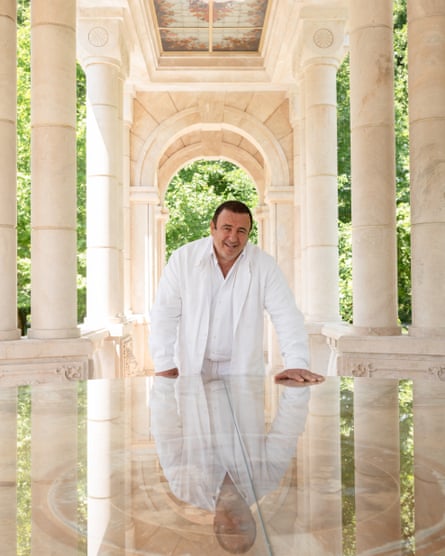
Having secured less than 4% of the vote in this month’s parliamentary election, Tsarukyan’s chances of ever leading Armenia look slim, but one of Armenia’s richest and most divisive men remains determined to leave his mark on the country.
His chosen monument: erecting the world’s tallest statue of Jesus Christ, perched atop a 2,500-metre (8,200ft) mountain overlooking Yerevan.
It is, depending on who you ask, either a celebration of the small Caucasian nation’s ancient Christian heritage or the ultimate expression of one oligarch’s appetite for excess.
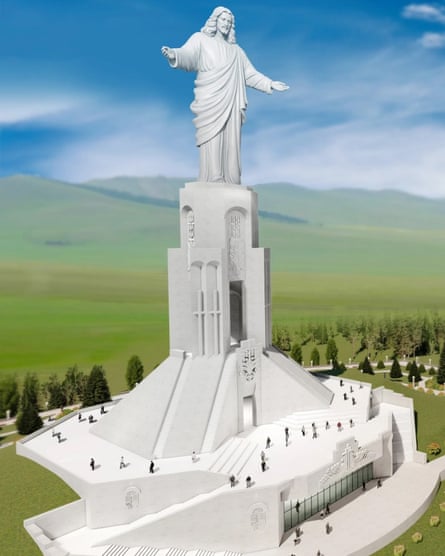
“This will be Armenia’s calling card,” Tsarukyan said during a rare interview at one of his homes in the village of Arinj, where he was born. “Christianity will become Armenia’s new brand.”
A former athlete turned businessman and politician, Tsarukyan built his fortune in gambling, alcohol and mining during the turbulent decades that followed the collapse of the Soviet Union.
Dressed head-to-toe in white linen and matching trainers, the barrel-chested one-time arm wrestling champion said the project was designed to resonate with a growing international movement that blends religious faith with nationalism and cultural conservatism – a trend most visible in Donald Trump’s Maga movement and among far-right parties across Europe.
“Trump is, of course, invited. We hope he comes,” Tsarukyan said, adding that an unofficial American delegation from the US embassy had already visited the mountain site.
Once completed, the 101-metre (331ft) statue will stand atop Hatis, a mountain about 25km (15.5 miles) east of Yerevan, making it visible from much of the Armenian capital. Tsarukyan noted with evident satisfaction that it would dwarf Brazil’s iconic Christ the Redeemer and stand slightly taller than New York’s Statue of Liberty.
“We are the oldest Christian nation in the world,” Tsarukyan said. “It only makes sense we should have the biggest Jesus statue in the world.”
Although most of its neighbours today are Muslim-majority countries, Armenia is widely regarded as the world’s oldest officially Christian nation, traditionally dating its conversion to AD301.
But the Armenian Apostolic church has repeatedly opposed the project, arguing that its mass scale and style sit uneasily with Armenia’s religious and architectural traditions.
Church leaders say Armenian Christianity has historically expressed itself through monasteries, churches and khachkars – intricately carved stone crosses unique to Armenia – rather than colossal statues modelled on monuments elsewhere in the world.
The proposal has also drawn criticism from environmentalists, who warn that construction could cause lasting damage to the natural landscape of Hatis.
Tsarukyan brushed aside the clergy’s and activists’ objections, insisting he enjoyed good relations with the Armenian Apostolic church and pointing to the eight churches he says he has financed across the country.
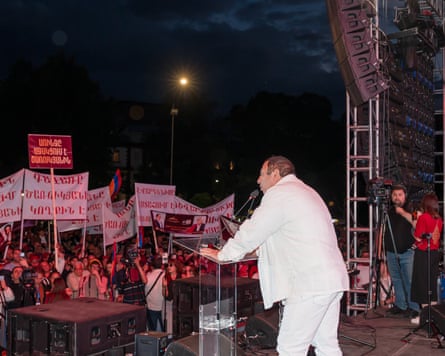
More importantly, Tsarukyan said, the monument was intended to appeal to a far broader audience than Armenia’s faithful alone.
He claimed that 10 million tourists a year would eventually visit the site. “There’s nothing else like it in the world. From ocean to ocean, everyone will be talking about it.”
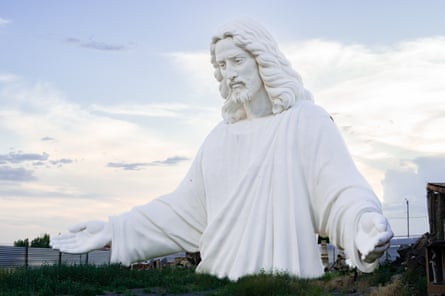
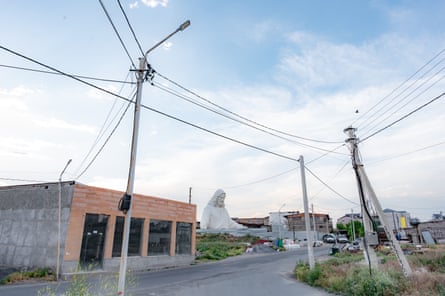
At present, however, the monument, which has been under construction on and off since 2022, looks less like the centrepiece of a future pilgrimage site than a giant relic abandoned in a construction yard outside Yerevan, where it is being pieced together before its eventual ascent to the mountain.
On the Guardian’s recent visit to the site, Christ’s vast white figure loomed over piles of stone, cranes, and workshop buildings, appearing almost surreal against the sparse landscape.
Back at the estate, Tsarukyan appeared tired after a bitter election campaign that had only just ended.
Voting results showed his nationalist and Russia-friendly Prosperous Armenia party hovering just below the 4% threshold needed to enter parliament, a result the party was challenging in court.
The poor showing continued a reversal for a politician who, for two decades, had been one of Armenia’s most durable power brokers.
Tsarukyan built that position on close ties to the former president Robert Kocharyan, expanding his empire as part of a small group of politically connected businessmen who came to dominate much of Armenia’s economy.
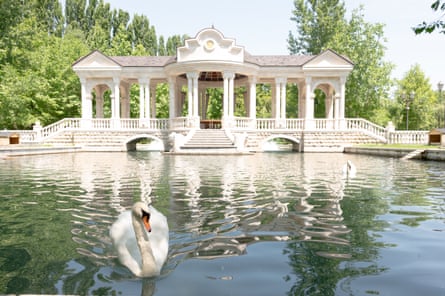
With his private zoo, marble mansions and fleet of luxury cars, he can seem like a relic of the post-Soviet boom years, when fortunes were amassed at dizzying speed and displayed with little concern for subtlety.
That image made him a natural target for the current prime minister, Nikol Pashinyan, who rose to power in the 2018 Velvet Revolution pledging to dismantle Armenia’s oligarchic system.
Pashinyan has repeatedly cast Tsarukyan as a symbol of the country’s corrupt old order, at times reviving dark episodes from his Soviet-era past, including a 1979 gang-rape conviction that was later overturned after Armenia gained independence.
In his victory speech on 7 June, Pashinyan further vowed to jail his political opponents, singling out Tsarukyan, Kocharyan and the billionaire businessman Samvel Karapetyan.
The following day, investigators arrived at Tsarukyan’s estate to formally charge him with tax-related offences. Local media reported that he had attempted to flee the country before the charges were announced.
Tsarukyan rejected the allegation, saying he had merely planned a short trip to the United Arab Emirates but had been prevented from boarding his flight and returned home.
Yet Tsarukyan strongly dismissed suggestions that the authorities could derail his construction plans, arguing that the Jesus project had become too significant to abandon and would bring substantial benefits to Armenia’s economy and tourism industry.
“How can a man be afraid?” he said. “Why be afraid? What will they put me in prison for?”
For now, he said his team appeared more concerned with the practical challenge of getting Christ to the mountaintop.
The logistics of building the monument have proved almost as ambitious as the project itself.
Tsarukyan said the original plan was to transport sections of the statue by helicopter. The idea was eventually abandoned in favour of a more conventional solution: hauling the enormous pieces up the mountain by truck before assembling them onsite.
And the Jesus statue, he insisted, is only the beginning.
Construction has already begun on another biblical attraction nearby: a giant Noah’s Ark. Pulling out images of the project on his phone, he described a vessel 134 metres long, 24 metres wide and 18 metres high. The ground floor would house a museum, the first floor a hotel and the second a cafe.
“These projects are sacred,” he said. “This is how I will inscribe my name in history, for the world to see during my lifetime and long after.”
For now, though, on the hillside above Yerevan, the world’s largest Jesus has yet to rise.
In the summer heat, passersby stopped to photograph the towering figure and debate its merits.
“It’s beautiful. It will make Armenia known across the world,” said Arman, a 54-year-old taxi driver who had pulled over to admire the statue. “I am really proud of this.”
Others were less convinced.
“I don’t quite understand why it has to be this big,” said Mariam, a local resident, looking up at the monument. “It’s all a bit crass.”