3 hours ago
18
3 hours ago
18
Anthony Page, who has died aged 90, was one of a group of talented and individual – sometimes wilful – directors who helped establish the English Stage Company at the Royal Court in London at the end of the 1950s and the early 60s.
The company, led by George Devine and Tony Richardson, became the seedbed of modern playwriting, notably John Osborne’s Look Back in Anger (1956) in a repertoire that embraced Beckett, Brecht, Ionesco, Arthur Miller and Tennessee Williams, as well as the native voices of Arnold Wesker, Ann Jellicoe, John Arden and NF Simpson.
Page, quietly spoken but tough as old boots, shared a general predilection for waspishness in this fearsome company that included John Dexter, William Gaskill and Lindsay Anderson, with Devine a benign and pipe-smoking presence; his “old school” professional connections to the likes of Peggy Ashcroft and Laurence Olivier stamped the enterprise with their status and eminence.
Page started at the Court as an assistant director in 1958 and emerged as Osborne’s ideal director after Richardson had supervised the rough and tumble of Look Back in Anger and then Olivier in The Entertainer (1957). He directed six Osborne premieres, notably Inadmissible Evidence (1964), with Nicol Williamson as the washed-up, craven solicitor Bill Maitland; A Patriot for Me (1965), with its Viennese 1890s drag ball and infiltration of Russian intelligence agents; and the still underrated Hotel in Amsterdam (1968), with Paul Scofield as an acidic version of Osborne himself on the other side of a decade of success.
The one thing shared among all the Court directors was a regard for the primacy of the author’s text. Page, highly civilised and literate, tall and not a little forbidding, had an almost faultless ear for music, tone and rhythm, which led him to be as adept with Beckett and Shaw as he was, in the later part of his career, with the more inflamed and baroque poetry of Tennessee Williams and Edward Albee.
He was born in Bangalore (now Bengaluru), India, the son of a British brigadier, Frederick Page, and his wife, Pearl (nee Hall). Educated at Oakley Hall, Cirencester, and Winchester college, Hampshire, he studied English at Magdalen College, Oxford. He then went on a free passage with the Royal Canadian Air Force to visit his parents, who were now based in Canada, and hitchhiked to New York, where he studied at the Neighbourhood Playhouse School, an offshoot of the Stanislavski-influenced Group Theatre of the 1930s.
He became obsessed with a form of method acting, developed by the director Sanford Meisner, that replaced the Stanislavskian use of affective memory with an emphasis on “the reality of doing”, a technique devised to find a fresher way for an actor to speak the truth. He returned to London and, with Anderson, instigated a series of workshops along those lines. The future Court alumni Albert Finney and Alfred Lynch came along. So did Maggie Smith, whom Page would direct in three of her finest performances in plays by Albee.
His first production at the Court was Harold Pinter’s The Room in 1960, with Michael Caine and Vivien Merchant in the cast. He then went off to work in various reps around the country and was artistic director of the old Dundee Rep for a couple of seasons before it burned down in 1963.
Williamson was in the Dundee company and followed Page to the Royal Shakespeare Company’s 1962 experimental season at the Arts theatre in both Henry Livings’s Nil Carborundum, a comedy about national service, and Thomas Middleton’s Jacobean shocker Women Beware Women, with Elizabeth Spriggs and John Thaw.
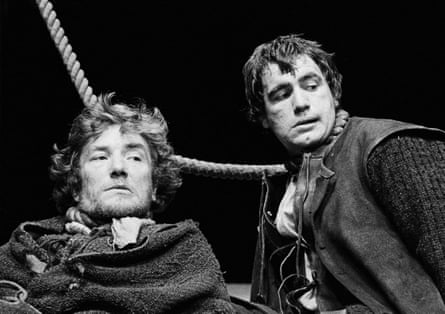
As Devine fell ill, Page took over the reins in Sloane Square with Anderson and embarked on an incredible quartet of productions at the Royal Court in 1964-65: Inadmissible Evidence, Ben Travers’s 1925 Aldwych farce A Cuckoo in the Nest (the cast including Alan Bennett, Arthur Lowe and Osborne, as well as Williamson), the first British revival of Waiting for Godot (with Williamson and Lynch as the tramps) and A Patriot For Me.
Following the death of Devine, Gaskill returned to take on the artistic leadership in 1969, with Page, Anderson and Peter Gill his associates. Page directed Alan Bates as Hamlet at the Nottingham Playhouse and the Cambridge theatre in London, and Pirandello’s The Rules of the Game (in a version co-written by David Hare, his first NT credit) at the National in 1971.
His last productions at the Court, in the early 70s, were Ted Whitehead’s coruscating Alpha Beta, with Finney and Rachel Roberts tearing up the stage; Jill Bennett as Hedda Gabler; a double bill of Beckett’s Not I (Billie Whitelaw as the mouth in a black hole) and Krapp’s Last Tape with Finney; and Finney again, with Brian Cox, in David Storey’s Cromwell (1973).
Page’s American career continued in the 80s with television films featuring Jason Robards as Franklin D Roosevelt, Mickey Rooney as a lost soul in Bill, and Dirk Bogarde and Glenda Jackson as Roald Dahl and Patricia Neal in The Patricia Neal Story. He had also worked in British television since 1963, notably on The Parachute (1968) by David Mercer – with Bennett, Osborne and Anderson in the cast – and a superb six-part version of George Eliot’s Middlemarch in 1994.
A 1991 TV revival of Rodney Ackland’s Absolute Hell (1952, when, as The Pink Room, it was dismissed by one critic as a libel on the British people), with Judi Dench as the hostess in a West End drinking den between VE Day and the Labour landslide in 1945, was a reimagined revelation on the National Theatre stage in 1995, again with Dench.
All of Page’s work was about finding the right style and the right cast for each play or film, never trying to make a name for himself at the expense of the text or script. This scrupulousness went right back to the early Royal Court days.
And it went hand in hand with a sensitivity for the most difficult of Albee’s plays, for instance The Goat (at the Almeida and the West End in 2004), which dealt in the limits of tolerance rather than bestiality in the fable of a securely married architect (Jonathan Pryce) falling in love with, well, a goat; Eddie Redmayne made a touching West End debut as the architect’s gay son.
His reinvention, almost, as a go-to director of American and European classics occurred in the West End and on Broadway, where he directed a Tony awardwinning A Doll’s House with Janet McTeer (1996-97).
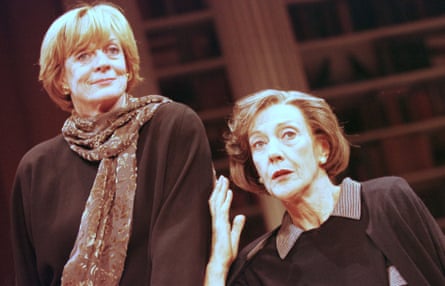
The three “Maggie Smith in Albee” collaborations marked an Indian summer for Page with commercial managements: Three Tall Women (1994) at Wyndham’s he described, and treated, as a Restoration comedy about death; his blistering revival of A Delicate Balance in 1997 at the Haymarket teamed Smith, unforgettably, with Eileen Atkins as viciously intemperate siblings; and, also at the Haymarket, in 2007, Smith was The Lady from Dubuque, an angel of death who brings bad tidings to a drunken party where the hostess is dying of cancer. This was Greek tragedy with cocktails and laughter, and ornately macabre dialogue.
For one of his last productions, Page returned to New York, and to Beckett, in 2009 to stage an acclaimed Waiting for Godot at Studio 54 with Nathan Lane and Bill Irwin as the tramps and John Goodman as Pozzo.
Page was predeceased by a younger sister, Jane. He is survived by his husband, Ken Butler, an artist. Their 40-year relationship was formalised by a civil partnership in 2006 and a marriage in 2014.