3 hours ago
18
3 hours ago
18
At the height of the summer, the mood was optimistic in the world’s financial capitals. Powered by the AI revolution, the US stock market had rallied to a fresh all-time high, as investors bet the multitrillion-dollar investment spree would overshadow the hit from the Iran war.
Now the warning lights are flashing red. As the fighting in the Middle East intensifies without clear sign of a resolution, financial markets have been thrown into renewed turmoil. A slowdown looms in the AI arms race, and tinderbox conditions in the market for government debt are fuelling alarm.
In the past week the US government’s borrowing costs climbed to the highest level since 2007, with knock-on consequences for the finances of households, businesses, and other governments worldwide. The fear is that Donald Trump’s war is igniting higher levels of inflation. The president’s tax and spending plans – driving Washington’s debt levels above $40tn (£29.9tn) – also has investors worried.
But as the soaring global oil price to above $100 a barrel stokes heavy selling pressure in the bond market, could shares be the next in line for a crash?
With the S&P 500 index of leading US companies 3% below an all-time high, and a combined value of more than $20tn for the “magnificent seven” tech stocks – Nvidia, Apple, Google, Microsoft, Meta, Amazon and Tesla – the concern is that markets are overextended just as the storm clouds gather for the world economy.
“These are febrile times,” Albert Edwards, a senior analyst at the French investment bank Société Générale, wrote in a note to clients. “The key worry for investors and policymakers alike is the extent to which the current oil price ‘shock’ will ripple through the global economy and whether it will necessitate sharply higher, recession-inducing, interest rates.”
Famed for his gloomy predictions, Edwards thinks the ingredients for a financial crisis could be coming together amid tinderbox conditions in the US government debt market.
Such is the worry over the Iran war stoking inflation that the US Federal Reserve defied Trump this week with its first interest rate rise since 2023. As households and businesses come under pressure from rising energy bills and surging fuel prices, central banks elsewhere are also taking action.
Financial markets suggest the Bank of England will raise interest rates four times before the end of next year, even after it kept borrowing costs on hold this week. The European Central Bank raised rates last week, highlighting the hit to the eurozone from the escalating conflict, and the Bank of Japan raised its policy rate to a 31-year high on Friday.

The rationale is that adding to the cost of borrowing will weigh on the economy – limiting the potential for short-term higher rates of inflation from becoming entrenched. However, it will hit households and businesses already struggling with a cost of living crisis. Job losses will probably rise, in-turn compounding the challenges facing governments swimming in debt.
A US recession has historically followed about three to 3.5 years after the first rate rise, on average, Deutsche Bank’s Jim Reid has calculated. Markets have a habit of falling, or even crashing, before a recession begins, and often start to recover before the economy does.
However, the big concern among investors is that the main hope of economic redemption – AI – could also turn out to be a dud, amid fears it has fuelled an almighty bubble in the US stock market.
One popular measure used by investors to assess whether a market is overvalued – the CAPE ratio – or cyclically adjusted price-to-earnings ratio – has risen to its highest level since 2000, showing that the US stock market is unusually highly valued compared with its profits.
The CAPE ratio for the S&P 500 share index is almost 41 points, more than double its long-term average of about 17 points, and approaching the record high of 44.19 points in December 1999, just before the dotcom crash.
Highlighting the challenge, research by Fathom Consulting shows that for the multitrillion-dollar AI boom to turn a profit, it would need the AI-related sales of the tech companies involved to rise by between $600 and $800bn within two years.
Against a febrile backdrop as investor patience is increasingly tested, the consultancy gives a 30% chance that the AI bubble pops next year.
Brian Davidson, an economist at the consultancy, said: “For all the impressive advances in AI technologies in recent years, the economics behind the current capex boom do not work.
“Yes, recent AI advances could yet unlock huge productivity gains; but sales of AI models need to increase by hundreds of billions of dollars per year over the next two years to justify the current spend. Such growth appears unlikely.”
Investors are clearly worried. More than 1,000 investors registered for an analyst call conducted by Jefferies this week into “AI Extinction Warnings”, after the bosses of the world’s top tech companies called for a slowdown in “reckless” development.
The situation has parallels with the dotcom crash of the year 2000, when many internet companies that had been billed as the next big thing dramatically tumbled in value. That was a reminder that even if a technology is going to be revolutionary, investors can still lose their money if they finance too much infrastructure too early.
“It took a decade or more for demand to catch up with the infrastructure laid down in the British canal and railway and US telecoms and fibre booms – and many investors never recovered their capital,” points out Adrian Cox of the Deutsche Bank research team.
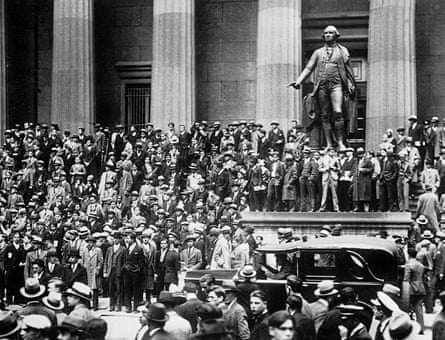
There are also sobering comparisons with the buildup to the great crash of 1929. A hundred years ago, many small US investors were buying stocks “on margin” – acquiring them with borrowed money. They blew up in the market turmoil that preceded the Great Depression.
This year, South Korea’s army of traders have been buying shares in AI-linked chip makers on margin – doubling the value of the blue-chip Kospi index. But once the market started to fall, they were hit by a massive wave of margin calls – when investors are told to stump up more cash to keep borrowing. Many were forced to sell their shares. According to Goldman Sachs, 1.2 million South Korean retail investors were hit by margin calls – which is the equivalent of one in 30 adults getting a nasty call from their broker asking them to hand over more money.
The huge spending plans announced by AI companies are causing concerns that they may simply borrow too much.
One firm with ambitious AI plans is Oracle, the database software vendor. Oracle’s shares surged a year ago after it announced a cloud computing deal with OpenAI, the company behind ChatGPT.
However, they have halved since, as investors have fretted that Oracle could be borrowing too much to fund datacentres.
There are other signs of rising stress in the credit markets. The Bank of England reported this summer that the spread between the riskiest and safest high-yielding debt has widened since the Iran war began, showing that investors are warier of holding risky debt.
Government bonds have been sold off in recent weeks, and that fall in prices pushes up the yield (or rate of the return) on sovereign debt. Those higher bond yields make owning shares less attractive – an investor has less incentive to buy equities (which are riskier) than bonds, which are seen as safer.
For the US this week the rise in borrowing costs involved the yield – or interest rate – on 10-year bonds, known as Treasuries, climbing above the psychologically key threshold of 5%.
That level is “seen by some as a threshold above which financial markets might go into meltdown,” said John Higgins, the chief economic adviser at Capital Economics.
“While we aren’t convinced that 5% is that ‘magic’ number, higher Treasury yields would certainly pose a risk to the sustainability of the US public finances as well as threaten equities,” Higgins told clients.
Bloomberg macro strategist Simon White argues that trouble would really start if the US 10-year Treasury yield rose above 5.25%. He has calculated that this is the “inflection point” where, historically, stocks and bonds have reinforced losses in one another.
Despite the turbulence there are still hopes that a crash can be avoided, including optimism that markets are overestimating the inflation risk from the Iran war.
“A major downturn would need a trigger. Further geopolitical instability could be the catalyst, but we’ve long argued that the impact of geopolitical shocks on economic activity is overstated,” analysts at Oxford Economics wrote in a note to clients.
“Resurgent inflation and policy rate hikes by the Fed and other central banks are another candidate. However, our view on inflation is less alarmist – we think market expectations overstate the risk of further policy tightening.”
For many investors a slowdown in feverish AI investment will guard against the danger of a bubble.
There are signs that AI is beginning to power economic growth. The US economy has recorded a rise in productivity growth, while AI is also among reasons the UK economy has beaten expectations to grow at the fastest rate in the G7 in the first half of this year.
Such a turnaround in productivity could help the companies with sky-high share prices to begin justifying their valuations. However, it is a high-stakes play at a time of intense global volatility.
“Do I think there’s a significant dose of reality though in that productivity miracle in AI? Yes,” Andy Haldane, the former Bank of England chief economist, told LBC this week. Still, he warned the situation is fragile.
“I don’t think outright collapse in a dotcom bubble type fashion. But could I see a slow release of air that doesn’t collapse the world economy, but slows it down? Yes, I could.”