3 months ago
72
3 months ago
72
When she was living in Denmark, the seemingly unshakeable safety of Greenland was a comforting source of reassurance for Najannguaq Hegelund. Whenever there was any instability in the world, she would joke with her family: “Well we will just go to Greenland, nothing ever happens in Greenland.”
But in the past two weeks – during which Donald Trump has repeatedly threatened military action on the largely autonomous Arctic territory the US president claims he “needs” for national security purposes, despite it being part of the Danish kingdom – Hegelund, 37, has realised this is suddenly no longer true.
“Look where we are today,” she says, laughing incredulously. “It’s just so crazy.”
Like many of Greenland’s 57,000-strong population, Hegelund has found herself worrying about evacuation plans in case of US invasion, whether or not to flee to Denmark beforehand and fielding questions from her children about becoming American.
Others said they have been watchful of the skies and seas around Greenland, tracking US planes on flight trackers and even discussing plans on how best to respond if they were captured. Many said they were suffering from anxiety and struggling to sleep.

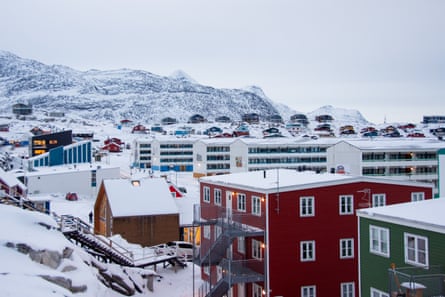
Greenland, Hegelund says in a coffee shop in the snow-covered capital, Nuuk, has never experienced anything like it. “How do you deal with it when you haven’t experienced anything like that, at all, at any point in history?” she asks.
Almost exactly a year ago, Trump talked about the US needing to acquire Greenland – by military force if necessary. Back then, the mood in Nuuk was more lighthearted, verbally combative and sceptical. Today, many are openly alarmed, trying to prepare themselves and their families for what could happen and wanting practical advice from the authorities. The big difference now, says Hegelund, who works monitoring Inuit legal rights for the NGO Sila360, is that there is now the precedent of Venezuela.
The prospect of the high-stakes meeting in Washington on Wednesday between the Greenlandic and Danish foreign ministers, Vivian Motzfeldt and Lars Løkke Rasmussen, with the US secretary of state, Marco Rubio, has brought some relief. It will, it is hoped, mark the start of a proper dialogue.
However, some say the last-minute announcement that the US vice-president, JD Vance, will also be involved brings a worrying unknown quantity. When Vance visited Pituffik, the remote US military base in north-west Greenland, in March he said US control of the autonomous territory was critical to fend off China and Russia and accused Denmark of having “not done a good job”.
Trump’s seemingly renewed desire to take Greenland has made headlines around the world, prompting increasingly fraught statements from European leaders and an ever-accelerating stream of dramatic social media content. Yet for most of its residents, this is not a talking point or a piece of content from which they can move on or swipe away. It is existential.
If US troops were to arrive in Nuuk tomorrow and lay claim to Greenland, many Greenlanders feel they would be powerless. “What could we do?” says Hegelund. “We are like 20,000 in Nuuk. How are we going to go against American troops?”
Over the past couple of years, Joint Arctic Command (JAC), the Danish military forces tasked with protecting the sovereignty of the kingdom of Denmark in the Arctic, has run a preparedness course for young Greenlanders in response to the region’s heightened security situation. But many say they lack basic information on what to do in case of invasion.
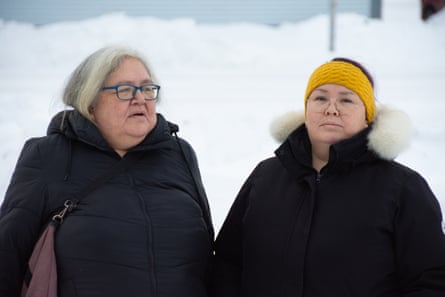
Hedvig Frederiksen, 65, and her daughter, Aviaja Fontain, 40, are so worried that they have taken Greenland’s surveillance upon themselves. “It’s scary,” says Fontain, who is struggling to focus on her university exams because of the geopolitical tension. “She [Frederiksen] keeps looking at the planes because she has a view and I keep on looking at the harbour because I have a view to the harbour.” Frederiksen, who uses flight trackers, recently got a scare when she said she spotted a Hercules plane leaving Pituffik and thought it was coming to Nuuk to invade.
“If they [the US] take over Greenland, what am I supposed to do then?” says Fontain. “Are we going to have to pay for our studies? Are there going to be soldiers here shooting Greenlandic people?”
Frederiksen is one of 143 women who recently won a legal battle against Denmark’s government after being forcibly fitted with IUDs when young by Danish doctors. Speaking through her daughter, who translated, she says: “If the soldiers are coming here, then what will they do? We are all just thinking that they are going to do bad stuff to us because we don’t want to be US citizens or a [US] state.”
Greenland, says Fontain, already has the generational trauma of Danish colonisation. “Are we going to have another one?” she says, adding that there is so much on people’s minds. “I hope to God that we won’t be Americans. Trump can just make bases here instead of making threats. It is people’s lives he is talking about and we are not violent here. I’m so afraid if they take over are they going to bring their violence here?”
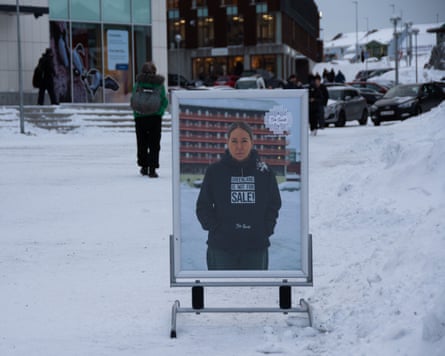
In October, Copenhagen announced an additional 27.4bn in Danish kroner (£3.26bn) for Arctic and North Atlantic security, including for two new Arctic vessels, greater maritime patrol aircraft capacity and a new JAC headquarters.
But on the ground there are few visual signs of increased security. The current JAC headquarters looks cosy rather than imposing or threatening. Even the US consulate, an unfenced traditional red-painted building, channels hygge rather than attack.
A Danish defence spokesperson says: “It is important to note that almost all military capabilities deployed in the Arctic are mobile in nature.” As a result, they are not necessarily publicly visible in a specific geographic area, he adds.
Having finished high school and voted for the first time last year, Aviâja Korneliussen, 19, is part of a generation that has come of age during this unprecedented time of Greenlandic history in which one of the world’s most peaceful populations has come under repeated threat from a military superpower.
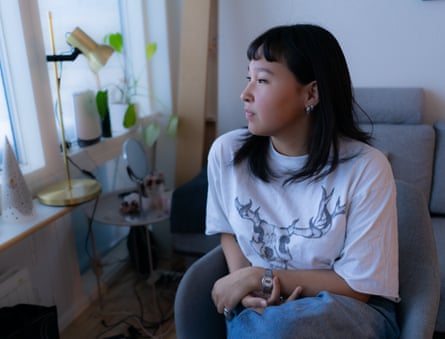
Korneliussen, who is an artist and works at a museum and a bar, says Trump’s threats are dividing society. “Before all of his claims it was just an easy life. You had no worries, you were friends with everybody,” she says, eating breakfast in her apartment as the morning fog cleared outside to reveal white mountains. “But now someone has a different idea of how Greenland will be and another has a whole different idea and if they clash you cannot be friends.”
She finds the way people talk about Greenland online, as an object to be traded, dehumanising. Amid the global attention, Indigenous Greenlanders are, Korneliussen says, becoming more open to expressing their Inuk identity, including through Inuit tattoos and art, and separating themselves from Denmark: “The whole idea of being Inuk instead of Qallunaaq, Danish.”
If the US was to invade, Korneliussen thinks there would be a lot of protest, but she is not sure how people – herself included – would react. “I think I would just lock myself inside and find a way out of here,” she says. But at the same time, she does not want to have to leave her life in Greenland. “It is weird to think about because you don’t want to think about that stuff – like the what ifs and what not. Especially if you have people you care about and it is the land you were born and raised in. The culture that you live every day.”
Many Greenlandic people, Korneliussen says, have guns, so people could try to defend themselves. “But at the same time we are not that type of people to go kill one another.”
As well as fear and anxiety, there is also a strong sense of wanting to get something positive for Greenland out of the situation.
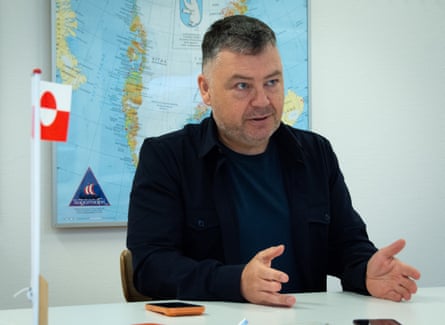
Pele Broberg, the leader of Naleraq, the most US-friendly of Greenland’s political parties that came second in last year’s election, says Greenlandic politicians have been asking Denmark for a free association deal with them for decades, but that for the Danish government “there was never a good time”.
Now he wants Greenland to have the opportunity to talk about the possibility of such a deal with the US, but that Denmark is telling them they must appear united. “They keep saying we cannot appear divided, we have to appear unified,” he says, speaking in his party office at the Greenlandic parliament, Inatsisartut. “There is nothing for us to be unified about, they want something else.”
But on Tuesday, after weeks of repeating similar statements, Greenland’s prime minister, Jens-Frederik Nielsen, changed tone. On the eve of the White House meeting, standing alongside the Danish prime minister, Mette Frederiksen, he said: “If we have to choose between the US and Denmark here and now, we choose Denmark, Nato and the EU.”
Aqqaluk Lynge is one of the founders of the Greenlandic party Inuit Ataqatigiit, a former president of the Inuit Circumpolar Council, and the author of On the Trails of the Inuit. He says this is exactly the message that Greenlanders needed to hear: “That is what we have been waiting for. It’s so good because people are really really tired of this situation. We need at least Denmark and Greenland to be on the same footing in terms of what we are saying.”
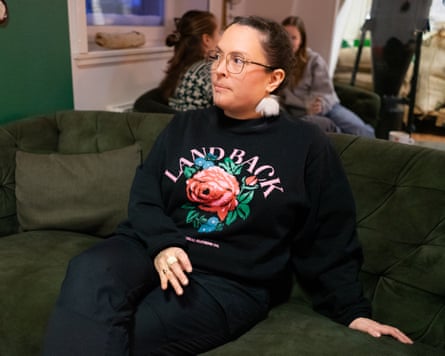
Aka Hansen, an Inuit film-maker and activist, says she wants Greenlandic independence whatever happens, but that “we have to be smart around it”. Recent years, she says, have proven – through invasions of Ukraine, Gaza, Venezuela and now potentially Greenland – that international law is “ineffective”. In that sense, she is relying on Denmark’s protection.
“Which is weird for me to say as someone who fights for independence that I actually have to rely on Denmark right now,” Hansen says. “But I think those are the facts: that we actually have to have hope that Denmark will make sure that we are secure.”