3 months ago
62
3 months ago
62
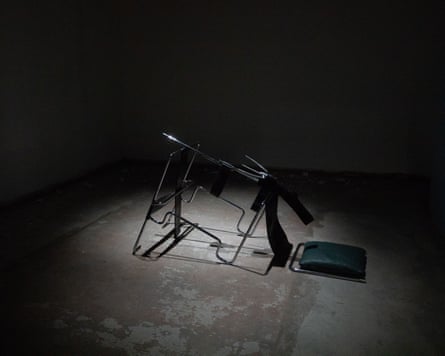
Mourning has many colours and many layers. One mourns people. But one can also mourn a state, a system, an ideology – even those that were deeply flawed. In 2019, the artist Henrike Naumann built an East German living room and rotated it by 90 degrees. The sofa, chairs and coffee table – all in the unmistakable aesthetic of the 1990s – climbed the wall. The carpet became vertical. Cabinets hovered near the floor alongside a CD rack, baseball badges and a flag bearing a slogan in Sütterlin script: “Beware of storm and wind and East Germans who are enraged.”
The installation – titled Ostalgie (a portmanteau of the German words for “east” and “nostalgia”) – made physical what many had felt but struggled to articulate: the collapse of the GDR and its aftermath for those who had lived through it and felt it on some level as a loss. That rupture was not abstract. It tilted the room. It unsettled the ground beneath your feet.
Few artists examined the emotional infrastructure of German reunification – and its global resonances – with such power and clarity as Henrike Naumann, treating design history as social history and redefining what political art could look like. This weekend, on 14 February, she died at the age of 41, after a cancer diagnosis that came too late. In just a few months, the world will see her work at the German pavilion at the Venice Biennale, which she has conceived in tandem with the artist Sung Tieu but will now never get to see in situ.
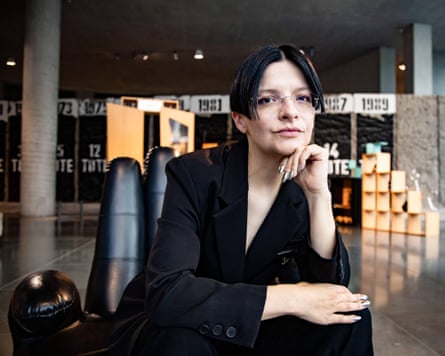
Naumann was among the first millennial artists from East Germany to gain international recognition and emerged as one of the most distinctive voices of her generation. Born in 1984 in Zwickau, in what was then the GDR, she came of age in a unified yet deeply dysfunctional landscape: two political orders, two ideologies and countless “isms” that collided and continue to battle over authority and interpretation. That upbringing taught her early on that history is never singular or objective, no matter how insistently it is framed as such.
After studying stage and costume design at the Dresden Academy of Fine Arts and scenography at the Film University Babelsberg Konrad Wolf, Naumann worked as an artist for more than a decade. She won numerous awards, her works entered international collections and she exhibited in museums, galleries and biennales around the world.
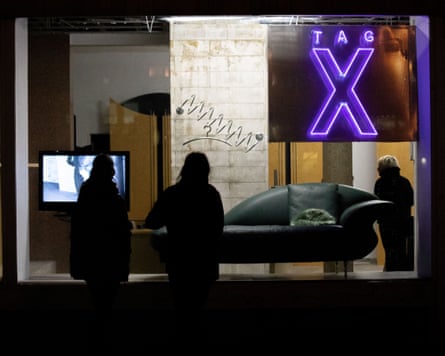
She became known for installations made from used furniture, design objects and video works – walk-in analyses of specific historical moments. She sourced many of her pieces on eBay from private individuals. In her hands, wardrobes, sofas and armchairs became historical documents once more, carrying the biographies of their former owners. History did not just hang on walls; it sat in the room with you.
At the Haus der Kunst in Munich – a building erected by the Nazis – she placed armchairs from the Hitler era alongside post-reunification wall units and decorative figurines from the 1990s, revealing unsettling aesthetic continuities across modern German history. At Documenta in 2022, she presented a temple to the trance subculture of the 1990s, exploring the strange convergence of radicalisation and hedonism that marked that decade. In an exhibition at the Bundestag, she dissected the ideology of the Reichsbürger movement – those who believe the German Reich still exists, who see themselves as a threatened people in an occupied country, and who hoard weapons in preparation for an imagined reckoning. In another installation, she created a “German Unity Mourning Altar”, complete with a Milka-purple funeral wreath bearing the inscription Der Deutschen Einheit – In stiller Trauer (German Unity – In silent mourning) – a gesture at once humorous and unsettling.
Her personal background was always a starting point, a prism through which she examined broader political and social belief systems. Yet part of her international success lay in the fact that her work never remained confined to an East German landscape. She understood that the 1990s were not merely a local story of strange interiors, neo-Nazis and techno clubs, but a laboratory for understanding how societies metabolise rupture – and how political extremism does not begin and end with flags and speeches, but settles quietly into living rooms. In 2022, at SculptureCenter in New York, she extended this inquiry, examining the role furniture played in the storming of the US Capitol in 2021. As she once put it: “I think I like furniture because it’s something that everybody has. It’s not so abstract – it’s something everyone can relate to.”
Last year she examined the role of state artists in the GDR and under National Socialism, while remaining conscious of her own position within that lineage. With her German pavilion in Venice – rebuilt by the Nazis in 1938 and long a site of controversy – she knew she, too, would be read as part of this national history.
In her work, history was a battlefield of narratives; nothing and no one stood alone. Every object and every space carried a past that shaped the present. She traced connections between violent ruptures and regime changes, placing them along a continuum and asking which histories we failed to think together – which stories we chose not to see and where one stands within that history.
In one of her recent lectures, Naumann compared art to chocolate. Neither is essential for survival. Both are luxuries. Yet taste – like aesthetic experience – carries memory and emotion. It lingers. We would notice its absence.
We will notice hers. Henrike Naumann’s art altered how we look at rooms, at objects, at the seemingly quiet surfaces of everyday life. In doing so, she made visible what is bubbling beneath the surface – not only in Germany, but far beyond it.