1 month ago
72
1 month ago
72
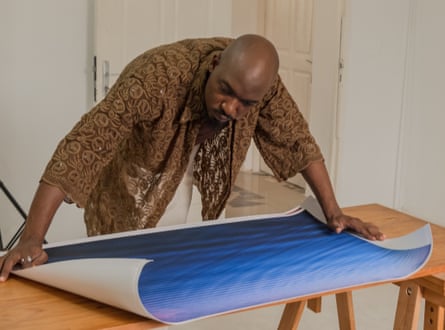
By the poolside of La Fourchette de Rōze hotel in Grand Bassam, a Côte d’Ivoire city sandwiched between the Ébrié lagoon and the Atlantic Ocean, a birthday party was in progress. On the second-floor gallery, the artist Nuits Balnéaires stood by a huge painting in one corner and looked out through the window towards the billowing waves of the Atlantic Ocean.
“It’s poetic … that immense energy of the ocean, which also fuels my work,” the Ivorian visual artist said. “The natural elements are the very essence and foundation of my artistic practice,” he added, as he reflected on the way in which his name, which translates as “coastal nights”, matched the ambience.
Many families in Abidjan, the commercial capital of the west African country, have often drifted to Grand Bassam, just 30 miles (45km) to the east, for Sunday relaxation, including Nuits Balnéaires, whose visits from childhood gave him a strong connection to the city. In July 2019 he moved there permanently from his family home in Abidjan.
In the last decade, it has become a road well travelled. As rents continue to rise amid a cost of living crisis in Abidjan, residents there, especially artists, have been reconsidering their lives in the city.
“It [is] increasingly difficult for many artists to maintain studio spaces in the city,” said the Abidjan-based art collector Ozong Agborsangaya-Fiteu. “As a result, they are seeking more affordable alternatives in places such as Grand Bassam, Bingerville, and increasingly even farther afield in Dabou and Jacqueville. Grand Bassam itself is becoming more expensive, prompting some artists to relocate even farther out.”
The biggest beneficiary of the exodus from Abidjan has undisputedly been Grand Bassam, the country’s first capital where the colonial architecture was listed as a Unesco world heritage site in 2012. With its scenic beachfronts, fresher food, cheaper markets, proximity to the airport and a sense of nostalgia even in the abandoned colonial buildings, the city represents an easier pick than Abidjan, its livelier and more chaotic cousin.
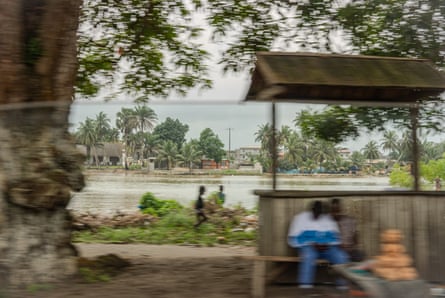
This, for the Guadeloupe-born artist Elladj Lincy Deloumeaux, makes it “a very calm and soothing place that’s conducive to working and finding inspiration”. Five years ago, he moved from Paris to Abidjan, and then two years ago to Grand Bassam, where he now has a studio and apartment.
Once a centre of cultural trade and tourism, Grand Bassam lost some of its appeal over the years as Abidjan became more cosmopolitan and opportunities in arts and entertainment increased. A jihadist attack in 2016 that left 19 people dead also punctured the town’s reputation.
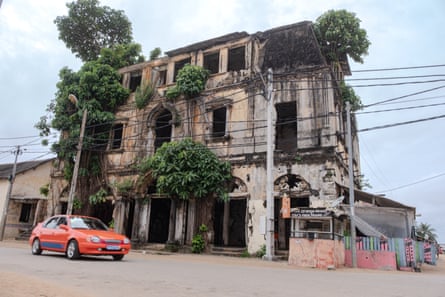
These days, evidence of its renaissance abounds.
Last year, the former colonial customs and post office building was reopened after a restoration project as La Maison de l’Art, a contemporary art museum with a sculpture garden and a cafe in the courtyard. At the launch, the culture minister, Françoise Remarck, said the collaboration between the private and public sector to protect local history and shine a spotlight on the country’s modern art was a “fresh breath of life” to the old city.
“Today, we are doing much more than opening the doors of a space dedicated to art,” she said. “We are taking an act of recognition and appreciation of African artistic genius.”
Other organisations in the vicinity are following the same route. La Fourchette de Rōze, a boutique hotel, has become a creative hub: in January 2023, it began an artist-in-residence programme that has brought in more than two dozen artists and musicians so far from all over the globe, including Nuits Balnéaires. La Cocoteraie des Arts, a creative space with an open-air art atelier and gallery in Mondoukou, only a few minutes outside the city, also offers artist residences.
after newsletter promotion
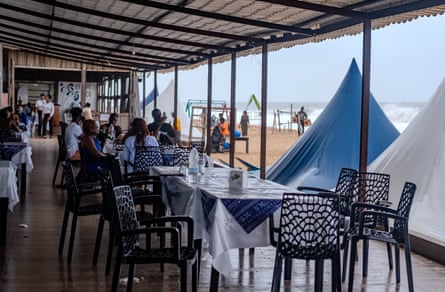
Across Grand Bassam, dozens of new studios are popping up across the city. Later this year, the Ivorian-French photographer Aïcha Fall will add another to that number.
“I grew up in the French countryside and I’ve always loved a place that is calm,” said Fall, who moved to Grand Bassam on her return from Paris in 2023, despite an attachment to Abidjan where she had spent her early years. “Bassam represents all of that. It offers you time for reverie, unlike Abidjan, which is always effervescent.”
Some enthusiastic followers of the art scene are predicting that the city could eventually upstage Abidjan as an art haven in the coming years, or at least rival it.
Not everyone within the industry is as optimistic. Most of Côte d’Ivoire’s galleries and art institutions remain in Abidjan, as do many of the collectors, patrons and other important elements of the ecosystem. Festivals such as Abidjan art week, for example, still bring people in from across the continent and are yet to be replicated elsewhere in the country.
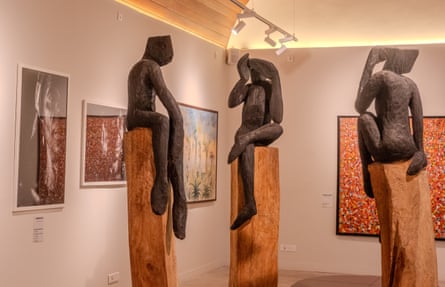
“Rather than weakening the scene, this geographical shift has created a different dynamic,” Agborsangaya-Fiteu said. “Artists benefit from more affordable and inspiring places to work while remaining close enough to the city to participate in exhibitions, openings, and other cultural activities whenever needed.”
As he sipped his coffee, legs crossed, Nuits Balnéaires agreed, before pointing out that the situation was a bit like having his cake and eating it. “One of the advantages is that in Bassam, you can feel very disconnected, yet at the same time, you’re not that far removed from what’s happening in Abidjan.”