2 months ago
71
2 months ago
71
Almost exactly one year ago, Graham Platner, who has no political experience, was cherry-picked by out-of-state political activists.
According to a person familiar with the campaign, Daniel Moraff and Leanne Fan, who have made a name for themselves by recruiting populist candidates across the country, traveled to Maine and rented a house near Platner’s home in Sullivan to convince him to run for the US Senate. Throughout the process, Moraff became Platner’s “right-hand man”, the person described, speaking on condition of anonymity for fear of backlash.
But homing in on Platner as a newcomer to oust long-serving Republican Susan Collins came at a cost. The Wall Street Journal recently reported that Moraff asked for an expedited, cheaper background check to be completed in a matter of days. The firm Moraff and his team contracted with also did not do a candidate interview or questionnaire, per the Journal’s report.
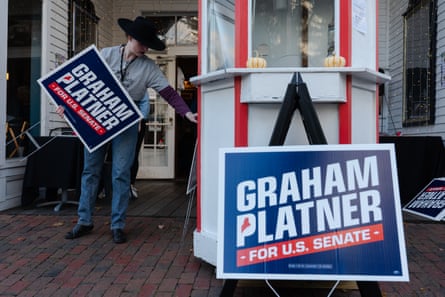
The fallout of those decisions happened on a colossal scale. In a midterm year with record spending across the country, the Democratic party had come to pin its hopes on Platner to help clinch Senate control with his meteoric campaign and ability to unite independent and progressive voters alike with a clear, anti-establishment message.
Controversies ensued, bringing with them straight-to-camera videos of Platner explaining and denying various scandals. Finally, an allegation that broke the dam this week: a woman he dated accusing him of sexual assault, of drunkenly forcing her to have sex with him after coming to her house uninvited. Asked in an interview on CNN whether Platner raped her, the woman, Jenny Racicot, replied: “By definition, yes, absolutely.”
His support collapsed. Platner waited days as calls grew for him to withdraw. Then on Wednesday, he released an 11-minute video announcing the end of his campaign that left Maine voters scrambling and betrayed, and the country wondering: how did this happen?

“It feels like some of the first rules of politics may have been broken here,” said Andrew Feldman, a national progressive strategist. “We were seeing rookie mistake after rookie mistake, and now we find ourselves in this situation.”
David Farmer, a Democratic strategist based in Maine, said the vetting process for Platner was tantamount to “malpractice”.
“I’ve had to have these conversations with candidates in the past – where you sit down and you ask them really tough questions,” Farmer said. “What drugs have you used? Have you ever had an affair? You ever cheated on your wife? You ever cheated on anybody? It’s really uncomfortable and probing, and a miserable event for everybody involved.”
The person familiar with the campaign said that Moraff and Fan “fell in love with an aesthetic without knowing the state” that ultimately did a “disservice” to Maine’s working-class voters.
Platner’s campaign did not respond to the Guardian’s request for comment on the methods used to check the former nominee’s background.
A rising star and an early redemption arc
Platner’s early campaign days – after he announced his run in August of last year – saw a rare rush of grassroots excitement as he criss-crossed the state for town halls, with backing from Bernie Sanders and an ad produced by Zohran Mamdani’s 27-year-old media strategist, Morris Katz.
An oyster farmer and marines veteran, Platner issued plain-spoken warnings that Maine’s working class had been hollowed out – healthcare was unaffordable, young people couldn’t buy homes – and said he’d survived only because of the veterans’ benefits he receives from being “blown up” too many times in combat. His searing indictment of the political establishment matched the anti-Washington mood and anger many Democrats felt toward their party’s leaders.
“His tone, his look, his voice, his message captured a frustration with Washington, a frustration with economic injustice,” Farmer noted.
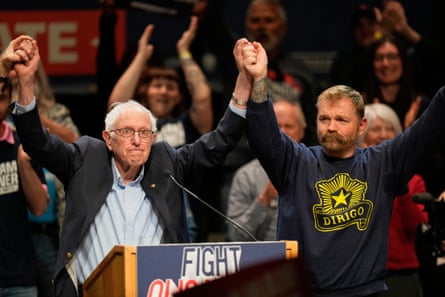
Democratic leaders had someone else in mind: the 78-year-old term‑limited governor Janet Mills. But Mills hadn’t yet announced her run. In the meantime, 41-year-old Platner positioned himself as the gruff local businessman hardened by tours in Iraq and Afghanistan, pushing for generational change. Once Mills entered, he quickly framed her as emblematic of the status quo, arguing that a Chuck Schumer‑backed candidate would mirror Collins‑style “fake moderation”.
The Democratic establishment was skeptical of Platner from the outset, concerned that he brought too much baggage to the race against a seasoned incumbent. But progressives say the party is also to blame for pushing Mills as an alternative. If she had been elected, Mills would have been the oldest freshman in Senate history.
Platner brushed off his earlier scandals: Reddit posts from 2013 to 2021 where – among other things – he called white rural Americans “stupid” and “racist”, questioned why “Black people didn’t tip” and said sexual‑assault survivors should “take some responsibility … and not get so fucked up”. While apologetic, he characterized the posts as side-effects of severe PTSD and disillusionment from combat.
He tried to get ahead of more controversy by revealing a covered-up skull-and-crossbones tattoo that resembled a Totenkopf, a symbol known for its use by the Nazi SS. Platner said it came from a night drinking with military buddies in Croatia 18 years earlier. “I’m not a secret Nazi,” he told the Pod Saves America hosts.
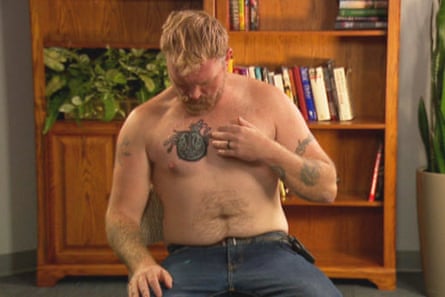
Platner and his allies in Congress argued the uproar was overblown. At the time, Platner told the Guardian that Mainers related to his struggle and didn’t see the posts or tattoo as disqualifying. Many voters also said they could look past his mistakes and viewed his redemption arc as genuine. “If what the voters wanted were people who were grown in vats and had never done or said anything that they might regret their entire lives, we’d have a very different country,” Moraff told the Journal in May.
But inside his campaign, cracks had started to appear. In October, Platner’s political director, Genevieve McDonald, and his finance director both left his team. The latter, Ronald Holmes III, said his “professional standards” no longer “fully aligned with those of the campaign”. McDonald said Platner’s failure to fully disclose the extent of his Reddit posts led to her departure. She went on to question whether Platner really didn’t know the meaning of his tattoo.
Bracing for the worst
There was lingering concern among Maine locals and political operatives that more would come out about Platner’s past. One voter at a town hall in April asked him – point‑blank – if there were examples of sexual misconduct in past relationships that could emerge and endanger his chances. Another said that she was extremely wary about how untested Platner was.
Ultimately, his star continued to outshine the septuagenarian governor’s lackluster campaign. Mills, citing dwindling financial resources, eventually dropped out of the race, giving Platner a glidepath to the nomination.
And then – 10 days before the Democratic primary – reports revealed that Platner’s wife, Amy Gertner, had confided in McDonald about sexually explicit messages he’d sent outside their marriage, disclosures she made in an attempt to get ahead of any opposition research.
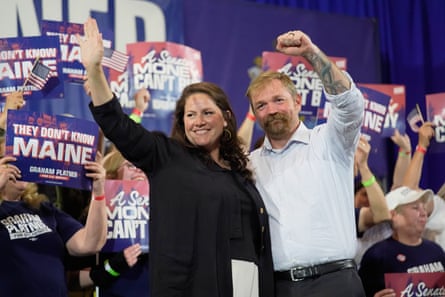
In extraordinary fashion, Platner was summoned to Washington DC to answer lawmakers’ questions about the latest controversy. Shortly after the meeting, the New York Times reported that previous partners described “unsettling” and “toxic” behavior. One of the women, Lyndsey Fifield, a conservative operative who dated Platner from 2013 to 2015, alleged he frequently grabbed her by the shoulders, once yanked her out of a taxi by her wrist, and during one argument twisted her arm behind her back, shoved her into a bedroom and held the door shut until she was “calm”. Fifield also cast doubt on Platner’s claim that he was unaware that his tattoo was a Nazi symbol, telling the Times that he referred to it as “my Totenkopf”.
Platner rejected Fifield’s claims and branded them as “politically motivated”.
While some voters were deterred, Platner still ended up clinching more than 70% of the vote in the primary. National Democrats, however, were left to grapple with a catch‑22: what would be an insurmountable scandal? And would it be worse than if Collins, who had helped overturn Roe v Wade and backed several key Trump policies, was re‑elected to a sixth term?
“It’s like a frog being in a pot of boiling water. If you raise the temperature slowly, you don’t know it’s boiling until it’s too late,” said Farmer.
The final straw
When Politico published their story on Monday, outlining Jenny Racicot’s claims that Platner raped her nearly five years ago, the condemnation came hard and fast. Endorsements evaporated and calls for Platner to withdraw were immediate. As he denied the allegations in a lo-fi self tape, it became clear this would be the red line for those who had stood by him until this point.
“The messenger was not the right person to match the inspiring message,” said Adam Green, executive director of the Progressive Change Campaign Committee. “It is really unfortunate for the overall project of trying to challenge corporate power and shake up a broken political system.”
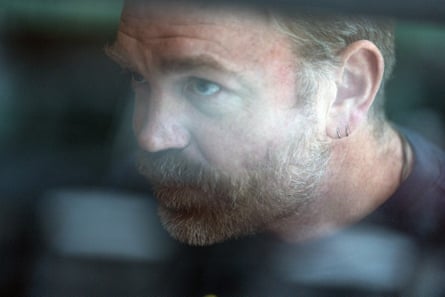
It would be another two days before Platner published another video announcing his decision to end his campaign, claiming the allegations against him were part of a coordinated political attack.
Troy Jackson, who campaigned alongside Platner while running for the Democratic nomination in the Maine gubernatorial race, and is now one of several candidates running to replace him, told MS Now: “Graham told me point-blank that there was nothing in his past that I had to worry about. And he lied to me. And he lied to a lot of us.”
Now, as Democrats battle with the feeling of deja vu from Joe Biden’s withdrawal from the 2024 presidential race, it’s left some unnerved about whether the Maine Senate race is still winnable. “It’s so upsetting because it feels like we’ve been completely bamboozled by a candidate that so many people believe in,” said Feldman.