3 months ago
65
3 months ago
65
Sergio Busquets didn’t expect to last this long. More than a decade ago, he predicted he’d retire by his early 30s. But when he finally announced in September that he’ll hang up his boots at the end of Inter Miami’s season, he did so as a 37-year-old defensive midfielder who still somehow never leaves the pitch for one of the best teams in MLS.
He could be playing his final game this weekend, if Miami losetheir conference semi-final against FC Cincinnati on Sunday.
“For me it’s a shame, because I think he’s a player who’s still active, who can continue to give a lot to the club. We can continue to enjoy the level he has,” said his manager Javier Mascherano, who was once forced to become a center-back when he couldn’t beat out a young Busquets in Barcelona’s midfield.
What is it that still makes Busquets so good? The one flaw in his game is glaring – he’s old and immobile, practically Methuselah by midfield standards. But his virtues are more subtle, a hundred small decisions per match that have to be rewound a few times to be fully appreciated. As an anonymous blogger’s wife famously said, watch Busquets and you see the whole game.
“I’m not, and never have been, an athletically quick player,” Busquets confessed on Catalan radio a few years back. Like everything else about him, that was elegantly understated. According to data from Gradient Sports, no midfielder in MLS travels less total distance per 90 minutes this season or covers less ground at speeds above a jog. Although his sprints still top out at a respectable 19.6 miles per hour, he grinds through the gears like an old hatchback, accelerating slower over the first 10 meters than any outfield starter in the league.
Busquets’ secret has always been that his brain is quicker than his opponents’ feet. “Mine is a position where you can’t be moving all over the pitch,” he told the Catalan radio show. “You’ve got to think more than run.”
Watch him play and you’ll see his head moves more than his body, swivelling and scanning, spotting the next play before it unfolds. His movements are short but purposeful, always slightly anticipating the action, stepping into space just as it opens or closing ground the moment before a turnover. He thinks in and out of possession at the same time.
“Defensively, positioning is everything,” Busquets once said. “More than stopping the counterattack when it happens you want to prevent it from starting. It’s more about being tactically astute than physically dominant. You need to know exactly where to be on the pitch at all times.”
That’s truer than ever in his final season. In SkillCorner’s advanced stats, the defensive metrics where Busquets is still above average have anticipatory names: “disrupt or regain,” “stop or reduce danger.” He knows better than anyone that he has to snuff out trouble or he’ll struggle to catch up to it.
Youth and athleticism may be fleeting but class on the ball never gets old. “He could just be walking around and dictate games. He didn’t feel the pressure,” Busquets’ former Barcelona teammate Cesc Fàbregas marvelled on a podcast. “You could press him as hard as possible and he would do unexpected things.” The internet loves videos of Busquets’ signature move, in which he shows opponents the ball and then yanks it away at the last second, switching direction just in time to leave would-be pressers in a confused heap.
His comfort under pressure lets him pick and choose the pace of play. He’s famous for his one-touch passing in tight spaces but is just as likely to linger on the ball, letting the game unfurl in front of him. “It can appear that I have waited too long to play the pass, but I’m just waiting to see if the options will change. They usually do,” he said. “I play the way I am as a person. I don’t panic, I’m patient.”
How can data measure this? That knack for always making the right decision? The simplest indicator is sheer volume – his 70 pass attempts per game in the MLS regular season rank near the top of his position, a sign of his teammates’ trust – but advanced stats can go further.
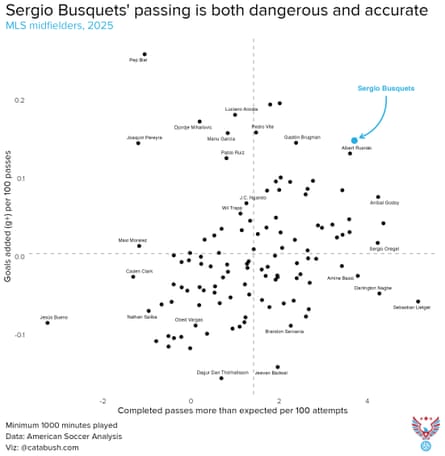
According to American Soccer Analysis, Busquets is in the 94th percentile of MLS midfielders this season for how much his passes beat their expected completion percentage and in the 93rd for how much each pass improves his team’s goal probabilities.
No midfield passer who’s more accurate than him is more dangerous and no one more dangerous is more accurate.
after newsletter promotion
SkillCorner’s off-ball data tells a similar story: when opponents close him down, Busquets ranks near the top of MLS for both ball retention and difficult passes under pressure. The only midfield starter who beats him on both axes is Darlington Nagbe, another press-resistant MLS legend who has made 2025 his last year as a pro.
Show Busquets any kind of defensive line and he’ll find a way to crack it open. One of his favorite tricks is a disguised pass where he shapes his body as if to shovel the ball sideways, drawing opponents outside, then swivels his hips to slice them open through the middle. Per SkillCorner, he’s in the 97th percentile among midfielders for pass attempts through the first line of defense, 98th through the second and 84th through the last line – not bad for a deep-lying pivot.
“I really like to slip passes inside, which is ultimately the hardest thing from my position,” Busquets told Vincente Del Bosque. “To play backwards or sideways, to bring ‘pausa’ to the game, is fine, but there are moments that call for something else.”
Lionel Messi, his teammate and Barcelona and now Inter Miami, is his favorite target for those incisive passes because “we understand each other well.”
Their connection runs even deeper in Fort Lauderdale than when they first linked up in Barcelona 17 years ago. According to the new live score app futi, which I co-founded, Busquets has played 74 progressive passes to Messi this season, more than any other passer-receiver pair in the league.
Even at the end of a long career that spans pretty much the entire modern history of soccer analytics, there’s still a lot about Busquets’ game that evades easy measurement: his vision and awareness, the technique behind his peculiar defensive crouch and spindly legged tackles, the way he yo-yos in and out of Inter Miami’s back line to rearrange both sides’ shapes and create new lanes on the fly.
That slight air of mystery suits Busquets, who became a legend – your favorite defensive midfielder’s favorite defensive midfielder, the player Pep Guardiola famously wished he could be reincarnated as – by learning how to disappear completely. “I don’t want people talking about me,” he told the Guardian just before he departed Barcelona for Miami and the history books.
Good luck stopping that one, old man.