2 days ago
30
2 days ago
30
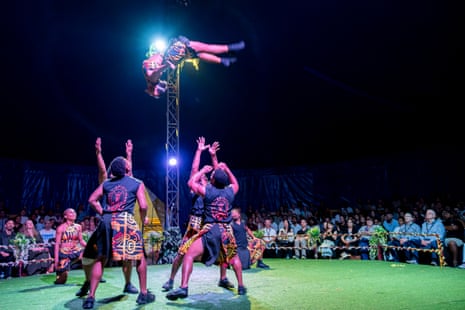
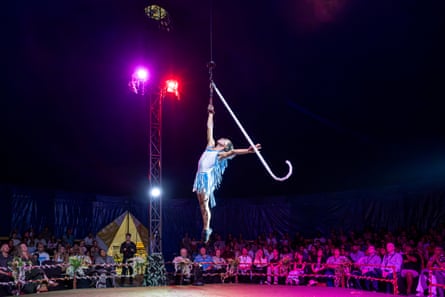
I’m watching a young man dressed like a bird flying through the air under a big top when I look past him, outside the tent door opposite me, and see a line of people holding on to a rope, muscles straining and shining with sweat in Brisbane’s muggy heat. My eyes trace the cable back inside, and I realise that this rope and this group of people are what is holding the performer up in the air.
Moments earlier, the rope wranglers were on stage themselves, dancing and performing acrobatic tricks. I don’t know if this is how other circuses work, but it’s how things go with the Fijian Flying Circus, whose performers are responsible for every bit of magic you see on stage – including the stage itself.
They also put up the tent and installed the seats. “If you came a day or two ago, we all had hard hats on and safety boots and hi-vis vests,” says Navi Fong, the artistic director of Vou, the Fijian dance company behind the Flying Circus. We’re sitting outside in a shady patch of rainforest just beyond South Bank Piazza, where the show has opened as part of the Brisbane festival.
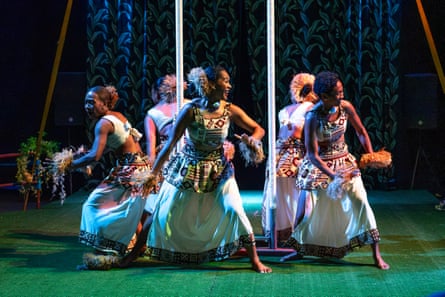
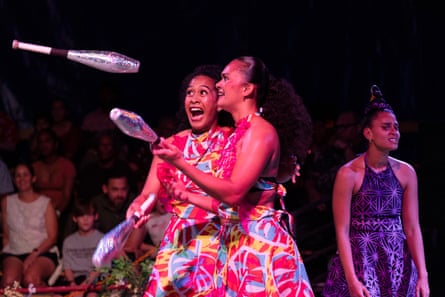
Sitting to Fong’s left is Michelle Seini Florence Barrack, a 21-year-old dancer, juggler and master of hair suspension, who two days earlier was assembling scaffolding. Two hours later, I will watch as she juggles rings and clubs. To Fong’s right is Patrick Joseph Mecatric, also 21, who is a dancer and specialist in aerial silks. He’ll be flying like a bird shortly, before manning the snacks stall during interval.
Both performers, the youngest in the troupe, tell me they’re pleased to have the extra skills – hard and soft. “The main thing I’ve learned is teamwork; I’ve also learned some accounting,” Mecatric says.
Meanwhile, Barrack says “learning from the others really helped me grow as an individual”. She’s also trained in merchandise, stock management and bookkeeping. “It helps me support my family back at home,” she says.
When Vou launched the circus in 2024, the company was learning these administrative and technical skills “on the job, touring around the towns in Fiji”, Fong says. The troupe of young dancers had only been trained in circus skills for a year. The company then took the show international, touring Tahiti, New Caledonia, New Zealand – and now Australia, including stops in Darwin, Sydney and Melbourne.
It speaks toVou’s incredible ambition and can-do attitude, founded 19 years ago in Suva. Vou means “new”, and Fong, who joined 15 years ago as a teen, says its distinctive blend of traditional Fijian and contemporary dance “came out of a yearning of young people to make work that talked about us now”.
“Dance and singing has always been a part of what it is to be Fijian,” he says, “and I think for the longest time, even though the country was changing, the arts were tethered to the past. It was a great preservation of our traditional knowledge, but it was very hard as an urban Pacific Islander or Fijian to see yourself reflected in those stories.”
Vou now offers the country’s only accredited tertiary performing arts training: a two-year diploma covering dance (including ballet, jazz, hip-hop and Fijian cultural), theatre, circus, singing and drumming.
Back inside the big top, I see how this grab-bag of skills, styles and influences coalesces in a family-friendly show, set in a “mystical world” of cheeky spirits and elemental forces and loosely arranged around the story of a young girl on a quest to retrieve an enchanted shoe from a mischievous spirit.
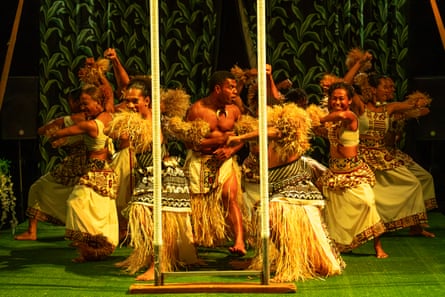
The show’s energetic young cast, all graduates from the Vou conservatorium, alternate between full-throated song, floor-shaking ensemble sequences and traditional circus acts such as juggling, trapeze, tight-rope and aerials. Sometimes, they wear traditional costumes, with vesa (arm and calf bands made from hibiscus bark) and liku vau (hibiscus bark skirts). Sometimes, they wear sequins.
It’s a lo-fi, high energy mix, fuelled by the natural charisma and easy charm of the performers, who use physical theatre to communicate the story and marshal the audience into a call and response of clapping and hollering. It’s the kind of show that reminds you tricks are only half the circus experience; working the crowd is equally important.
The most important thing for these performers, however, is what is happening back at home. Once their salaries are paid, every extra dollar from ticket, merchandise and food and beverage sales goes towards funding Vou’s scholarship program, which provides free tuition, board and stipends to between 12 and 14 students annually from around Fiji. After graduation, they’re guaranteed paid full-time work with Vou.
“In Fiji, the avenues for a successful life are narrow,” says Fong, pointing to the country’s current HIV and drug addiction crises. “The education system, [traditional] career pathways – they don’t fit everyone …
“We won’t catch everyone, but there’s a few people that are going to come in through our system that, had it not been for [this opportunity], might have been part of the statistics.”
-
The Fijian Flying Circus is performing in Brisbane until 4 October, then Melbourne from 17 October to 22 November and Sydney from 12 December to 10 January 2027