3 months ago
64
3 months ago
64
When the French architect Renée Gailhoustet died in 2023, the residents of Le Liégat, a social housing block she completed in 1982, put up a large handmade sign saying: “Merci Renée.” Architects are often accused of designing impersonal rabbit hutches that they themselves would never deign to inhabit, but when Gailhoustet died at the age of 93, she had been living in her Liégat duplex in the Parisian suburb of Ivry-sur-Seine for more than 40 years.
Outside her living room window, several storeys up, was a large cherry tree and a profusion of greenery. Characterised by their riotous informality, Gailhoustet’s free-plan apartment blocks invariably featured cascading terraces and loggias covered with a foot of soil, so residents could cultivate and enjoy un jardin derrière, a back garden.
Over time, planting has enrobed the angular contours of Le Liégat, as it has her other housing schemes, softening and subverting its concrete armature in a kind of post-apocalyptic, nature-takes-over way that plays well on Instagram. Yet it originally sprung from the socially minded view that people should have access to green space, anticipating today’s preoccupation with a more eco architecture, capable of mitigating the effects of rising temperatures. In 2003, around 15,000 people died in France in a heatwave. Planting provides natural shade and cooling.
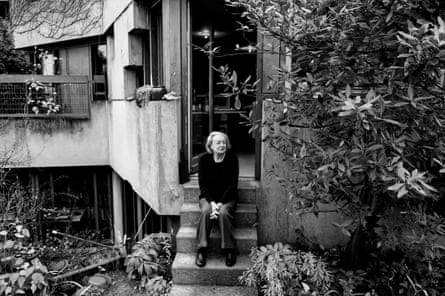
Gailhoustet might be described as an “eco-brutalist”, but her work across the decades, after she graduated in architecture from Paris’s École des Beaux-Arts in 1961, cannot be easily pigeonholed. She specialised in social housing and urban planning in the suburbs beyond the périphérique – the less privileged, less photogenic Paris, where few tourists venture. Often combined with communal facilities such as shops and cafes, her housing megastructures were formally and spatially complex, like modern mini-cities. Designed to be adaptable over time as residents’ living arrangements changed, individual apartments were generously proportioned, with space, light and air flowing in all directions.
Le Corbusier famously remarked that a house was “a machine for living in”, an aperçu that has dogged modernist architecture down the decades. Although her work is undoubtedly modernist, Gailhoustet took the opposite position: that homes should be shaped by their occupants and architecture should provide a template for elaboration and enrichment, rather than soul-numbing constriction. “The idea of social housing as an addition of little functional room boxes,” she once wrote, “should not be given sociological sanction. Almost no one living in those conditions chose to. We are not so pretentious as to propose an ideal dwelling. We merely wish to create possibilities for choice.”
Architect and academic Nichola Barrington-Leach, editor of a hefty forthcoming tome on Gailhoustet, explains her appeal: “Her work invites us to imagine new ways of living together as an ecosystem, to reframe our relationship with nature, the city, with each other and ourselves. Homes are not machines for living in – but gentle, human, individual spaces.”
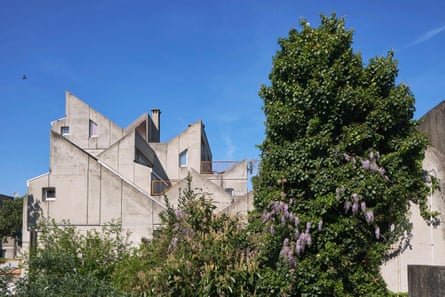
In a career dedicated to building more than 2,000 social homes, Gailhoustet offered a visionary riposte to the grands ensembles, the industrialised and standardised postwar housing developments that dominate the peripheries of most French cities. Commissioned directly by leftwing municipalities, she was able to work freely and experimentally to an open brief but still had to conform to a limited budget. “She used those constraints to develop her vision and ideas,” says Barrington-Leach. “And I think that’s the message I get from her – which is, actually, you can do so much with so little.”
In tandem with the book, which will be the first English language exploration of Gailhoustet’s oeuvre, Barrington-Leach has curated an exhibition, A Thousand and One Ways of Living, at London’s Architectural Association (AA), where she teaches. The exhibition takes its title from the words of Rima Abdul Malak, a former French minister of culture, who observed that Gailhoustet’s architecture offers “a thousand and one ways of inhabiting our world”.
Part of the AA’s grand Georgian interior has been subtly transformed into a 1:1 scale installation of a Le Liégat apartment. “The aim was to bring one of her flats into the AA,” says Barrington-Leach, “to show her spaces rather than just her ideas.” Walls are represented by thick sheets of white paper suspended by cable ties from steel wires strung across the exhibition space defining the level of the apartment’s ceiling height. Intended to convey proportions and relationships, the effect is both abstractly sculptural and intimately functional, poetry infused with pragmatism.
Along with photographs and drawings, different dwelling types are further represented by smaller scale models in card and cast concrete – bizarre, sharp-edged and waywardly random. Yet the appearance of complexity belies an underlying constructional simplicity and clarity, based on a hexagonal structural grid and lightweight partitions that could be easily rearranged. Gailhoustet once described the architect’s role as being “an artisan of a difficult material: space”.
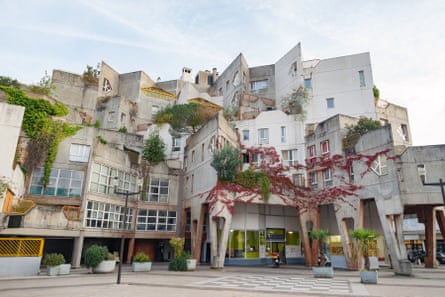
Born in Oran, Algeria, in 1929, the daughter of the deputy director of the Echo d’Oran newspaper, Gailhoustet grew up in the coastal city’s European quarter before moving to Paris for university. She alighted on architecture after studying philosophy at the Sorbonne, a move impelled by an ambition to build rather than theorise, underscored by her political convictions. She was active in the Young Communist movement and, during periodic clashes with far-right groups, had the dubious distinction of once having her nose broken by Jean-Marie Le Pen, founder of the country’s National Front party.
Between 1963 and 1985, Gailhoustet oversaw the radical transformation of Ivry-sur-Seine, on the south-east edge of Paris, while working on projects in other suburban locales, including La Maladrerie in Aubervilliers, to the north. Animated by an abundance of civic spaces – a library, cultural centre, home for elderly people and a children’s centre, along with shops, gardens and artist’s studios – La Maladrerie was designed in 10 phases, took 10 years to build and is her largest project, with 850 dwellings.
By the 1990s, however, the political context had changed, with France’s central government increasingly hostile to large-scale housing projects. Work began to dry up and in 1999 she closed her practice for good.
For decades, Gailhoustet has remained on the margins of architectural history, her reputation overshadowed, to an extent, by Jean Renaudie, whom she met in her mid-20s. They lived together for around 15 years, had two daughters, and collaborated on several projects. But her pioneering contribution is now being acknowledged, albeit belatedly. In 2022, a year before she died, she was awarded the Royal Academy architecture prize. “Her achievements reach far beyond what is produced as social or affordable housing anywhere today,” said jury chair Farshid Moussavi.
Crucially, rather than top down, her design process was collaborative. Concepts such as open-plan living and garden terraces were discussed with residents through large-scale physical models. And though some occupants initially struggled with the lack of conformity, finding it difficult to imagine themselves in unorthodox geometries and unprescribed spaces, the homes she built are still loved and sought after.
Most of Gailhoustet’s housing is still council-owned and, despite decades of state neglect and some misguided renovations, resident groups continue to fight for the preservation of her work, successfully listing several buildings. “She proved that we can explore alternative ways of living and create a framework for our cities that allows for adaptation and reuse,” says Barrington-Leach. “Her legacy, like her architecture, is growing as a living archive: evolving with every resident and every season.”