3 months ago
95
3 months ago
95
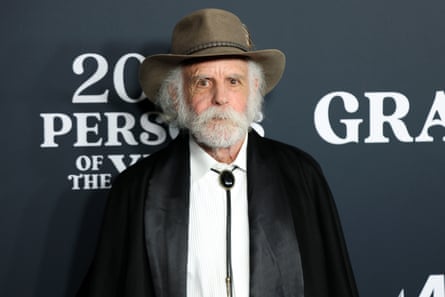
Though perhaps not as instantly recognisable as the band’s guru-like lead guitarist Jerry Garcia, Bob Weir, who has died from cancer aged 78, was an indispensable pillar of the Grateful Dead as guitarist, singer and songwriter.
Weir, Garcia and their bandmates first came together in San Francisco in 1965, and would become integral players in the psychedelia boom and the city’s summer of love in 1967, fuelled by the mind-expanding drug LSD.
Blending influences from rock, blues, country and folk music, they developed a unique form of collective improvisation that might see a single song stretching out to 45 minutes. Meanwhile the group’s egalitarian philosophy encouraged fans to record their live shows, and their loyal battalions of “Deadheads” would follow the group everywhere they played, like a nation on the move.
But the band proved to have far greater influence and staying power than most of their contemporaries, and continued to work collectively until 1995, when Garcia died, subsequently performing and recording in a variety of solo and collective guises until last year.
As Weir told Rolling Stone magazine: “We speak a language that nobody else speaks. We communicate, we kick stuff back and forth, and then make our little statement in a more universal language.”
As a songwriter, Weir contributed to many of the group’s key songs, not least Truckin’ (a kind of potted autobiography of the Dead), Sugar Magnolia, The Other One, Cassidy, One More Saturday Night and Playing in the Band.
The last three of those first appeared on his first solo album, Ace (1972), but soon became Grateful Dead staples. He recorded two additional solo albums, Heaven Help the Fool (1978) and Blue Mountain (2016), and was also a member of several bands outside the Grateful Dead, including Kingfish, the Bob Weir Band, Bobby and the Midnites, RatDog and Wolf Bros. The director Mike Fleiss’s documentary film about Weir, The Other One: The Long Strange Trip of Bob Weir, premiered in 2014 and subsequently appeared on Netflix.
He was born in San Francisco, the son of John Parber and Phyllis Inskeep, two college students who gave him up for adoption, and he was subsequently raised by Eleanor (nee Cramer) and Frederic Weir, in Atherton, in San Francisco’s Bay Area. He displayed an early interest in athletics, but when a family nanny introduced him to jazz it triggered his passion for music.
After experimenting with the trumpet and the piano, he gravitated to acoustic guitar at the age of 13. He suffered from undiagnosed dyslexia which caused him to be expelled from several schools. However, during a stint at Fountain Valley, a Colorado school for boys with behavioural issues, he met John Perry Barlow, who would later become the regular lyricist and musical collaborator on Weir’s solo work.
Back in California, Weir studied guitar with Jerry Kaukonen (later to find fame as Jorma Kaukonen, the Jefferson Airplane’s guitarist) and began performing with a bluegrass group, the Uncalled Four. At the time, Garcia was a bluegrass banjo player. Weir met him in Dana Morgan’s Music Shop in Palo Alto on New Year’s Eve, 1963, and after playing together they decided they would form a band.
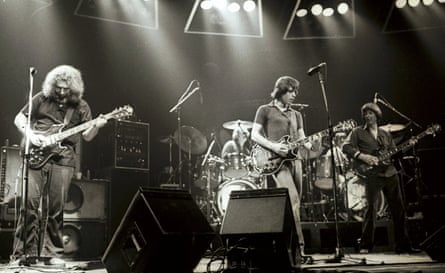
This was Mother McCree’s Uptown Jug Champions, who played folk and country, but by early 1965, inspired by the arrival of the Beatles, they had evolved into a rock band, the Warlocks, with Ron “Pigpen” McKernan on organ, the drummer Bill Kreutzmann and the bass player Phil Lesh.
In the summer of 1965 the Warlocks became the house band at the so-called Acid Tests organised by the author Ken Kesey, promoting the use of LSD, the psychedelic drug that would fuel the hippies and the “flower power” values of peace, love and anti-Vietnam war protests. By the end of 1965 they had become the Grateful Dead, and signed a record deal with Warner Brothers in 1966.
The band only scored one Top 40 hit single, Touch of Grey in 1981 (which reached No 9 in the US), but their devoted live audience made them one of the most successful touring artists of their era, while they also achieved a string of successful albums, including the Top 30 hits Workingman’s Dead and American Beauty (both 1970), and the Top 20 releases Wake of the Flood (1973), From the Mars Hotel (1974) and Blues for Allah (1975). Their highest charting album was In the Dark, which reached No 6 in 1987.
However, it was in live performance that the soul of the band really resided. They were able to capture much of their performance magic on the double LP Live/Dead (1969), which contained the epic Dark Star (which took up the whole of side one) as well as other enduring pieces including St Stephen and The Eleven. Another double LP, Grateful Dead (often known as Skull and Roses after its sleeve artwork), struck a more even balance between extended pieces and shorter songs, with Weir taking lead vocals on several of them including Mama Tried, Playing in the Band and Me and Bobby McGee.
The album’s opening track, Bertha, was a splendid showcase for Weir’s agile and inventive rhythm guitar work, dovetailing perfectly with the heavier tone of Garcia’s lead guitar. Weir himself commented that his guitar playing technique owed much to the left-hand work of the jazz pianist McCoy Tyner, renowned for (among other things) his work with the saxophonist John Coltrane’s quartet.
The triple live LP Europe ’72 showcased further dimensions of their performing and songwriting skills, reaching expressive peaks on tracks such as Jack Straw and Truckin’. Elvis Costello, a Grateful Dead fan, commented how “it’s like weird time travel music … that ability to summon another time, in relatively simple chords – they’re not actually that complex – without really sounding like a pastiche”.
After Garcia’s death, Weir participated in several reunions with his bandmates. In 1998 he joined Lesh and the percussionist Mickey Hart as the Other Ones, who morphed into the Dead and continued touring until 2009. Lesh and Weir then formed Furthur, the name taken from Ken Kesey’s magic bus from the Acid Tests era. In 2015 they were joined by Hart and Kreutzmann to celebrate the Dead’s 50th anniversary with five Fare Thee Well concerts at stadiums in Santa Clara and Chicago.
The Dead story was not quite over, since Weir now formed Dead & Company with Hart, Kreutzmann and additional musicians including John Mayer on guitar and vocals. They played residencies at Sphere in Las Vegas in 2024 and 2025, and celebrated 60 years of the Dead with three shows at Golden Gate Park in San Francisco in August 2025.
Weir is survived by his wife, Natascha Münter, whom he married in 1999, and children, Monet and Chloe.