3 months ago
64
3 months ago
64
In the behind-the-scenes documentary series Taylor Swift: The End of an Era, the singer Florence Welch ascends to the stage to perform their duet Florida!!! to a crowd of 90,000 people. Welch later reflects on their duet at Wembley Stadium with a mix of awe and bemusement. “Taylor is my friend,” she says. “I know her as this very cosy person, and I came out of that lift and I was like, ‘Oh my God, it’s fucking Taylor Swift.’”
If Swift is a cosy person, The End of an Era – now complete, with its concluding episodes dropping today – is certainly a cosy watch; the sort of lighthearted, low-demand viewing that feels especially welcome in the lazy days leading up to Christmas and stretching towards the new year. Viewers will be familiar with the story. The Eras Tour was great, it tells us. It broke records, burst hearts and boosted the economy. We know she pulled it off. This is only a problem insofar as it means there is almost zero jeopardy in the series, which feels repetitive and thinly stretched over its six hour-long episodes.
Only the first episode offered true revelations, dwelling on a genuine moment of peril: the aftermath of a foiled Islamic State plot to target her three concerts in Vienna in August 2024, just over a week after three little girls were murdered at a Swift-themed dance class in Southport. Swift is clearly and understandably shaken, but wills herself not to break down in front of the grieving parents she has invited to the show: she is graceful enough to know it’s not a good look to make their loss about her.
Much less significant, although still a good titbit, was the revelation that it was Swift’s mother, Andrea, who suggested she try dating a fun-loving athlete instead of another tortured poet, namely NFL star Travis Kelce after he said on his podcast that he was “butt-hurt” he hadn’t been able to meet her at an Eras show. The pair are now engaged.
Otherwise, the choice to focus on the tour’s final months – essentially its victory lap – doesn’t particularly make for dramatic storytelling. In this chapter of the tour, Swift is in a happy and secure relationship, and it’s no wonder she had perfected the show with military precision after an entire year of performing it. There are blatant attempts to engineer tension where there is none. We see male dancer Whyley Yoshimura plucking up the courage to ask Swift if he can perform Ready for It?, which is usually an all-female routine (she barely bats an eyelid). There is a plotline concerning a new bodysuit for the Reputation section not being ready in time (it is). One day, Swift has a cough.
There is too little to root for, and too few moments of challenge beyond the sheer superhuman endurance required to deliver a three-and-a-half hour show for 18 months (Swift’s admittedly impressive gym routine montage notwithstanding). Considering the reams written about the tour – the most successful of all time – The End of an Era gives very little insight into the emotional and practical considerations of how they kept this show on the road.
So if we learned little in the way of definitive new information, what story did The End of an Era tell us about the world’s biggest pop star? As with most contemporary music documentaries, it’s an act of brand consolidation. Her devoted dancers, backing singers and session musicians are presented as one big happy “family”, but of course they are her employees, too. “It’s more than a job … I never want this to end,” says one singer, while a dancer remarks that her boss “has made us feel seen, worthy and treated with the utmost respect”, as Swift’s song It’s Nice to Have a Friend plays in the background. Much is made of the diversity of the dancers. It is well documented that Swift gave out a reported $197m in bonuses to the Eras tour crew. Is it necessary to show her employees receiving their cheques as a scene here?
In one perhaps unwittingly revealing part, Swift glancingly mentions the two breakups that took place during the tour’s first run, without naming the men – firstly her partner of six years, the actor Joe Alwyn, and then Matty Healy of the 1975, with whom she had a fling as the tour was underway in spring 2023. “I didn’t feel like a person, but like a large conglomerate that no one sees as human, especially the men I was dating,” says Swift. But each shrewd decision she is shown making seems to underline the fact that she is indeed a corporation, and one with corporate interests.
In the fourth episode, she remarks that the presidential election is in five days but that “the one thing I can provide for people is an escape, like nothing ever could or should ever bother any of us, and nothing will for three-and-a-half hours. I’m glad that I will have given just 100% girlhood and hope and belief and sweat and effort because that’s the job”. She mentions neither Donald Trump nor Kamala Harris, which feels pointedly apolitical, particularly given that she had formally endorsed Harris, the democratic candidate, two months earlier.
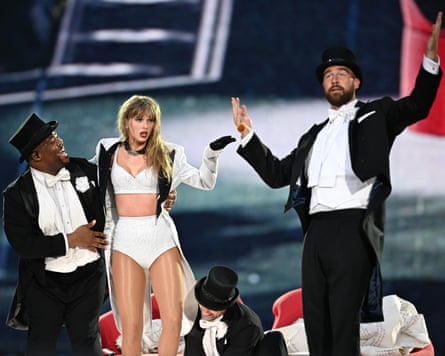
You don’t doubt the sincerity of her relationship with Kelce, pictured sparingly, but it’s also clear how mutually beneficial it is. Swift points out that, once their relationship became public, every 12th person in her audience was wearing a football shirt like his. It’s fun to glimpse her creative process as she secretly recorded this year’s album The Life of a Showgirl with co-producers Max Martin and Shellback in Sweden between Eras tour dates – especially how boozy they seemed, with glögg and sancerre flowing – but the doc glosses over the fact that she made another album on this tour, The Tortured Poets Department, in the wake of the Healy debacle: presumably a more fraught process than the album celebrating her new love. It’s completely understandable that Swift didn’t want the narrative of her failed romantic relationships to overshadow the success and achievement of the tour, but she has offered less and less of herself as she has sold her fans more and more product, including this series.
It’s telling that the most electric moments of The End of an Era are of Swift working out her surprise song mashups for the show’s solo acoustic set, which changed for each performance. In a nondescript backstage dressing room for the final night in Toronto, Swift works out how she’ll transition in and out of Long Live, New Year’s Day and The Manuscript on the piano, three particularly devastating examples of her gift for eulogising her own life. I could have watched six episodes of that – of scenes detailing the ease of her musicianship, and her ability to craft an emotional moment.
“I specifically created this tour on a molecular level to make people feel that sense of escape,” says Swift, and it’s true that the Eras tour offered fans a powerful sensation of belonging. But a question the documentary doesn’t ask is what this kind of undertaking – one whose scale is so big, and whose emotional scope is so reflective, surveying her entire catalogue – offers Swift herself. Archive footage of her as an ambitious and musically talented girl reminds us that she has realised her childhood dream. But it’s not clear what it all means to her as an adult – beyond, once again, the business practicalities. Before the credits roll, text appears on screen saying that the tour’s financial success in part allowed her to buy back her master recordings – her project for the best part of a decade. I can’t help but wonder if there’s more to say.
While the series is called The End of an Era, it is careful not to position Eras as a career pinnacle. At the end of the film, we’re told that The Life of a Showgirl, released 10 months after the tour ended, is her “most successful album yet”. Swift may be breaking new ground commercially, but artistically she has been treading water. In an early episode, she says that her goal with this tour was to “overserve” the fans, which is perhaps the show’s sharpest insight. This series, like all her recent output, is for those who are already onside: a shrewd investment with a guaranteed return.