3 months ago
67
3 months ago
67
In Ethiopia, the birthplace of coffee, more than 4m households rely on coffee as their primary source of income. It contributes almost a third of the country’s export earnings, but for how much longer is uncertain.
“Coffee farmers in Ethiopia are already seeing the impact of extreme heat,” said Dejene Dadi, the general manager of Oromia Coffee Farmers Cooperatives Union (OCFCU), a smallholder cooperative.
An analysis has suggested the countries where coffee beans are grown are becoming too hot to cultivate them because of climate breakdown.
The top five coffee-growing countries, responsible for 75% of the world’s supply, experienced on average 57 additional days of coffee-harming heat annually because of the climate crisis, according to the findings of Climate Central, which researches and reports on the crisis.
Coffee beans are primarily sourced from an area known as the “bean belt” between the tropic of cancer and the tropic of capricorn, and need specific temperature and rainfall conditions to flourish.
The plants, especially the most-prized arabica variety, struggle in temperatures above 30C.
About 2bn cups of coffee are consumed every day, according to the industry. But that industry is under strain. According to the World Bank, the prices of arabica and robusta coffee beans almost doubled from 2023 to 2025. In February 2025, coffee prices reached an all-time high.
Climate Central’s analysis counted the number of days above 30C in coffee-growing regions between 2021 and 2025, then compared them with the number that would have occurred in a world without carbon pollution.
The worst-affected coffee producing country was El Salvador, which they calculated had 99 additional days with coffee-harming heat. Brazil, the world’s most important coffee producer, accounting for 37% of global production, had 70 additional days above 30C. Ethiopia, which accounts for 6.4% of coffee production, had 34.
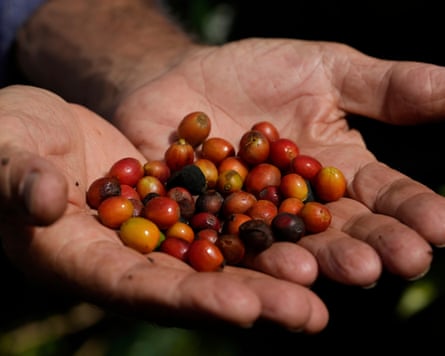
“Ethiopian arabica is particularly sensitive to direct sunlight,” Dadi said. “Without sufficient shade, coffee trees produce fewer beans and become more vulnerable to disease.”
The Oromia co-op has distributed energy-efficient cookstoves to its members to discourage deforestation in the wooded areas that serve as natural shelters for coffee cultivation.
The climate finance needed for meaningful adaptation is lacking, campaigners say. Smallholder farmers produce 60% to 80% of coffee, but received just 0.36% of the funds needed to adapt to the impacts of the climate crisis in 2021, according to a study last year.
Without help, there is only so much they can do, Dadi said. “To safeguard coffee supplies, governments need to act on climate change.”