3 months ago
60
3 months ago
60
After four shark attacks in New South Wales in less than 48 hours, authorities on Tuesday urged beachgoers “just go to a local pool instead”.
Sydneysiders have heard similar warnings before – in the past, they’ve been issued for beaches polluted with faecal matter after heavy rains.
The city’s unique, outdated sewage management system has been linked to “debris balls” which have been washing up with increased frequency on Sydney beaches, including again last week at Malabar.
Experts also say dirty waters can attract more sharks, as the nutrients attract plankton, which in turn attract the fish sharks feed on.
So is there any link between Sydney’s sewage system and the “unprecedented” number of shark attacks in a short space of time? Here’s what experts say.
What do we know about the shark attacks?
The shark attacks happened on the 18, 19 and 20 of January at Vaucluse, Dee Why and Manly in Sydney, and on the mid-north coast. The NSW minister for primary industries and regional development, Tara Moriarty, has described this month’s shark attacks as “unprecedented”.
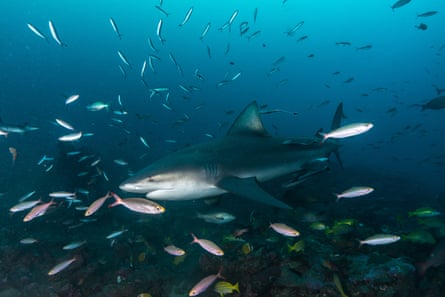
Dr Amy Smoothey at the NSW Department of Primary Industries and Regional Development analysed images of the bites from the recent attacks, and concluded bull sharks were probably involved. Bull sharks prefer water temperatures above 19C, and tend to arrive in Sydney in October, with their numbers peaking in January and February.
Experts have said the attacks were the result of a “perfect storm” of factors, including more people in the water during summer, a rise in ocean temperatures caused by global heating, and murky waters after weekend storms.
Many experts have pointed to the intense rainfall seen in Sydney last weekend, where some areas received more than 50mm in the space of a few hours, as a key factor behind the attacks.
They say the rainfall flushed out brackish water from estuaries into the ocean, which suits bull sharks because they can hunt in low visibility. The murky waters also attract “bait” fish, who feed on microorganisms such as plankton, which themselves thrive on nutrients and bacteria flushed from river, storm water and sewage overflows.
Sign up: AU Breaking News email
“After heavy rain, [bull sharks] move into foraging mode, so they are actively feeding more,” Robert Harcourt, emeritus professor of marine ecology at Macquarie University, said. A paper which analysed tagged bull sharks around Sydney found they followed fish to areas with turbid waters after heavy rains – within a day in the case of male sharks.
So could Sydney’s unique sewage system have played a part?
For Prof Ian Wright, a water scientist at Western Sydney University who worked for Sydney Water between 1989 and 2006, “the answer is yes”.
“There’s a lot more than just that, but that has a role,” Wright said.
After four attacks in close order, Wright said he had been “racking my brain, [asking] ‘why did this happen?’
“Well, we had extraordinary rain, warm water, very poor water quality,” Wright said.
Sydney’s sewage management system is unique among Australian cities in that it only uses “primary treatment”, a process which removes solids – or sludge – before releasing the remaining effluent directly into the ocean.
Other cities use secondary treatment, which involves biological processes such as using bacteria to break down organic material, or more sophisticated forms that remove nitrogen and nutrients from effluent.
Sydney’s system is also very old, with many ageing pipes, plants and sewers – some from the 19th century – unable to keep up with a growing population. During extreme rain events, storm and wastewater overflows can increase the risk of drinking water and the environment being contaminated.
Wright said storm water could have flushed Sydney’s diffuse pollution and “sewage from overflows from a sewage system that does need to be upgraded” into the ocean, ultimately driving shark activity.
“A lot of our urban runoff, especially in the heavily developed areas, becomes dilute sewage. Bacterial levels rise.”
Shark Ethology Australia consultant and academic Victoria Camilieri-Asch said the link between storm, agricultural and wastewater runoff following heavy rain and increased shark activity was “indirect”.
“A lot of those nutrients [in storm waters] … can provide a source of food for tiny microorganisms, then bring those microorganisms that can attract small fish, then larger fish, until it attracts more predators, because more food is around.”
Asked if Sydney’s sewage system could be adding to the effect, Camilieri-Asch said: “It is possible, and bull sharks especially are known to stay within areas where there is wastewater in other countries as well.”
What about the deepwater ocean outfalls?
Another unique feature of Sydney’s sewage system is its deepwater ocean outfalls, built in the late 1980s and early 1990s. Three treatment plants, at Malabar, Bondi and North Head, now pump 80% of the city’s effluent through pipes which extend between 2 to 4km out to sea.
A Sydney Water report from August 2025 pointed to a combination of heavy rain and a buildup of fats, oils and grease at the Malabar plant as the cause of poo balls being ejected from its deep ocean outfall. They washed up on Sydney beaches last summer and again after last weekend’s storms.
Harcourt said it was a “long bow” to link the deepwater ocean outfalls to recent shark attacks near beaches, saying that the “nutrification” process that attracts microorganisms and ultimately shark life had been pushed offshore after the outfalls were built.
Wright also said he did not believe the ocean outfalls were directly responsible.
But Dr Colette Kerry, a physical oceanographer at the University of NSW, said current coastal conditions could mean the ocean outfalls were having an impact. Climate change means the eastern Australian current, which normally veers away north of Sydney, was “about three degrees warmer” than usual for this time of year, and staying close to the coast, she said.
Kerry said that meant it was trapping the nutrient-rich, brackish water washed into the ocean from rivers and estuaries by last week’s storms, but also potentially the effluent discharged from the outfalls.
“The conditions that we have at the moment are more conducive to those [sewage] plumes being trapped close to the coast rather than dispersing,” she said.
What don’t we know?
Guardian Australia put questions to Sydney Water about the potential impact of its wastewater management practices on shark activity. The water utility referred questions to the NSW minister for water, Rose Jackson, who put out a statement after the attacks.
“I can absolutely understand why people are looking for answers as to why there’s been this cluster of attacks, but I would caution against over-simplifying the issue as directly linked to our wastewater network,” she said.
“It’s also important to keep in perspective that whilst heavy rainfall is a common occurrence, shark attacks in Sydney and NSW waters are very rare.”
Jackson said “Sydney Water takes water quality very seriously” and the utility was undertaking a $34bn network upgrade and expansion over the next 10 years, including to the Malabar, Bondi and North Head systems.
The Sydney Water chief executive, Darren Cleary, recently defended the use of the three outfalls at Malabar, Bondi and North Head.
“Deep ocean outfalls have been meeting environmental standards for nearly three decades,” he said.
Cleary said Sydney Water conducted regular testing around the site where diffusers release sewage offshore and Sydney beaches generally had very good water quality.
Camilieri-Asch said this week’s attacks showed wastewater systems and the way they are being managed raised good questions for new research.
Wright said the warnings for swimming water quality and shark safety were now effectively the same.
“If it’s poor water, if it looks dodgy, if it smells a bit off, don’t go in, because it’s not good. You could pick up a waterborne disease, but you could also become prey for a shark.”