2 months ago
75
2 months ago
75
Ten days before schools reopen for the summer term in eastern Zimbabwe, Hellen Tibu is worried about how she will pay the fees for her sister’s education. The 22-year-old landmine-disposal expert smooths the creases from her younger sister’s uniform as it hangs on the washing line outside a relative’s rooms in Sakubva, a densely populated township in Mutare. The shirt is faded around the collar and a new one is needed.
Tibu could afford the school fees and uniform – before the US funding cuts last year meant she no longer had her job clearing landmines. Now she can no longer pay her rent or look after her parents and siblings.
“Life became tough,” she says. “I was the breadwinner in my family.”
From January 2022, Tibu carried out mine disposal with Apopo, an international organisation clearing landmines around Sango, on Zimbabwe’s south-east border with Mozambique, near Chiredzi.
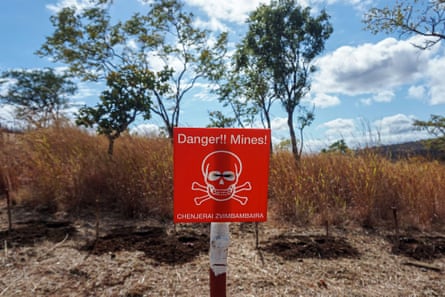
The Zimbabwe-Mozambique frontier is littered with millions of landmines, which were laid between 1976 and 1979 by the former Rhodesian regime during the country’s liberation war. In some areas, there are believed to be 5,500 mines for every kilometre.
More than 1,500 people have been killed or maimed by mines since Zimbabwe gained its independence in 1980, while farmers have lost an estimated 120,000 animals.
Tibu is one of the female deminers at Apopo, who made up more than 30% of the organisation’s staff in Zimbabwe.
Apopo, which says it received 90% of its income from the US state department’s weapons removal office, sent most of its staff home last February after the Trump administration halted funding. It shut down completely in June.
Tibu was earning US$400 (£300) a month when she started the job and by the time she was laid off her salary had increased to $490, more than many government workers such as nurses, teachers and soldiers earn in Zimbabwe.
She started renting a two-roomed house in a suburb of Mutare, in the Eastern Highlands of Zimbabwe. Tibu looked after her parents, a four-year-old sibling and paid the fees for one of the city’s elite schools for her other sister.
But everything changed in February 2025. “I could not believe it,” says Tibu. “This was my first job, so it really hurt. We were given some benefits, but the money could not sustain me for long.”
Barely three months after losing her job, she could no longer pay the school fees and her sister had to move to a cheaper local government school, where she is studying for her O-level examinations.
Tibu was also in arrears at the house she was renting and had to move in with a relative in Sakubva, a township in Mutare.
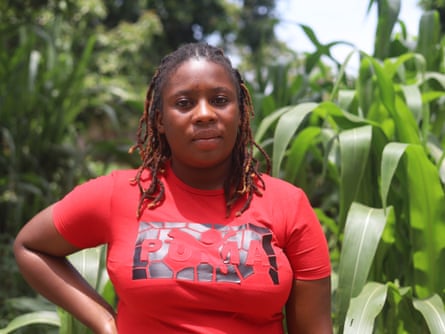
“It was painful to tell my younger sister that I was moving her. She was angry with me,” she says.
Moving to a more crowded area of the city was also difficult, Tibu admits. “I was used to a place which was quiet and calm. It took me a long time to adjust to this place, which is overpopulated, noisy and filthy,” she says.
Tibu, who is surviving by selling secondhand clothes in the city centre at night, says she is struggling to feed her four-year-old sister. “She cries for food every day,” she says.
Most of the international organisations clearing landmines included women in their workforce. Most were single mothers and widows, and the job gave them status as well as financial security.
For some of the women, clearing landmines is personal because it is women and girls who are often most at risk as they are usually the people tilling the land and fetching firewood on farms.
Robert Burny, a former country director at Apopo, says most of their field and office support staff lost their jobs.
“We were deeply saddened by the abrupt grant termination and its consequences. Apopo compensated all staff according to regulations, and we donated or sold some of our working materials at affordable prices to help staff transition,” he says.
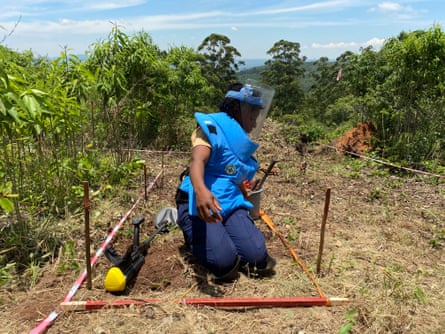
The Halo Trust, a British mine-clearing charity, was also affected by US funding cuts. The trust, which is operating in Rushinga in Mashonaland Central province, on Zimbabwe’s north-east border with Mozambique, had to reduce its staff from 470 in 30 demining teams to 230 in 12 teams in June 2025, according to the programme manager, Oliver Gerard-Pearse.
Funding from other donors, particularly European countries, was also cut.
Marlin Gombakomba, who is also from Sakubva, was recruited by Apopo to remove landmines in the Sango border area in 2021. The 31-year-old single mother used to earn $600 a month, enough to take care of her children and parents.
“Things became different after losing my job,” she says. “I am struggling to provide three meals for the family. We are lucky if we have two.”
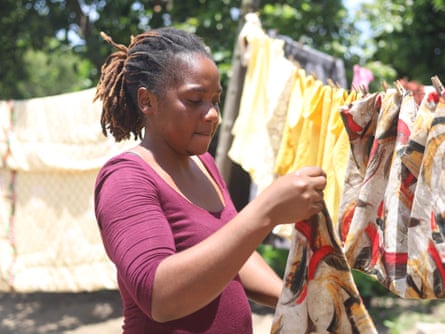
Gombakomba is also selling secondhand clothes in Mutare but she says that what she earns is not enough to pay her rent or school fees for her children, who are still in primary school.
“I cried one day after I failed to pay fees for my eldest daughter to go on a school trip,” she says. “It was difficult for me; it is not easy as a parent.”
Gerard-Pearse says making the decision to reduce the workforce in any Halo programme is always one of deep regret because such decisions are never taken lightly.
“In an organisation that exists to save lives and restore livelihoods, people are our greatest asset. Every role lost affects not just an individual, but their family and the communities we serve,” he says.
“In order to continue our vital humanitarian work, sometimes difficult choices have to be made, and we strive to support every colleague affected. A decision like this underscores the need to work even more closely with partners, donors and governments to prevent future job losses.”
Back in Sakubva, Tibu is working to earn the money to pay for her sister to register for her exams in March.
“I am not sure if the [mine]-clearing organisations will secure funding. But if an opportunity to clear landmines abroad comes, I will grab it,” she says.