3 months ago
65
3 months ago
65
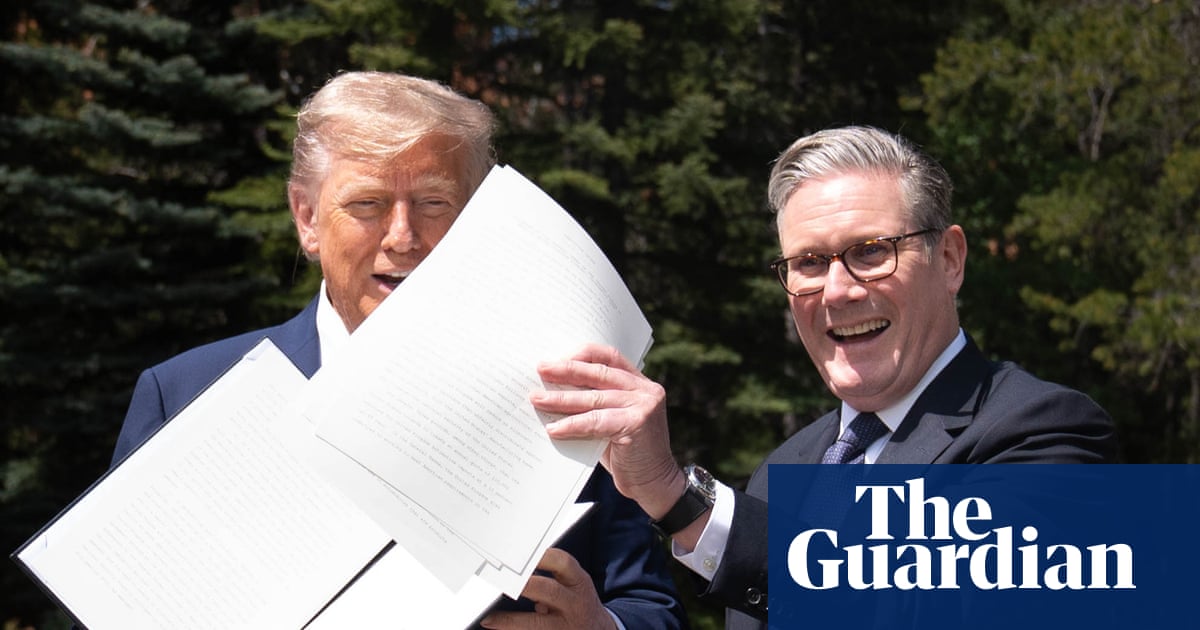
Bessent on tariffs: don't retaliate; sit back and let things play out
Scott Bessent then warns other countries not to retaliate against the US’s trade tariffs announced over the Greenland crisis.
Asked about the uncertainty that companies face, and why any country should enter a trade deal with the US, Bessent tells his press conference here in Davos:
I would say this is the same kind of hysteria that we heard on April 2nd. There was a panic.
[That was the day of Trump’s initial Liberation Day tariffs, which were reversed after a market panic].
Treasury secretary Bessent adds:
What I am urging everyone here to do is sit back, take a deep breath, and let things play out.
The Treasury Secretary reminds us that China’s escalation last year led to 145% and 125% tariffs between the two countries, before that relationship was stabilised.
What president Trump is threatening on Greenland is very different than the other trade deals. So I would urge all countries to stick with their trade deals.
Key events Show key events only Please turn on JavaScript to use this feature
The hall here at Davos is pretty packed to hear from the European Commission chief:
One of the biggest beneficiaries of attention from an erratic Trump may be the EU. I’ve never seen Davos’ congress hall so crowded for a WEF special address by Ursula von der Leyen. #WEF26 pic.twitter.com/w3duiv1Mvc
— Holger Zschaepitz (@Schuldensuehner) January 20, 2026Europe 'on cusp' of historic trade deal with India
On trade, Ursula von der Leyen points to the Mercosur trade deal agreed with South America.
Mercosur shows the EU is serious about free trade, to derisking our economies and diversifying our supply chains, she says.
And she then declares that Europe is on the cusp of a historic free trade agreement with India, but there is still work to do.
Von der Leyen says she will visit India next week, telling Davos:
“There is still work to do. But we are on the cusp of a historic trade agreement. Some call it the mother of all deals.
One that would create a market of two billion people, accounting for almost a quarter of global GDP.”
Von der Leyen tells Davos: We must build stronger European independence
European Commission president Ursula von der Leyen is now giving a special address to Davos – you can watch it at the top of this blog.
Von der Leyen starts by saying the world has transformed completely since the first WEF annual meeting in 1961.
She applauds this year’s theme, “A spirit of dialogue”, saying it is:
All the more important in a world that is more fractured and more fractious than ever.
1961, she reminds us, was the year of the Nixon shock when the then US president broke the link between gold and the dollar – (ending the Bretton Woods system of fixed exchange rates created after the second world war).
That move, although disruptive, resulted in a new global order, and “a sharp lesson to Europe to reduce their dependencies”, she says.
The world may be very different today, von der Leyen adds, but she believes the lesson is very much the same – that “geopolitical shocks can and must serve as an opportunity”.
The seismic changes taking place today means it is a “necessity” to build a new form of European independence, von der Leyen adds.
She denies this is a reaction to recent events; actually it’s been an imperative for some time.
If this change we are seeing today is permanent, then Europe must change permanently too, von der Leyen insists, declaring it is time to seize this opportunitty and build a new independent Europe.
“Protectionism is on the rise around the world,” warns Guy Parmelin, President of the Swiss Confederation, as he welcomes WEF delegates to this year’s meeting.
In the WEF congress hall, interim co-chairs Larry Fink and André Hoffmann are delivering welcoming remarks.
It’s not going completely smoothly, Hoffmann’s speech hits a hitch, and he has to be passed a fresh copy of the address from the audience.
UK CEO confidence dips
Even before these latest trade tensions, confidence among global CEOs was weakening.
A new survey of CEOs conducted by PwC found that only three in 10 chief executives were confident in their companies’ revenue growth prospects over the next year, the lowest level in five years.
The annual poll, released at the start of the World Economic Forum’s annual meeting, also found that CEOs are grappling with uncertainty over global political developments, increased cyber threats and technological change.
UK CEOs were notably more pessimistic towards the end of last year; a quarter (25%) expect the domestic economy to decline over the next 12 months - compared to 13% in 2025.
PwC’s survey took place in the run-up to November’s budget, when there was a high level of speculation about what Rachel Reeves might do.
Amid this uncertainty, Germany and India have joined the UK as the second most important destination for investment for global CEOs.
Marco Amitrano, senior partner of PwC UK, insists that the dip in CEO confidence doesn’t mean Britain is broken (as some politicians have claimed).
He says:
“Being the world’s second-most important investment destination for a second-year running should not be underestimated. It demonstrates that the UK still looks stable in a turbulent world.
But in now sharing that position it’s also a wake-up call – other countries are gaining ground and working hard to market themselves globally. As a leading nation, this now points to the need to step up our game, with government and business working together. This means action to support growth sectors, make the most of trade opportunities, and provide the consistency and clarity that underpins investor confidence.
Falling inflation will help lay the groundwork for this, which will in turn build momentum, improve productivity and create opportunity.”
Global stocks tumble while gold and silver rise

Julia Kollewe
Global stock markets and the US dollar have tumbled while gold and silver prices hit record highs, as Donald Trump stepped up his rhetoric over Greenland, threatening fresh tariffs on countries opposed to the sale of the Danish territory to the US.
In Asia, Japan’s Nikkei fell by 1.1%. The main European stock markets are all down around 1.1%, with the UK’s FTSE 100 index losing 1.1%, or 111 points, to 10,083.
US stock markets (which were closed for Martin Luther King Day yesterday) are also set to sell off when Wall Street opens later. The Dow Jones is expected to drop more than 700 points, or 1.4%, while the S&P 500 is seen down more than 100 points, or 1.6%, and the Nasdaq is set to tumble 466 points, or 1.6%.
The dollar fell by 0.8% against a basket of major currencies.
The price of gold, seen as the ultimate safe haven, rose 1.3% to $4,728 an ounce. Silver touched a fresh peak of $94.77 an ounce and is now down 0.5% at $94.23 an ounce.
Meanwhile, yields on UK government bonds, known as gilts, rose, indicating higher borrowing costs. The yield, or interest rate, on the 10-year gilt, the benchmark bond, rose 5 basis points to 4.467%, the highest since 6 January.
Today, the US president threatened to impose 200% import duties on French wines and champagne, amid reports that the French president, Emmanuel Macron, does not want to join his so-called Board of Peace for Gaza.
Scott Bessent, the US Treasury secretary, then warned other countries not to retaliate against the US’s trade tariffs, speaking at a press conference in Davos today.
Trump declared in a Truth Social post on Saturday that eight European countries including the UK, France and Germany, will face tariffs “until such time as a Deal is reached for the Complete and Total purchase of Greenland”. The tariffs are due to start at 10% on 1 February, rising to 25% on 1 June.
Trump also hit out at the UK today, calling the plan by Keir Starmer’s government to hand over sovereignty of the Chagos islands, which host a joint UK-US military base, to Mauritius “an act of great stupidity”.
Georgieva: Would be good to avoid tit-for-tat trade war
The head of the International Monetary Fund has urged world leaders to avoid a new tit-for-tat trade war.
Speaking to CNBC here in Davos, Kristalina Georgieva warned that renewed trade tensions woud hurt global growth.
Georgieva says:
We had upgraded projections for this year. One of the factors for the upgrade is that the impact of tariffs was muted, there was no tit for tat trade war, and it would be very good if we keep it this way. It would be good for the world economy. It would be good for individual countries.
Incidentally, the Deutsche Bank report into the possibility that Europe might stop buying US government debt due to the Greenland crisis, cited by Scott Bessent today, was released on Sunday.
In it, Deutsche Bank analyst George Saravelos wrote:
Europe owns Greenland, it also owns a lot of Treasuries. We spent most of last year arguing that for all its military and economic strength, the US has one key weakness: it relies on others to pay its bills via large external deficits. Europe, on the other hand, is America’s largest lender: European countries own $8 trillion of US bonds and equities, almost twice as much as the rest of the world combined. In an environment where the geoeconomic stability of the western alliance is being disrupted existentially, it is not clear why Europeans would be as willing to play this part. Danish pension funds were one of the first to repatriate money and reduce their dollar exposure this time last year. With USD exposure still very elevated across Europe, developments over the last few days have potential to further encourage dollar rebalancing.
Finally, Bessent is asked if he sees Europe as an ally of the United States – and if so, how much economic pain the US is prepared to inflict on the EU.
Bessent returns to his ‘false narrative’ position – accusing the media of “going to the farthest point” rather than waiting for events to play out.