2 months ago
72
2 months ago
72
For a few frenetic days last January, after losing their midcentury ranch home to the wildfires that ravaged Los Angeles, Jessica and Matt Conkle thought they could see a glimmer of hope.
Their insurance company, State Farm, had sent emergency response teams to Altadena, where they lived, and they filed a claim right away. It wasn’t long before they received a check that covered four months of living expenses.
Then the process bogged down. Like many homeowners, they imagined that since they had suffered a total loss they could collect on the full value of their coverage. Instead, they had to negotiate over the value of each of their lost possessions with a claims adjuster, only to have to start again with a second adjuster and then a third – a process they believe was expressly designed to deter them from moving forward.
Months went by with no discernible progress. They felt they were being shortchanged on item after item, and when they attempted to challenge the valuations State Farm was offering, they struggled to get anyone to respond.
They questioned, for example, why the company thought their Waterford crystal collection would have lost more than 50% of its value when they had owned it for just two years. The insurance company asked for photos to check its condition and appeared unmoved when the Conkles said their photo collection had burned up, along with everything else.
“It was all delays and denials,” Jessica Conkle, a public education administrator, said. “It felt like someone was training these people not to answer our questions.”
It was a similar struggle with the cost of rebuilding. State Farm’s first offer was significantly below the market rate, the Conkles said, and they spent months haggling to increase it. To this day, they said, the money is in an escrow account, out of their reach pending a settlement with no provision for architects’ fees or the cost of city planning permits, without which they could not start the rebuilding process.
“We’re at a real breaking point,” said Jessica. “It’s consuming all our time … and it’s exhausting, having to fight for what should be a relatively straightforward transaction. The way they are treating people who have lost everything is literally inhuman.”

Fire survivors seeking to collect on their insurance policies in other fire-ravaged neighborhoods across the LA region report similar frustrations. Recent reports by Department of Angels, a non-profit set up by government experts in the wake of the fires, echoed the Conkles’ experience, as almost eight out of 10 surveyed homeowners reported a variety of obstacles including multiple adjusters, lowball estimates, fights over property lists, and poor communication. People whose houses were damaged reported even more severe frustrations with their insurance companies than those who lost everything.
It’s a sign of how Los Angeles’s post-fire recovery has exemplified a much broader crisis facing the insurance industry in an age of climate volatility, raising troubling questions about the stability of home ownership and housing affordability – the bedrock of the American middle class.
Insurance companies citing the increasing risks and costs of climate-driven natural disasters – including fires, hurricanes and tornadoes – have lobbied state regulators into granting steep premium increases, squeezing all but the wealthiest homeowners and leaving many under-insured, if they can find insurance at all.
Many providers have scaled back coverage in high-risk areas or stopped writing new policies altogether, leaving many consumers in the hands of state-sponsored emergency insurance plans that tend to offer inferior coverage and often struggle to stay afloat financially. In California, reliance on this last-resort option known as the Fair plan has soared.
At the same time, the insurance companies themselves have never had it better. The US industry generated record profits of $169bn last year and is on target for another bonanza year in 2025, despite the Los Angeles fires and other natural disasters. The bulk of these profits come from companies investing premium income in the financial markets, which have been booming.
This disparity in fortunes between the insurers and their customers infuriates fire survivors like the Conkles and is now fueling a movement, across California and beyond, to demand an end to the industry’s lobbying grip on state regulators and lawmakers, and a more equitable solution that spreads the undeniable risks associated with the climate crisis more broadly.
“We need regulators who are willing to fight for consumers, and around the country including here in California the regulators have responded with deference to insurance companies,” charged Douglas Heller, director of insurance at the Consumer Federation of America. “That’s a mistake, and we’re paying for it.”
Fighting for claims all the way to the top
Not all insurance companies have attracted the same anger. The bulk of complaints from LA fire survivors, documented both by Department of Angels and local activists in the affected areas, have been directed at State Farm, the region’s largest writer of homeowner insurance, and at the Fair plan.
“Delays, lowball offers and outright denials,” is how one activist, Joy Chen of the Eaton Fire Survivors Network in Altadena, characterizes the obstacles her members have faced from their insurance providers.
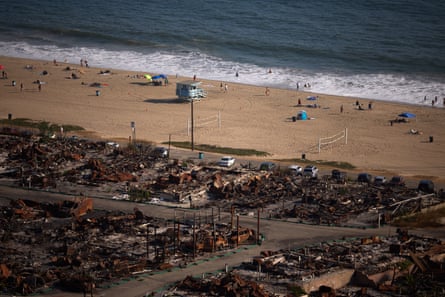
The insurance industry itself insists it is working diligently to process its claims. State Farm says it has paid out more than $5bn on about 13,500 claims between Altadena and the coastal communities of Malibu and Pacific Palisades and expects that figure to reach somewhere between $6bn and $7bn. “Insurance claims can be complex, especially after disasters,” the company says. “We are committed to clear communication, listening to customer needs and addressing concerns promptly.”
State Farm offered no response to questions about the Conkles’ criticisms of their claim process or any other specific complaint about its performance.
At the same time, insurance industry advocates bristle at what they describe as over-restrictive price controls, and say if they cannot increase premiums to cover catastrophic climate-related losses, they cannot remain profitable.
When State Farm and others stopped writing homeowner insurance in fire-prone areas in 2023, citing what State Farm calls a “lack of alignment between price and risk”, they spooked state officials into granting a major rate increase.
But the insurance cancellations continued regardless. And a provision that supposedly obliged insurance companies to keep writing policies in “distressed” areas at 85% of the rate it wrote them elsewhere proved to be largely hollow. A New York Times investigation found that the definition of these “distressed” zip codes was so broad it allowed the companies to fulfill their obligation with properties outside fire zones, while they continued to drop their highest-risk customers.
Consumer advocates accuse insurance companies of over-emphasizing fluctuations in their income based on the difference between premiums and claims, when in fact they make the bulk of their revenue – and profits – in the markets.
“At every regulatory meeting, they ask, how can you expect us to sell policies when we have a loss on our underwriting in your state or community?” Heller said. “The truth is, the insurance industry has had underwriting losses in nine of the last 15 years, but in every one of those years the industry has been profitable because of investment income.”
Heller also challenged the notion that California’s system of price regulation was an obstacle to industry profitability. He pointed to other, far less regulated states in the midwest and south where insurance companies have imposed dramatic price increases and still canceled policies at an alarming rate. Wildfires turn out to be a relatively modest industry concern, accounting for about 5% of catastrophic claims, according to industry data. Hurricanes account for about 12%, while tornadoes and other convective storms, increasingly common across the midwest, account for a staggering 40%.
Another target of popular outrage has been California’s department of insurance, the state’s industry-regulation arm seen by its critics as a classic case of an agency “captured” by the corporate interests it is supposed to police. Consumer advocates give particularly low marks to the current commissioner, Ricardo Lara, who acknowledged last summer that his department had allowed itself to be “bullied” by the industry into climate change-related accommodations, including steep rate increases.
Consumer advocates as well as fire survivors accuse the department of failing to enforce existing California law or to impose meaningful new regulations in the wake of the fires to ensure fair treatment of homeowners who have paid for coverage and should now be receiving it.
“This crisis isn’t inevitable. It’s a failure of leadership and enforcement,” says Chen, who has been at the forefront of calls for Lara’s resignation. “Our recovery can’t wait another year without insurance benefits being paid out. And California can’t afford another year of an insurance business in collapse.”
Lara’s office did not respond to a Guardian request for comment.
One effect of the LA fires is that aggrieved consumers are paying far closer attention to both the insurance industry and the state officials it lobbies. Chen, the Eaton fire network’s hard-charging leader who has a rich background in state and local politics, realized early on that insurance companies are obliged to use the same claims-processing criteria with all customers. Simply by cataloguing everyone’s experiences on a spreadsheet and noting the differences, her organization could start to put pressure on the industry.
Chen noticed one particularly troubling recurring problem: that State Farm and other companies were either failing to test smoke-damaged homes for carcinogens and other toxins, or declaring those homes to be safe for habitation, whereas subsequent independent testing came to dramatically different conclusions. For years – until its approach was declared illegal in court – the state Fair plan had a policy that said if you couldn’t see or smell smoke damage, then a home was by definition safe.
After trying and failing to get Lara to address this and the other claims-processing issues, Chen switched gears and brought her evidence to Los Angeles county officials, who are not under the same sway of industry lobbyists and soon announced a major investigation into State Farm’s “failure to comply with various state insurance laws and regulations”.
The county’s consumer protection division demanded a full documentary record of the company’s fire-related work and threatened to impose fines for any instance of wrongdoing it uncovered. Chen said that as soon as the county announced its investigation, State Farm unblocked claims that had been in limbo for months and started cutting checks for hundreds of thousands of dollars.
State Farm is yet to respond to any of the specific charges listed by the county, saying only that the investigation will be a “distraction from our ongoing work in California to help our customers recover from this tragedy”. Asked whether payouts had accelerated in the wake of the investigation starting, a company spokesperson offered no response.
Insurance in an age of climate extremes
Behind all this wrangling lies the obstinate fact that catastrophic events have become more common and are likely to become dramatically if not exponentially worse as global temperatures increase.
Last year, according to the risk-management firm Aon, the global insurance industry saw $145bn in underwriting losses from natural catastrophes, a figure that exceeded the 21st-century annual average by a staggering 54%. Losses in 2025 were greater than $100bn in the first half of the year alone.
As private insurance companies across the US become more leery of taking on risk, state-sponsored emergency funds like the Fair plan are playing a bigger role – a Band-Aid solution, experts and government leaders say, that is neither financially sustainable nor sufficient to cover catastrophic losses when they occur.
Dave Jones, who served two terms as California’s insurance commissioner in the 2010s and now leads a climate risk thinktank at the University of California in Berkeley, agrees with the insurance industry that the surge in natural disasters is very far from business as usual but sees the crisis as too big and too complex to be tackled through industry-based solutions alone.
“We’re not going to price-increase our way out of a climate crisis … and we’re not going to deregulate our way out of a climate crisis,” he said.
Jones argues that insurance companies should use their clout as institutional investors and divest from, and even sue, the fossil-fuel companies that have driven the climate crisis.
At the same time, Jones believes consumers need stronger protections to ensure they have access to insurance in the first place, and to credit them for actions they take to protect their home from the risk of wildfires or other catastrophes – something that does not often happen now.
He also believes homeowners should be given regular, realistic updates on the cost of rebuilding in the case of a total loss so they do not go under-insured. That’s been a problem for many wildfire survivors including the Conkles, who are insured for about $400,000 less than the $1.4m they believe it will cost to rebuild their house. Jones said insurance companies are increasingly turning to algorithms to calculate replacement costs, and those calculations tend to skew low, further exacerbating the problem.
That said, even the most enlightened regulatory framework and more responsible industry behavior are not going to tackle the problem at its root, as Jones sees it. “We’re marching toward an uninsurable future because we’re not doing enough or going fast enough to transition from fossil fuels and other greenhouse gas industries,” he said. “The background of climate change is overwhelming and will continue to overwhelm price increases and other regulatory changes. The news is not good.”
Jones foresees a future of much higher prices and dramatically scaled back coverage in high-risk areas, with state governments possibly stepping in to provide home insurance subsidies to lower-income families along the lines of healthcare insurance subsidies offered by the Obama-era Affordable Care Act.
None of that grim outlook has prevented insurance companies from seizing opportunities to make money in the short term, whether through investment income or lobbying efforts that have allowed them to squeeze consumers with higher rates and slow payout schedules.
Chen sees that as an inexcusable form of opportunism at a time when people and communities are suffering, and she expects insurance companies to do a lot better.
“We’re not against the industry,” she said. “We are simply against illegal conduct.”