2 months ago
57
2 months ago
57
On Thursday 8 January, in a midsize Iranian town, Dr Ahmadi’s* phone began to buzz. His colleagues in local emergency wards were getting worried.
All week, people had taken to the streets and had been met by police with batons and pellet guns. With treatment, their injuries should not have been too serious. But emergency room staff believed many wounded young people were avoiding hospitals, terrified that registering as trauma patients would lead to their identification and arrest.
Quietly, Ahmadi [who remains anonymous due to fear of reprisals, but whose identity, credentials and presence within Iran during the unrest have been verified by the Guardian] and his wife began treating patients at a location outside Iran’s government hospital system. Alerted by a local whisper network, wounded young people flocked to them. Mostly, they brought superficial injuries – laceration wounds needing stitches and antibiotics. As Thursday evening wore on, more and more arrived to be patched up.
The next day, everything abruptly changed. Protesters kept coming, but their injuries were close-range gunshots and severe stab wounds, typically to the chest, eyes and genitals. Many proved fatal.
Ahmadi was shocked by the number being killed – more than 40 in his small town alone – but with the internet blacked out, no one knew what the national picture was. To piece it together, Ahmadi assembled a network of more than 80 medical professionals across 12 of Iran’s 31 provinces to share observations and data, and to build a clearer picture of the violence.
Their observations, shared with the Guardian and combined with accounts from morgues and graveyards across the country, begin to reveal the vast scale of violence inflicted on Iranians during the state’s crackdown. Ahmadi and his colleagues are hesitant to provide a figure for the toll but agree “all publicly cited death tolls represent a severe underestimation”. Comparing the number of dead they witnessed with hospital baselines, they estimate it could exceed 30,000, far surpassing official figures. This is based on the conclusion that “officially registered deaths related to the crackdown likely represent less than 10% of the real number of fatalities”.
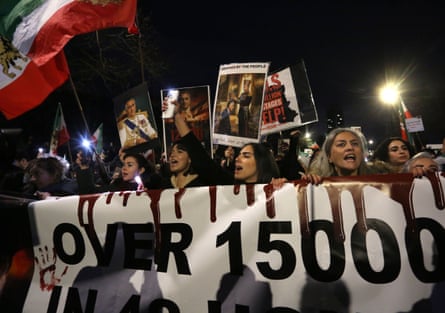
Estimates of the number killed vary substantially, hampered by the ongoing internet shutdown. The Iranian government has acknowledged more than 3,000 dead, and the US-based organisation HRANA (Human Rights Activists News Agency), whose figures have been reliable during previous crackdowns, says it has verified more than 6,000 dead and has more than 17,000 more recorded deaths under investigation, giving a possible total of about 22,000. Other estimates from doctors based outside Iran range up to 33,000 or more.
Testimony from morgues, graveyards and hospitals around the country reveal concerted efforts by authorities to conceal the true size of the toll: bodies being transported in ice-cream vans and meat trucks; piles of the dead being hastily buried; and hundreds of bodies apparently disappearing from Iran’s network of forensic facilities.
The language Ahmadi uses is measured and clinical, but he is brought to tears describing the violence the doctors documented. “From a medical standpoint, the injuries we observed demonstrate a brutality without limit – both in scale and in method,” he says. Another doctor, who is based in Tehran, tells the Guardian: “I am on the verge of a psychological collapse. They’ve mass murdered people. No one can imagine … I saw just blood, blood and blood.”
Across Iran in morgues and cemeteries, the bodies piled up – overwhelming many hospitals and forensic units, which were forced to turn trucks filled with corpses away. Graveyard and forensic medical staff describe chaos, with reports of authorities pushing for fast, mass burials to conceal the number dead.
At one morgue, staff say they were confronted with several trucks loaded with bodies, far exceeding the facility’s refrigeration and storage capacity. When staff protested that they could not process the volume of corpses, two trucks loaded with the dead were moved elsewhere – but when the morgue workers tried to track down where the bodies had been taken, they found none of the large forensic facilities in the region had received them. The doctors “expressed suspicion that this was linked to dafn-e dast-e jam’i [mass burial]”.
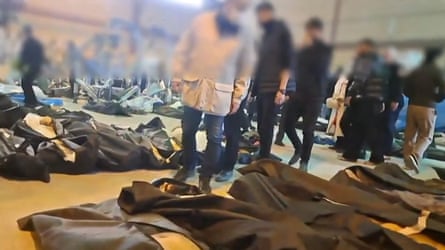
Ahmadi’s network found at least seven other colleagues from forensic facilities across four large provinces who reported similar experiences. Verified video from Kahrizak morgue in Tehran shows similar scenes, including what appear to be hundreds of bodies laid out in the street outside the facility.
The Guardian also spoke to three witnesses who independently described a push for mass burials and piles of hundreds of bodies at a large graveyard (Behesht-e Sakineh) in the city of Karaj, 30 miles (50km) west of Tehran.
In a written account shared with the Guardian, Reza*, a witness who says he was present at Behesht-e Sakineh, says: “On January 10 and 11, they brought in hundreds of bodies which were said to be unclaimed and unidentified.” Many of the dead, he says, were transported in small pickup trucks typically used for fruit and vegetables, and not all were sealed in body bags.
“These vehicles make dozens of trips back and forth from storage facilities … I have seen bodies in these trucks so stuck together it required strength to pull them apart. The blood was still fresh and dried up when they overcrowded them in piles.”
His description is echoed by Ahmadi and his network, who say they observed a pattern across multiple towns of “refrigerated trucks normally used for ice-cream or meat” that were “moving in convoys to forensic medicine facilities and hospital back entrances”.
One witness at Behesht-e Sakineh, who was granted access to the site to look for the body of a friend, says he personally searched through hundreds of “stacked” bodies and was told by graveyard staff that they had “received thousands of bodies just in the past two days”.
Staff told him that “the order was to bury these bodies in mass graves,” but many refused, afraid of reprisals. He relayed one staff member saying: “I am frightened to do that, because people … will eventually come looking for their missing family members and they will kill and bury me as being responsible for these mass graves.”
The accounts from Behesht-e Sakineh form just one example of what appears to be a national pattern, with forensic medical staff around the country reporting similar scenes. Doctors and morgue staff emphasise that the types of injuries seen on patients and corpses indicate deliberate, systematic killing and maiming of protesters as opposed to random, chaotic shooting.
In some cases, the killings bore the hallmarks of executions. Medical workers at forensic facilities in two different Iranian towns described receiving bodies with close-range gunshot wounds to the head that had been transferred from hospital morgues while still attached to catheters, nasogastric tubes or endotracheal tubes.
“This is highly suspicious,” Ahmadi says. “As a rule, foreign medical instruments are removed after death. Their presence suggests that these individuals died while still under active medical care.”
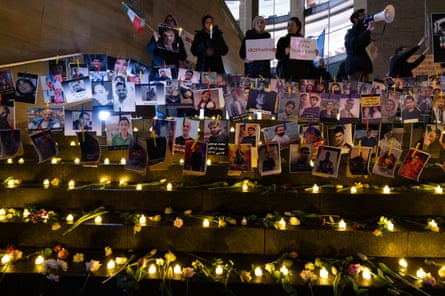
Those accounts correspond to photographs verified by the Iranian factchecking organisation Factnameh, which show dead patients in body bags wearing hospital gowns, with catheters still attached, and what appear to be gunshot wounds to the forehead. The Guardian has not independently verified the photographs. A UK-based Iranian doctor who analysed the photographs said: “From a medical point of view, it appears the bodies seen with catheters and medical devices attached were shot directly in the head while under treatment.”
Even as medical staff attempt to share their testimony and data, many fear that the true number of dead may never be known, concealed by an orchestrated national effort by authorities to obscure the death toll.
“These mechanisms include discouraging hospital attendance, removing bodies from standard forensic pathways, relocating large numbers of corpses beyond documented facilities, and limiting the ability of medical staff to register causes of death,” the doctors’ observations conclude.
Taken together Ahmadi says, “they form a system designed not only to suppress protest, but to suppress memory”.
*Names have been changed to protect identities.