3 months ago
85
3 months ago
85
Friday
It’s a seven-hour trip from one end of the opening ceremony to the other. I leave Milan at midday and arrive in Cortina just as the athletes are making their parade around the town square. Cortina’s a one-street town, and it’s been closed down, but everyone’s hanging off the balconies. I see three men in lederhosen, five in identical Wayne Gretzky jerseys, and more people than I can count in luxurious furs. The first person I talk to is a member of the Qatari police force, who is working here as part of a security agreement between the two countries. This is the sixth Olympics I’ve worked on, but the others all took place in summer. I’m pleased to see he looks even more out of place than me.
Saturday
The Ice Arena in Cortina is the only sports venue I’ve ever been to with a memorial on the wall for a famous photoshoot. Apparently it was here, in 1958, that the legendary Italian photojournalist Giancolombo took his famous images of Brigitte Bardot skating, “capturing the Dolce Vita of Cortina”. Sophia Loren and Ingrid Bergman were both photographed here back then as well, and they filmed the James Bond movie For Your Eyes Only here, too. It is a stunning building. Or it was, before they redeveloped it for these Olympics. Seventy years later, I’m here watching Bruce Mouat and Jen Dodds play Brett Gallant and Jocelyn Peterman in session seven of the mixed doubles curling.
Sunday
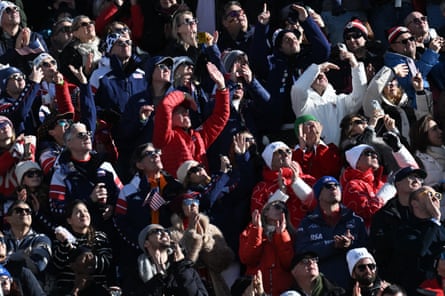
There is nothing like the moment a crowded stadium falls entirely silent in shock. I’ve been doing this 20 years, and I’ve only heard it happen once, when Jofra Archer hit Steve Smith on the head with a short ball at Lord’s in 2019. Today it happens again when Lindsey Vonn crashes 12 seconds into her run in the women’s downhill and tumbles down the mountain. It felt like all Cortina had come up into the mountains to watch what was the most eagerly anticipated event of these Games. As Vonn goes down, people scream, then stop making any noise at all. The mood has changed in a split second of sudden violence that leaves everyone praying that she’s OK.
Monday
These Games are being spread across northern Italy, and the organisers have told everyone participating in them to put their trust in the bespoke travel app that will help us navigate our way around the venues. Today it tells my colleague Tom Jenkins that a bus to the ski jumping is coming at midday. Three hours later he’s still waiting. I’m lucky, mine is only 30 minutes late. Tom has found someone who talks Italian and I put them on loudspeaker while she shouts directions to my driver to come and pick them up. From there, it is a three-hour trip across an endless twist of vertiginous hairpin bends to Predazzo.
I spend the evening asking Norwegian fans about ski jumpers’ penises. None of them think the scandal is remotely funny.
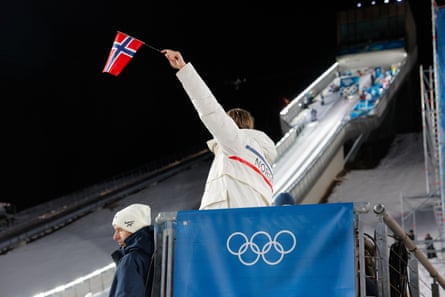
The last bus back is 45 minutes after the finish and to catch it we have to get the public shuttle into town along with 5,000 other people. We end up walking down the highway, Tom dragging his suitcase full of photo kit behind him. We manage to flag down the last bus as it passes us. The engine is spluttering and the driver stops to give it a kick before we head over the mountains at midnight. He doesn’t speak English. The way he shrugs at us isn’t very reassuring.
Tuesday
While we were away Mouat and Dodds lost their semi-final against Sweden. Today they are beaten by Italy in the bronze medal match. It is Great Britain’s third fourth-place finish in the space of 24 hours. Afterwards the team chef de mission, Eve Muirhead, gives us a short interview. She uses the phrase “stay positive” four times in the space of three answers.
Wednesday
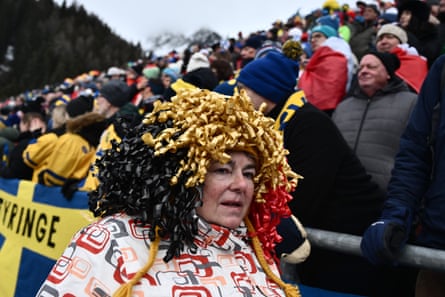
Someone decides Tom and I need to be at the biathlon. It turns out this is being held in what seems to be the last village in Italy before the Austrian border. The app, which I’m coming to think only exists to give everyone something to stare at while they’re waiting, tells me this is a simple two-hour trip involving four connecting buses and a train. It turns out to be worth it. Biathlon – who knew? – turns out to have the biggest, and most devoted crowds of any sport I’ve attended yet. Everyone’s in fancy dress. It’s like a night at the darts.
I’ve come to write about one of the two Greenlandic athletes competing here, and I end up in a conversation with the territory’s minister for sport, culture, education, and church. She tells me she thinks Donald Trump is “crazy”. The race is won by the Frenchwoman Julia Simon, who has recently been convicted of committing credit card fraud against one of her own teammates, and who gives an enjoyably haughty press conference in which she absolutely refuses to talk about it. It’s gone midnight before we’re back.
Thursday
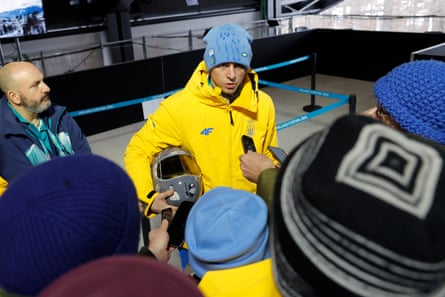
Up at dawn to make it to the sliding track in time for the first heat of the men’s skeleton. It ought to be a British story, the world champion, Matt Weston, sets back-to-back track records, but everything is overtaken by the IOC’s decision to disqualify the sledder Vladyslav Heraskevych after he refuses to remove his helmet decorated with images of dead Ukrainian athletes.
They announce this by press release 20 minutes before the start of the competition, and the upshot is that the world’s media spend the entire event with their backs to the actual racing while Heraskevych gives a press conference near the finish line. I’m convinced that the sight of him holding his helmet, talking to the massed ranks of the press, ought to be one of the iconic images of the Games, but of course it’s not one the IOC will be pushing out across any of their media streams.