26 minutes ago
5
26 minutes ago
5
Early voting begins in midterms as cost of living and Iran war loom large
Good morning, and welcome to our US politics live blog. The midterm elections are less than two months away, but some states begin early voting today, marking the start of a crucial stretch of campaigning for control of Congress.
Virginia begins early in-person voting, while voters in Minnesota, Idaho and South Dakota can cast absentee ballots in person, as the campaign turns increasingly on the cost of living and the continuing war in Iran.
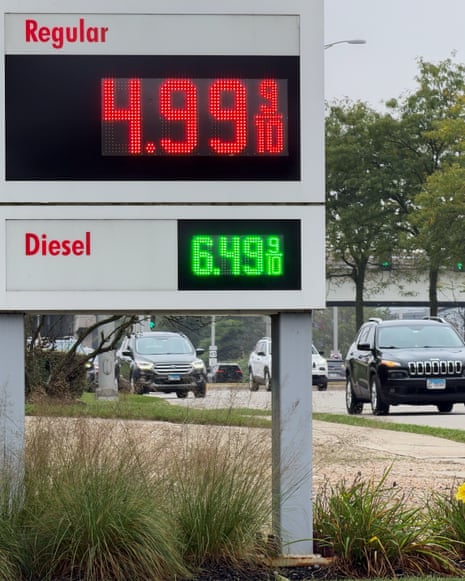
High gas prices and low approval ratings are adding to the challenges facing president Donald Trump as Republicans head into the 3 November elections with their control of the House and Senate at risk. In its analysis of the US economy, the Wall Street Journal reports that mortgage rates are nearing 7%, consumer prices rose 3.4% in the year to August and gas prices are close to their highest levels since 2022.
“We are seeing what happens when a president launches a war of choice without anticipating the unintended consequences,” Aaron David Miller, a former adviser on Middle East policy to Republican and Democratic administrations, told Reuters.
Trump will take his case to the UN on Tuesday, where he is likely to present the Iran war as a victory despite having initially promised the military campaign would be over within weeks. The conflict has instead entered its seventh month, with Iran still able to disrupt regional shipping and the war putting further pressure on global energy prices.
In other developments:
-
The Trump administration has approved a potential sale of 48 advanced F-35 fighter jets to Saudi Arabia, worth an estimated $24.3b. The Department of State said the propose sale “will improve Saudi Arabia’s capability to deter current and future threats by strengthening its homeland defense”. The move comes despite concerns from intelligence agencies that China could potentially gain access to, or steal, sensitive F-35 technology through Saudi Arabia, according to the New York Times. The newspaper reported:
One detailed report, issued months ago by the Pentagon’s Defense Intelligence Agency, raised questions about whether the Americans and Saudis would be able to secure sites with F-35 technology. It also raised concerns about the access that Chinese military personnel have to Saudi bases and the prevalent use by Saudi Arabia of Chinese technology in telecommunications infrastructure and defense installations.
-
Former staff members of the US Institute of Peace have asked a federal appeals court to prevent the Trump administration from carving the president’s name into the facade of its headquarters in Washington, which was renamed the ‘“Donald J. Trump United States Institute of Peace” last year. Lawyers for the institute’s ousted board members argued that engraving Trump’s name on the building would cause “irreparable harm” by undermining the organization’s independent mission.
-
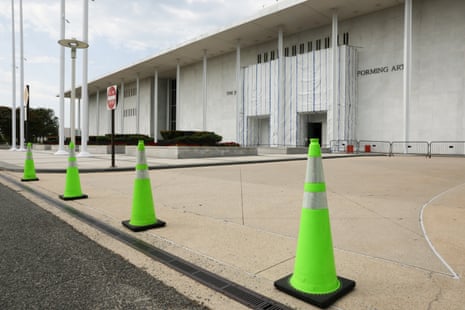
The USIP dispute comes as another Washington cultural institution faces a court battle over changes under Trump. A federal judge has ordered the Kennedy Center to give 30 days’ notice before making any major physical changes to the building, including demolition as Trump has threatened. The president said the centre could be “ripped down” amid a dispute over plans to put his name on the building and a proposed $257m renovation. The center is currently closed due to what its Trump-backed leadership described as safety issues caused by age and structural deficiencies.
Key events
Alexandria Ocasio-Cortez, the progressive standard-bearer and potential 2028 presidential hopeful, is planning to campaign for Democrats across New York state ahead of the midterms, according to a new interview with The New York Times. During the trip, she will reportedly venture far from her home district in the Bronx to make stops in Buffalo, Syracuse and Ithaca, among other sites.
AOC is backing up the campaign blitz with financial support, the Times wrote, contributing to a pot of money overseen by New York governor Kathy Hochul to support Democratic candidates around the state.
She embarks on the trip as speculation continues to swirl about her future ambitions – either for a Senate seat or for the presidency.
Head of Postal Service tells AP work has stopped on Trump-backed mail voting system
Earlier this week, the Supreme Court struck a final blow at President Trump’s audacious plan to centralize authority over mail-in voting under the federal government, which would’ve given his administration a say in who does and doesn’t get to vote by mail.
By Thursday, the behind-the-scenes efforts in the Postal Service to bring that system to life had ground to a halt, David Steiner, Trump’s postmaster general, told the Associated Press in a new interview.
Steiner and his agency had been caught in the middle of a legal and political whirlwind since March, when Trump signed an executive order seeking to position the USPS as an arbiter of mail-in voting. Under the terms of the order, states – which typically oversee their own elections – would’ve been required to turn over lists of eligible voters to the federal government for approval, and adopt a uniform design for mail-in ballot envelopes. The USPS could’ve refused to deliver ballots for states that declined to go along.
The whole project was the latest manifestation of Trump’s fixation with mail-in ballots and illegal voting by noncitizens, a largely debunked issue which has nonetheless formed a cornerstone of Trump’s domestic policy agenda in his second term.
In the same interview, Steiner dismissed rumors that the strain of being torn between Trump and the courts had prompted him to consider resigning.
JD Vance is back on the midterm campaign trail today, slated to head to Iowa to speak at a rally in Council Bluffs.
Republicans in the state are fighting to hold on to a Senate seat and the governorship, both of which appear too close for comfort. Vance will be joined at the rally by the Republican candidate for governor, Zach Lahn. The GOP’s Senate nominee, Ashley Hinson, has said she will not attend due to a previously scheduled commitment.
Analysis: What Trump’s attacks on mail-in voting mean for the midterms
George Zornick
For the millions of Americans who vote by mail – almost a third of the country – the week began with significant uncertainty that they would be able to easily submit their ballot this fall, thanks to a March executive order from Donald Trump that aimed to restrict mail-in ballots. By Monday night, the supreme court restored a measure of order by rebuking the president and rejecting his plan – but Trump’s frothing response portends more danger for the rapidly approaching midterms.
Trump’s March order forbade the US Postal Service from delivering mailed ballots to anyone the administration deemed ineligible. The Department of Homeland Security, working with the Social Security Administration, would have devised that list of supposedly ineligible, noncitizen voters. On its face, the move appeared plainly illegal. One expert told the Guardian’s Sam Levine, “This is a wholly unconstitutional EO,” because ultimately the federal government cannot set election rules; only states can.
The plan was full of logistical problems, too. A whistleblower told Congress earlier this month that the Postal Service simply didn’t have the ability to implement the system safely, and that the whole plan was “perilously rushed and potentially unlawful”, according to Richard Blumenthal, the senator who handled the whistleblower complaint. State election officials also complained they would be unable to implement Trump’s restrictions this close to an election, even if they were deemed lawful. Alabama, North Carolina and Wisconsin had already begun mailing out ballots before the supreme court ruled, and chaos would have reigned there and across the country had the court blessed Trump’s plan.
Read more:
Early voting in Virginia begins amid a legal dispute over voting by mail.
The Trump administration had sought to restrict mail ballots for the midterm elections, but on Monday the US supreme court declined to lift a lower court ruling blocking the new requirements. The decision means states can continue using the same mail-voting procedures they have used in previous elections.
The dispute stems from an executive order signed by Trump in March directing the US Postal Service (USPS) to introduce new rules for handling mail-in ballots. The rules would require states to provide the USPS with lists of voters receiving mail ballots and use specially marked envelopes.
Trump argued that tighter controls are needed to prevent election fraud and strengthen confidence in mail voting. Writing on Truth Social after the supreme court ruling, he said the US was “the only country that has to endure such a Nation Destroying SCAM”.
George Chidi, a politics and democracy reporter for Guardian US, provides more background on Trump’s efforts to change mail-in voting rules in this explainer:
The dispute could have an impact on how Virginians choose to vote, said Stephen Farnsworth, professor emeritus of political science at the University of Mary Washington
“President Trump’s continuing efforts to make voting harder, and the possibility of mayhem on election day, should really energize early voting in Virginia and around the country this fall,” he told the Virginia Mercury.
“Virginians have already demonstrated a great willingness to vote early and this year may see even more interest.”
Trump officials sending undocumented children to Texas sparks fears of mass deportation
Alexandra Villarreal
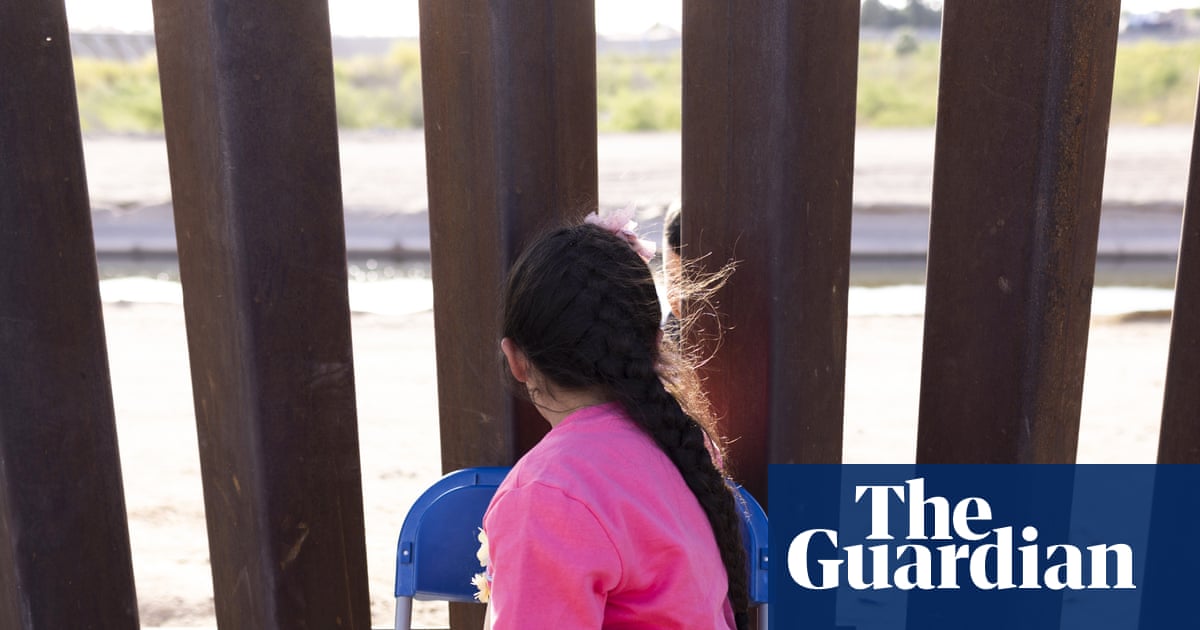
The Trump administration has started sending a majority of undocumented children who came to the US alone and have new immigration court cases to Texas, where government facilities for them are unlicensed, their chances of getting a lawyer are low and advocates fear that “a deportation churn-out factory” awaits them, the Guardian has learned.

Almost 80% of children in federal custody who arrived unaccompanied by a parent or legal guardian and who were placed in immigration court proceedings in July – and over 90% in August – have been funneled into shelter networks somewhere in Texas, a dramatic upswing from the months prior, according to analysis shared exclusively with the Guardian from researchers at the immigration data insights platform bklg.org.
This is understood to amount to a total of 925 children in the care of the Health and Human Services (HHS) department’s office of refugee resettlement (ORR) and in open immigration court proceedings based in Texas, with 651 sent there in July and August alone.
Read more:
Early voting begins in midterms as cost of living and Iran war loom large
Good morning, and welcome to our US politics live blog. The midterm elections are less than two months away, but some states begin early voting today, marking the start of a crucial stretch of campaigning for control of Congress.
Virginia begins early in-person voting, while voters in Minnesota, Idaho and South Dakota can cast absentee ballots in person, as the campaign turns increasingly on the cost of living and the continuing war in Iran.
High gas prices and low approval ratings are adding to the challenges facing president Donald Trump as Republicans head into the 3 November elections with their control of the House and Senate at risk. In its analysis of the US economy, the Wall Street Journal reports that mortgage rates are nearing 7%, consumer prices rose 3.4% in the year to August and gas prices are close to their highest levels since 2022.
“We are seeing what happens when a president launches a war of choice without anticipating the unintended consequences,” Aaron David Miller, a former adviser on Middle East policy to Republican and Democratic administrations, told Reuters.
Trump will take his case to the UN on Tuesday, where he is likely to present the Iran war as a victory despite having initially promised the military campaign would be over within weeks. The conflict has instead entered its seventh month, with Iran still able to disrupt regional shipping and the war putting further pressure on global energy prices.
In other developments:
-
The Trump administration has approved a potential sale of 48 advanced F-35 fighter jets to Saudi Arabia, worth an estimated $24.3b. The Department of State said the propose sale “will improve Saudi Arabia’s capability to deter current and future threats by strengthening its homeland defense”. The move comes despite concerns from intelligence agencies that China could potentially gain access to, or steal, sensitive F-35 technology through Saudi Arabia, according to the New York Times. The newspaper reported:
One detailed report, issued months ago by the Pentagon’s Defense Intelligence Agency, raised questions about whether the Americans and Saudis would be able to secure sites with F-35 technology. It also raised concerns about the access that Chinese military personnel have to Saudi bases and the prevalent use by Saudi Arabia of Chinese technology in telecommunications infrastructure and defense installations.
-
Former staff members of the US Institute of Peace have asked a federal appeals court to prevent the Trump administration from carving the president’s name into the facade of its headquarters in Washington, which was renamed the ‘“Donald J. Trump United States Institute of Peace” last year. Lawyers for the institute’s ousted board members argued that engraving Trump’s name on the building would cause “irreparable harm” by undermining the organization’s independent mission.
-
The USIP dispute comes as another Washington cultural institution faces a court battle over changes under Trump. A federal judge has ordered the Kennedy Center to give 30 days’ notice before making any major physical changes to the building, including demolition as Trump has threatened. The president said the centre could be “ripped down” amid a dispute over plans to put his name on the building and a proposed $257m renovation. The center is currently closed due to what its Trump-backed leadership described as safety issues caused by age and structural deficiencies.