3 months ago
68
3 months ago
68
Elana Meyers Taylor had already cemented her place in Olympic history long before Monday night. She had competed with and against men on the World Cup tour and at the world championships to help force women’s monobob into the Winter Olympic program. She had surpassed the speed skater Shani Davis as the most decorated Black athlete in Winter Games history. She had stacked more Olympic medals than any female bobsledder ever, reaching the podium at Vancouver, Sochi, Pyeongchang and Beijing.
But even at the age of 41, with a bad back and a concussion history, even with the added responsibility and time pressures of motherhood, even after five visits to an Olympic podium that would have been enough for a different athlete to call it a day, she had never let go of her dream of standing alone on the top step.
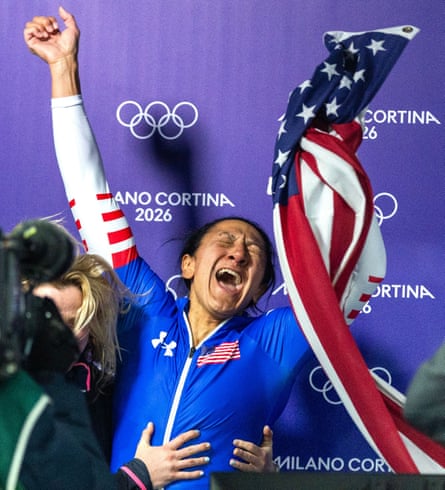
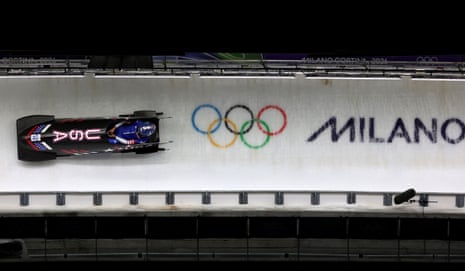
That goal was achieved on Monday night in the quiet residential pocket of Località Gilardon where she finally won gold in the monobob by 0.04sec over Germany’s Laura Nolte in the closest women’s bobsleigh finish in Olympic history. Meyers Taylor’s first gold came in her fifth Games – after three silver and two bronze medals over the previous four – and eclipsed Benjamin Karl’s record as the oldest Winter Olympic gold medalist in an individual event.
“The only thing missing from my resume at this point is an Olympic gold medal,” she told NBC last year. “I’ve done everything else. I’ve accomplished a lot in this sport. But to have the opportunity, one last time, to go after it, you can’t pass that up.”
Meyers Taylor was determined to squeeze every drop from her athletic gifts, not content with the Olympic near-misses, World Cup wins (21), world championships medals (10) and overall world titles (two, eight years apart) on her ledger. But the run-up to Monday’s cathartic gold had been the most difficult stretch of all. She didn’t reach the podium once in the World Cup season leading into her fifth Olympics, pushing through injuries, chronic pain, self-doubt, a horrific crash last month in St Moritz, and the logistics of raising two young sons who travel the mostly European circuit with her and a nanny: Nico, five, who is deaf and has Down’s syndrome, and Noah, three, who is also deaf.
“I don’t think I’m going to process this for a while,” she said of her gold medal. “There were so many moments during this entire season, during this past four years, that we just thought it was impossible – or I thought it was impossible.”
The most challenging part of this Olympic cycle, she said, was rarely the sliding itself but the day-to-day balancing act of raising her sons while maintaining an elite career. That reality was made possible only by an unusually hands-on support network that stretched from coaching staff to federation officials to family including her husband, the former US bobsledder Nic Taylor, who works full-time back home and sometimes went six months at a time without seeing their boys.
“The hardest mental battle is just the day to day with my kids and trying to figure out how to make this all work,” she said. “It took so many people just to get me to the starting line. And that was the biggest thing: I knew that if we could get to the starting line, that if we could get to this point, that we could make good things happen.”
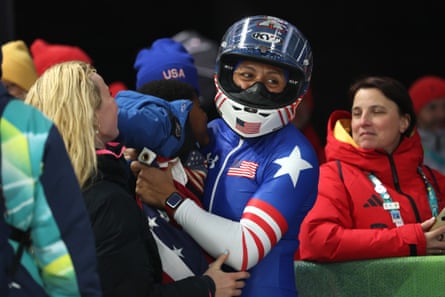
For anyone with even a passing connection to the Olympic movement in the United States, there was not a dry eye when Nolte’s heat-closing run came hundredths short and Meyers Taylor threw her fists skyward, wrapped herself in the American flag and dropped to her knees in tears with Nico and Noah beside her.
“I can’t even explain what they saw,” she said. “We went over all the signs beforehand, we went over bobsled, bobsled race, champion. They know all the signs, they were well-briefed beforehand. But it didn’t even cross my mind that we would actually be using them.
“I hope they remember this visually, and I hope they were able to take it all in, that visual memory, because obviously they couldn’t hear everything that was going on. One day when they’re a little bit older they’ll see it and they’ll know that their mom was Olympic champion.”
Meyers Taylor won the gold by being the most complete and consistent slider across all four runs. While her closest rivals were posting faster single splits or higher top speeds, Meyers Taylor carefully avoided mistakes. In a four-heat race decided by infinitesimal margins, that steadiness and composure was what ultimately secured her long-sought prize.
“I just focused on what I needed to do, the points I needed to hit,” she said. “I had gone over the track again with my coach this morning, and he told me what I needed to do. We discussed it and we just went to work. I was super grateful to be able to put the pieces together and finally have a run that I could walk away very proud with.”
Her gold also carries resonance far beyond sliding tracks. Meyers Taylor has become a visible figure for families raising children with disabilities, particularly within deaf and Down’s syndrome communities.
“I had some really good people in my corner who believed in me,” she said. “And people from all over the world reaching out and telling me their stories, and how they had kids with Down’s syndrome, they had deaf kids, and how they believed in me, too. They’ve been encouraging me and telling me it doesn’t even matter if I win, I’ve done so much for the communities. I’m so excited to represent them. I’m so excited to represent my country. I’m so excited to have a gold medal, finally. It took long enough.”
Her performance over nearly two decades has been surpassed only by her persistence, but her compassion, clarity of purpose and quiet moral authority extend far beyond self-interest. She’s interned with the International Olympic Committee in Switzerland, served as president of the Women’s Sports Foundation, advocated for gender equality and spoken forcefully about racial discrimination in her sport. Watch her long enough in an interview or at a press conference and it is easy to imagine a future IOC president.
The Olympic title, in the end, was never the only goal. Meyers Taylor has been acutely aware of what her career has come to represent beyond results: to families raising deaf children, to parents navigating disability, to athletes trying to build full lives alongside their pursuit of their dreams. And at three minutes to 10pm on Monday night, deep in the jagged limestone peaks of the Dolomites on the edge of Cortina d’Ampezzo, Meyers Taylor’s wildest dream of all finally came to pass.
“I don’t think I needed it. I wanted it,” she said. “And that’s what allowed me to keep going. If I’d needed it, I don’t think I’d have been able to have done it.”