3 months ago
53
3 months ago
53
Mumbai is known for its graphic inequality, its gleaming high-rises where the rich live with panoramic views of the Arabian Sea standing next to windowless hovels perched over drains. It is home to 90 of India’s billionaires, but also to more than six million slum dwellers, about 55% of central Mumbai’s population.
Now Mumbai has a new symbol of the gulf between rich and poor: a high-speed, eight-lane motorway on its western coast, which critics say serves only the wealthy despite being built with taxpayers’ money.
The road was intended as a solution to the gridlocked roads of India’s commercial capital. But Mumbai is a densely populated peninsula, 25 miles (40km) long and 6 miles wide, where land is as scarce as snow.
The new coastal road had to be built on land reclaimed from the Arabian Sea. An engineering marvel, it connects north and south, and is a dream for car owners, who used to average about 5mph through Mumbai’s congestion.
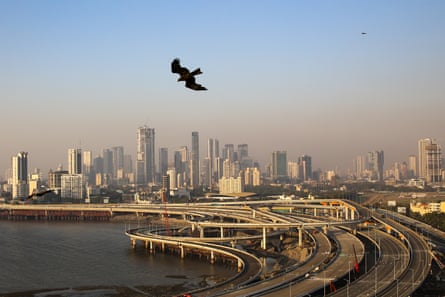
At Marine Drive in the south where it starts, cars now dip down into an undersea tunnel for more than a mile and, after making great loops across the shimmering sea where the road is built on stilts, they emerge 6 miles away in Worli in 10 minutes instead of the 45 minutes it took previously.
But an estimated 64% of the Mumbai metropolitan region’s 22.5 million residents travel by overcrowded buses and trains. Those unable to push inside cling to the outside as best they can. Seven to 10 passengers die daily on the local train network.
“The road is exclusively for the elite,” says Avlokita Shah, an environmental activist. She adds that the billions it cost “should have been spent on public transport to benefit the majority – repairing roads, adding more buses with more stops and routes, and expanding the metro”.
Hussain Indorewala teaches at the Kamla Raheja Vidyanidhi Institute for Architecture and Environmental Studies and calls the coastal road “welfare for the well-to-do”. “It represents a massive transfer of wealth to the rich and imposes costs on the rest,” says Indorewala.
Praveen Shastri, who shines shoes at Churchgate railway station, shrugged when asked what he thought of the road. “What do I know about it?” he said.
It’s lunchtime and the station is quiet. Come rush hour, the platforms will teem with commuters.
“It’s not for people like me. My commute remains the same – never getting a seat on the train to Borivali where I live. At the end of a long day, it’s even more tiring getting home,” says Shastri.
Vivek Tiwari, an investment banker, loves the new road for taking 45 minutes off his travel time. His office is in Nariman Point, the southernmost tip of the city, and home is 12 miles north in Bandra.
“It’s an amazing piece of infrastructure and driving on it is glorious,” he says. “Not all infrastructure can be equally parcelled out among the rich and the poor. Yes, only a minority like me use the road but maybe it’s going to help us generate more economic growth ultimately, which will benefit everyone.”
For Nikhil Anand, an environmental anthropologist at Pennsylvania University in the US, the idea of a motorway connecting different parts of Mumbai as a response to heavy traffic is not only elitist but outdated; “a 20th-century response to a 21st-century problem”, as he puts it.
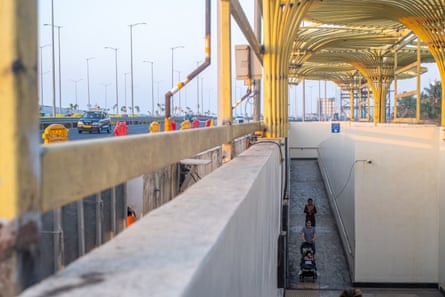
Urban motorways are a discredited solution to traffic congestion, dating back to the 1960s when roads were built to connect different parts of congested American cities, ignoring the need for public transport infrastructure and forcing more people to buy cars.
“This only served private car owners instead of building public transport and led to ‘induced demand’ for cars, resulting in more traffic,” Anand says. “More roads and cars benefit only a few, unlike public transport.
“They worsen carbon emissions and, by removing the mangroves in the intertidal wetlands that line the coast, make Mumbai even more vulnerable than it already is to flooding.”
During construction, critics and experts shouted themselves hoarse saying the reclamation would destroy the livelihoods of the Koli fishing community, the original inhabitants of Mumbai’s coast. For generations, they have parked their boats on the beaches, dried their catch there, and repaired their boats and nets.
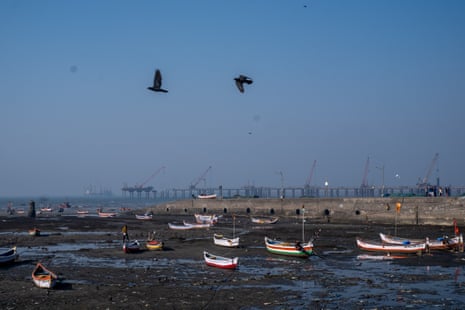
On a grey, polluted evening, Deepak Namaposhe, 45, sits in his fishers’ shack on the beach at Khar Danda, his weather-beaten face lined with tension. In the pleasant sea breeze, boys fly kites or play cricket while men squat under tarpaulin sheets repairing green nets.
In other parts of the coast where the road has been built, Namaposhe has seen how traditional fishing sites and breeding grounds have been lost, daily earnings halved, and costs almost doubled.
Now, the second phase of the road, which will connect it with the western suburbs farther north, is coming up. Through the distant haze, the piles being constructed are visible. His anxiety is that Khar Danda will suffer the same effects.
“By what right can they take land where my father, grandfather and great-grandfather lived and fished? It’s our land. When the road is finished, we won’t be able to access the sea. We will have to go out the long way round, use double the time, double the diesel and still ending up with smaller catch,” he says.
Waving his arm in the direction of the beach, Namaposhe says: “All this open space will go and builders will construct fancy apartment blocks for the rich.” He refuses to be photographed, saying the “builders’ lobby” is active in Khar Danda and he does not want to be labelled a troublemaker.
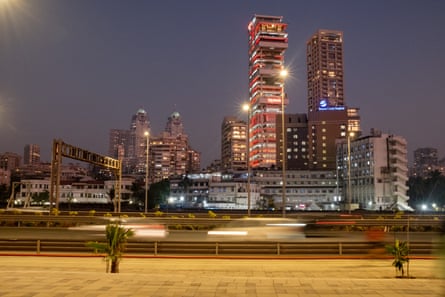
The coastal road is a godsend for builders and property developers who had fought over the scraps of land that become so rarely available in Mumbai. The reclaimed land for the road opens new large tracts for building the glass towers and luxury apartments worth billions of rupees.
Today, Mumbai resembles a big construction site. Tower cranes fill the skyline. The unusually high levels of pollution are in part the result of the frenzied construction of high-rises, either on land freed up by demolishing old, low-rise buildings or land created along the coastal road.
A “billionaires’ row” has risen up on the Worli seafront, with stunning, unobstructed views of the sea. The richest families have been buying up new homes at this desirable location.
At Versova, Shah explains how the second phase of the road will connect Versova to Bhayander, farther north. Despite protests, the Bombay high court ruled in December that 45,000 mangrove trees could be removed for the project.
“These mangroves act as a natural barrier against tidal surges and erosion. As it is, Mumbai is flooded every monsoon. Destroying mangroves that have developed over decades will also ruin the fragile ecosystem,” she says.
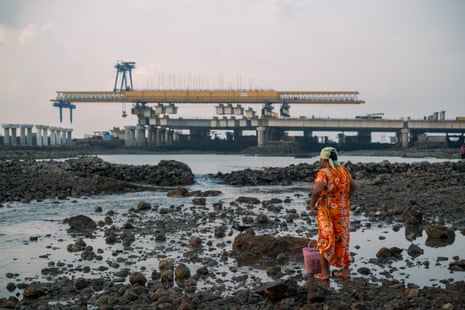
For ordinary people, the road has led to another, less publicised, less visible and less tangible loss: easy access to the shoreline. The beauty of the ocean and the tranquillity it offered were invaluable and a rare free pleasure enjoyed by all classes in a thronged metropolis.
After a long day at work, labourers, office workers, families and young couples could cross the road at various points – Haji Ali, Breach Candy, Worli – to walk the shore.
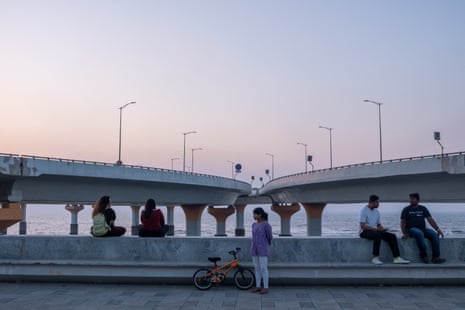
Now, an eight-lane thoroughfare blocks the way. A few subways have been created to allow pedestrians and cyclists to access new promenades that have been created for walking, cycling and jogging but these are too few and involve long walks, especially for those already tired after a day’s work.
“The road has distanced people from the ocean and the ocean is Mumbai’s most beautiful asset,” says Anil Gaitonde, a shopkeeper in Colaba.