2 months ago
65
2 months ago
65
“Things were getting grim,” says Gary Cavanagh, reflecting on Bradford in the early 1980s. “There was a hell of a lot of unemployment, and people were thrown on the scrap heap.”
Cavanagh was working for Bradford’s claimants union in 1981, helping the city’s poor and unemployed get benefits, when a government report stated that one in 12 dole recipients were defrauding the state. So he and some friends reclaimed this statistic – which they thought was ludicrous – as an identity. “We became the 1 in 12 Club,” he says.
Initially it was a nomadic club, putting on gigs and leftwing political meetings in the upstairs rooms of pubs. Unemployed people could see bands such as New Model Army cheaply, form camaraderie and support the club’s anarchist principles of self-management, co-operation and mutual aid. The club was built around the words liberty, equality and solidarity, and 45 years on, they remain painted on a mural on the building it has called home since 1988 – a space that took two years of voluntary work to convert.
As part of Bradford’s year as the 2025 UK City of Culture, and in collaboration with cultural history organisation Home of Metal, a new book and three-part podcast tell 1 in 12’s story, with contributions from members and bands including Lankum, Chumbawamba, Therapy? and Neurosis. “Some gigs were so hot and ridiculous, with eight of us on that tiny stage,” Chumbawamba’s Alice Nutter tells me. “You’d have sweaty black water dripping on you but the atmosphere was great.”
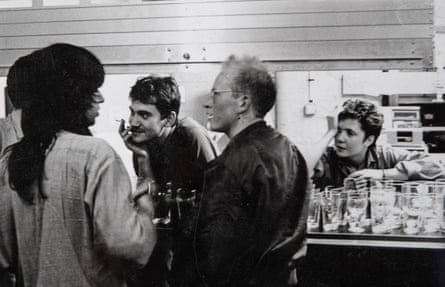
E, a trustee, has been coming to the club for the last 15 years, since he was a young teen. “I’d never seen a space like this before,” he recalls of his first visit. “I remember a bunch of teenagers – along with punks, hippies, all sorts – all spilling outside into the street. I’m from a Traveller background but nobody looked at you wrong or assumed anything about you. It quickly became a home from home and I wanted to put back into a place that had always given me a space.”
Over its three floors – each plastered with leftist stickers and posters – it has a cafe, members’ bar, games room and extensive library. Its 90-capacity gig room has welcomed countless shows and booming raves, with everyone from Pulp to Bikini Kill playing there over the years.
1 in 12 battled enemies in the early days when the National Front was prominent. “We were always fighting fascists,” says Cavanagh. “We were threatened but we always took on those people.” Politics are not forced on people at the club, however. “We aren’t a summer school for Marxists,” Cavanagh adds. “We’re not browbeating people with political dogma. We just encourage people to think for themselves.” E says that “not everyone here would define themselves as an anarchist”, and he would simply describe it as “an intersectional or leftist space – just somewhere you can go to be yourself”.
Inclusivity and egalitarianism are key to the club’s ethos but it has also responded playfully to outsiders. When the Canadian post-hardcore band Fucked Up arrived to play at the club in 2008 with the NME in tow, members came out with a giant cardboard box structure of a Trojan horse that had “NME Out of Our Scene” written on it. They then smashed it to bits.
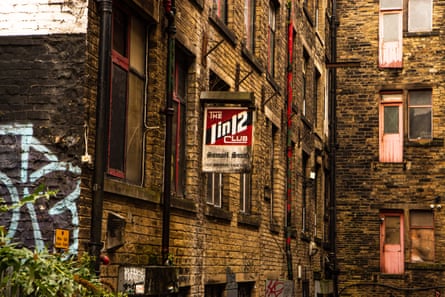
1 in 12 is entirely independent and volunteer-led, with the income from the bar – along with the odd grant – keeping the wheels in motion, and it has numerous collectives within it. “It’s always been more than a venue,” says Nutter, who as well as having been in Chumbawamba is also a TV writer and playwright. “I’ve been part of reading groups there, the peasant collective [which provides free communal meals with food from the club’s allotments] and my partner used to play on the football team. The bar is great too – it’s a place where there is always someone to have a pint with who isn’t a wanker.”
Nutter’s first play was performed there. “There was always an opportunity to use the space,” she says. “If you have the creativity, they will facilitate it. No one said no. If you were willing to put the work in, you could use the building – they would give you the keys.” She soon understood how much of a “special place” it was as her writing career evolved into traditional theatres: “I realised it costs thousands to put a play on. The first one we did, everyone did it for nowt.”
Despite the celebratory milestone, book and podcast, it has also been a sad time, as the club recently lost “vital” and “instrumental” founding member, Tony Grogan. Cavanagh, the sole remaining founder, is still going and attending gigs, and his daughter is now a member. “Part of the longevity is that there’s still a need for us,” he says, as the St George’s flag-waving far right becomes emboldened once more in the city. “It upsets me that we’re still fighting the same battles, but we’ve got a strong cultural resistance in Bradford and we’re part of that. Liberty, equality, solidarity. That’s what we started with and that’s what we’re still trying to do.”