3 months ago
103
3 months ago
103
In Fiji, babies know a connection to the sea from birth; their umbilical cords, or vicovico, are sometimes implanted in the reefs that frame the coastal Pacific nation, embedded among the coral. It’s an age-old practice among iTaukei, the Indigenous Fijian people – creating a lifeline to the ocean, a reminder of their roles as traditional custodians.
Yet for decades, controversy over the rights to the Fijian seabed has cast a long cloud over the island nation, which sees a million tourists flock to its shores each year, many to surf the perfect, barrelling reef breaks. It has led to heartache and, at times, violence.
Until 2010, access to Cloudbreak, one of the world’s most famous surf waves, was barred to Fijian locals, due to an exclusivity deal with a high-end resort from the early 80s. “It was demeaning, it was shameful,” says Ian Ravouvou Muller, an iTaukei surfer who recalls being threatened and chased out of the waters where the vicovico of his three sons are buried. “We are a saltwater people.”
In 2010, the Frank Bainimarama-led military dictatorship introduced a surfing decree, banning payments for the use of Fiji’s reefs, lagoons and beaches, and putting an end to all exclusivity deals. Prior to 2010, Tavarua Island Resort paid local Nadroga tribes so it could offer its guests private access to Cloudbreak, and leases totalling 12m Fijian dollars (US$5.2m) between resorts and villages in that region were estimated to have been overridden by the decree.
The Bainimarama decree meant open season on the waves for tourists and locals. This gave rise to a crop of young surfers, including Fiji’s first professional surfer – but trampled over customary marine rights, cutting iTaukei out of decision-making or profits as foreign-owned resorts sprang up and surf tourism boomed.
Now, the Fijian government wants to return the rights to govern marine areas – known as qoliqoli – back to the Indigenous people, allowing iTaukei to be compensated for tourism operations on the reefs and fishing grounds that have formed their livelihoods.
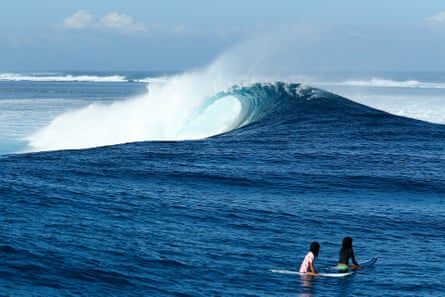
“Tourism going forward will see a huge degree of participation for Indigenous people,” said Fiji’s deputy prime minister and tourism minister, Viliame Gavoka, when introducing a marine areas bill to Fiji’s parliament in December. “This legislation is one way Fiji can ensure our Indigenous communities are part of tourism in a big way.”
The move has been celebrated within Fiji as a win for iTaukei rights. Tourism is Fiji’s lifeblood, contributing about 40% to its GDP and earning the country about FJ$2.5bn (US$1bn) last year. But many iTaukei live in rural poverty, on FJ$1.25 a day. “The very people who looked after these reefs for generations have nothing at all,” says Dr Jekope Maiono, a Fijian expert in Indigenous economic development. “The hoteliers, the resort owners, the airlines, they’re all benefiting from a customary resource. The Indigenous people just want to have a share, and rightly so.”
But the bill has also caused concern. Some tourism operators told the Guardian there is little detail about how it will work in practice.
Jon Roseman, the managing director of Tavarua Island Resort, says there is “ongoing uncertainty” about the bill.Others questioned how proceeds would be reinvested in Indigenous communities, and wanted extra costs covered by the government.The Fiji Hotel and Tourism Association declined to comment, but its chief executive, Fantasha Lockington, has called for more clarity. “We need a far clearer understanding of how it will affect tourism leases, accessibility to marine sites and practical enforcement.”
Leases to hotels are currently administered by the state, and customary owners typically receive a one-off payment for loss of fishing rights, environmental lawyer James Sloan says. The new bill would see customary groups register their rights to an area to a government commission, which would oversee lease negotiations. “It will affect business models and funding arrangements,” he says.
While the bill suggests additional costs be passed on to tourists, Sloan says there is a danger it could make Fiji too expensive as a destination, and cause disputes between tribes over custodial rights. However, he says, if those issues were addressed, it could be a “transformative and ambitious” piece of legislation.
History of resistance
Since the British claimed Fiji as a colony in 1874, there have been several attempts to return customary rights to iTaukei. Efforts ramped up from the late 90s, following Fijian independence in 1970. Qoliqoli areas had earlier been mapped and fishing grounds recognised, but not proprietary rights, which were held by the state.
But there has always been resistance; the last failed Qoliqoli bill, in 2006, was given as one of the main reasons for Bainimarama’s coup. Opposition at that time was fuelled by hoteliers, who raised fears that payments to local tribes in return for access would result in hotels closing and tourism declining.
But Indigenous rights experts say the fears are overstated. “The policy objective has always been iTaukei empowerment,” says Usaia Gaunavou, director of iTaukei studies at the University of Fiji. “Now, with this landmark legislation, it looks like we’re going to have this for the first time in Fiji’s history.”
It was in iTaukei interests for Fiji to thrive as a surf destination, and tourists already paid for the waves – by spending thousands of dollars at resorts, and for boat hire and guides, Gaunavou says.
Tourism Fiji’s chief executive, Dr Paresh Pant, claims recent meetings with landowners, communities and tourism operators showed the process had widespread support. Consultation on the bill is underway, and expected to take several months. A framework could include a “sustainability tax”, charged to tourists at the airport, he says. “At its best, this law supports tourism that lifts everyone socio-economically while making the use of Fiji’s natural resources sustainable.”
For those who live and breathe the ocean, like Muller, this has been a long time coming. “People don’t like the idea of paying for nature in general, they think it’s free for all, but nature comes at a price. It needs to be protected,” he says. “We are correcting the wrongs of the past to create change for the future, respecting how our people once lived. For us, this is surf redemption.”