3 months ago
64
3 months ago
64
‘I’ve only sung this once before and it makes me shake,” Florence Welch admits, crouching alone at the far end of a long, narrow thrust stage. Watching her command this arena during the first of two sold-out shows in Glasgow in honour of Florence + the Machine’s sixth album Everybody Scream, it’s hard to imagine Welch fearing anything. Just seconds ago, she was racing barefoot, flouncy skirts gathered in one hand, ripping through Spectrum (the band’s first UK No 1, back in 2012) and its searing demand: “Say my name!”
But the new song she is steeling herself to sing presses on a bruise. With ratcheting intensity, You Can Have It All grieves an ectopic pregnancy which almost killed her, as well as a music industry that punishes its stars for motherhood. Over grungy electric guitar, her tempestuous voice billows like sails in high wind: “Am I a woman now?” It leaves the arena in stunned silence. She gives a wry curtsey.
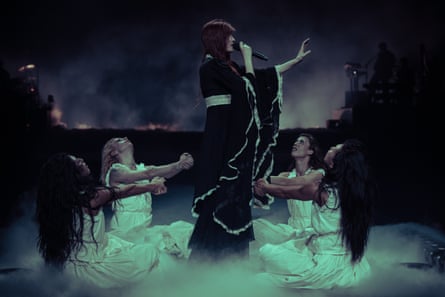
Everybody Scream deals in familiar Florence tropes – mountainous emotions, thundering drums, glittering harp – but with a new sombreness, particularly as she wrestles with questions of legacy. On earlier songs she raged against metaphorical demons; now, on One of the Greats, her targets are more explicit as she stares down male peers making “boring music” and sings, her face tight with frustration, about what it would take “to conquer and crucify”.
With her longstanding band the Machine performing in the shadows, Welch is accompanied by a choir who writhe and scream and rip at their frothy petticoats. This high-drama show could never be boring but it threatens to overwhelm: the choir’s folksy horror pulls focus away from a performer who can transfix a crowd, alone, with ease.
Last year’s single Sympathy Magic is an instant Florence classic: a sky-high plea for catharsis through song. “What else?” she yells, before throwing herself into the arms of a fan on the barrier. It makes the aching, pretty closer And Love feel intentionally anticlimactic. It is tender, quiet, about finding peace. “If we sing it, it might come true,” she offers, but Welch, like her audience, thrives on the edge of a precipice.