3 months ago
66
3 months ago
66
Through the first 10 days of the Olympics, Canada had more memes than medals. More gaffes than golds. More “oh no” than “O Canada.”
Canada didn’t win their first gold medal of the Games until the ninth day of full competition. Meanwhile, the narrative centered on the Great Curling Kerfuffle of 2026 and its accompanying viral online content.
But the Canadian comeback looks like it is already well under way. There’s even a chance that Canada could leave Italy with more medals than its noisier neighbor to the south.
To understand how, we have to first rewind to Canada’s biggest Winter Olympics embarrassment.
At the 1988 Calgary Games, the host nation failed to win a single event, finishing with two silver medals and three bronze. (In Canada’s defense, those Games had only 46 events, compared to 116 today.)
But those Games had glimpses of hope in events labeled “demonstration sports”. One such sport was curling, and the host nation took unofficial gold and bronze medals. The two other “demonstration sports” – freestyle skiing and short-track speedskating – also brought Canadian success.
As the Games expanded, Canada’s medal tally grew even faster. They accelerated their progress even further with the “Own the Podium” campaign in 2005, and the investment paid off – when Canada hosted again in 2010, they earned a then-record 14 gold medals and 26 total.
Through Tuesday, Canada has three golds and 12 total medals. If events were evenly spread out, they’d be on pace for some anemic tallies – another four-gold performance, like at Beijing 2022, and 16 to 17 total.
But events aren’t evenly spread out. These Games have had plenty of events in Alpine skiing, Nordic skiing and biathlon, none of which were expected to add to a Canadian gold rush. Neither were luge and skeleton.
Since 1988, Canada’s greatest Winter Olympic opportunities have come in the demonstration sports of that year – curling, freestyle skiing and short-track speed skating. And there are still plenty of medals at stake in those disciplines this week.
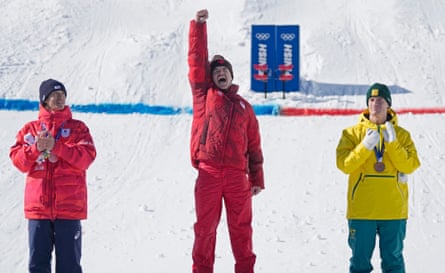
Already, freestyle skiing is leading the way for Canada with four medals – gold and silver for Mikaël Kingsbury, gold and bronze for Megan Oldham. Still to come: skicross phenom Reece Howden, halfpipe medalist Cassie Sharpe and the mixed aerials team. At the same venues, Canadian snowboarders will contend for medals.
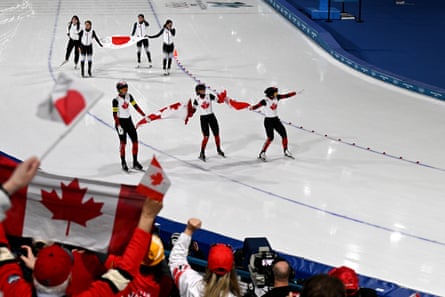
The only area that has lagged behind expectations is short-track speed skating. Courtney Sarault has medaled in two individual events and has one remaining, and she earned a third medal in the mixed relay. Steven Dubois and William Dandjinou have missed out on individual medals despite making the finals, but they each have one more individual opportunity plus the men’s relay. Sarault also has one individual event and one relay left.
The Olympic curling tournament is still in progress. The same is true in ice hockey. While Canadian teams there have had a few missteps, they have plenty of time for redemption.
The men’s hockey team, an overwhelming favorite to at least reach the podium with NHL players back in the Olympic fold, had no trouble winning their group. But the women’s hockey team were routed 5-0 in their first showdown with the US, albeit without captain Marie-Philip Poulin, and needed two goals from Poulin to see off a determined Swiss team 2-1 in the semi-finals. Thursday’s final will be the seventh gold-medal meeting of the rivals.
On the curling ice, Canada’s mixed doubles team missed the playoffs with a 4-5 record. Then the women’s team, who won consecutive world championships and dominated the world rankings since onetime rivals Rachel Homan and Tracy Fleury joined forces, lost to the underdogs from the US as well as a less-experienced British team and the powerful Swiss contingent.
But Homan’s team have rebounded, cruising past China and a solid Japanese team, then winning a thriller against first-place Sweden on Tuesday to strengthen their chances of making the playoffs.
The women have lost some games. The men have lost some fans.
While the sport with the rocks and brooms was invented in Scotland, it is biggest in Canada. Curling fits a positive stereotype of Canadians as people who are unfailingly polite even when they’re standing on a sheet of ice.
That image was shattered, though, when Canada’s men faced off against defending Olympic champion Sweden on Friday. Marc Kennedy, a member of the 2010 team that won gold on home ice in Vancouver, reacted angrily and profanely to an accusation by the Swedish team that he had illegally touched a stone upon delivery. When video surfaced that provided nearly certain proof that Kennedy had indeed touched his finger to the granite after releasing the handle, the Canadian response was to accuse the Swedish team of illegally taking video inside the curling venue – not exactly the best way to attempt an exoneration.
Kennedy’s teammates also did Canada no favors. While they said they would absolutely get a beer with the Swedish team if they liked – a common gesture in a sport that has an unwritten rule that the winning team should buy the first postgame round of drinks for the losing team – they pointedly compared the teams’ records, saying Sweden was “frustrated” and “trying to get in our heads a little bit”. Round-robin play continues through Thursday, with the men’s final set for Saturday and the women’s for Sunday.
Add it all up, and Canada has a solid chance of winning 10 to 12 more medals, which would put their total comfortably in the 20s. The chances of the Canadians raking in at least 14 golds, as they did at home in 2010 – or reaching the double-digit totals of 2014 and 2018 – are ebbing. But getting stuck at four golds, as they were four years ago in Beijing, is about as unlikely as Canada converting its curling clubs to bowling alleys.
Could they even catch the US? In total medals, probably not. The Americans, who finished Tuesday with 21 medals, can probably count on more in ice hockey, speed skating and women’s figure skating, with additional chances in freestyle skiing and snowboard.
But in terms of gold medals, Canada have rapidly moved up since starting the Games with a long drought. Then the lingering narrative for Canada in 2026 would change from “curling controversy” to “Canadian comeback”.