3 months ago
75
3 months ago
75
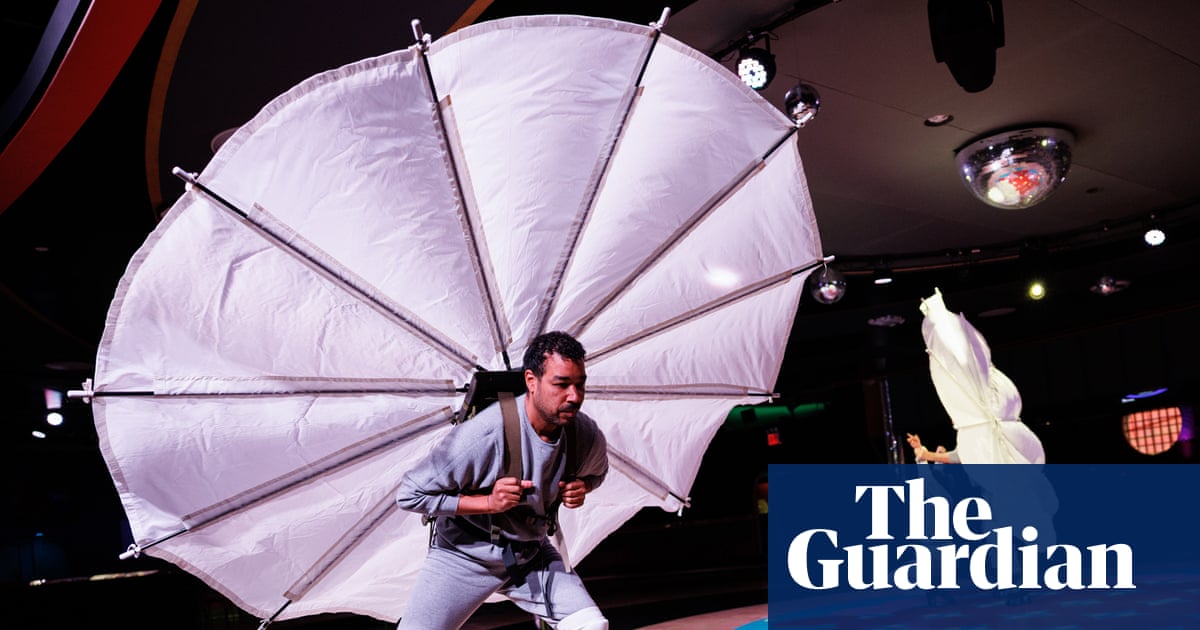
Suited dancers swing around a streetlight in Spanish choreographer Marcos Morau’s Horses but it’s not exactly Singin’ in the Rain. The mood is more like a stray dog has sidled up to that lamp-post and cocked its leg. The lamps multiply on these squalid, mean streets: uprooted, they become giant props for performers to illuminate and edit the action on a vast stage with its wings exposed and no artificial backdrop. A suspicious figure roams the outskirts with a torch; another drives a vehicle back and forth in the distance. One long-necked light snakes down from above like a tendril, its glow deepening the chiaroscuro. Bodies melt and morph. It is as if a film noir has caught fire in the projector, distorting each scene.
Nederlands Dans Theater’s production, at the 20th edition of Holland Dance festival, confounds from its ragged beginnings to the final seconds, when even the curtain is not allowed to fall in peace. Horses starts with the house lights up and a solo with instinctive flinches and hoof-like hands suggesting hunter and hunted before a second dancer arrives nose-first, as if led by scent. The animality briefly evokes NDT’s Figures in Extinction but this is an acutely urban nightmare, with humans’ survival skills put to the test. Suddenly, the auditorium’s doors slam shut and we are plunged into darkness.
On Max Glaenzel’s set, lit by Tom Visser, there are vaudeville vignettes of peril, the intrigue heightened by Andrzej Panufnik’s unsettling strings and the clowning overlaid with heavy breathing, canned laughter, comical splish-sploshes and other sound effects. The interactions are at times documented by a pair of figures who resemble wildlife photographers, yet the setting evokes a huge soundstage and revels in artifice.
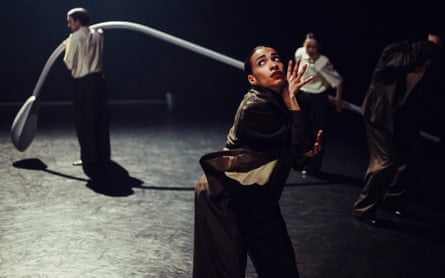
Morau tests this supple squad of dancers with choreography suggesting limbs that won’t behave, startling their owners with angular thrusts. Bodies are cradled but also dragged and disposed of in a desolate landscape where the lamp-posts are arranged to frame a jolting ensemble or, in a spellbinding sequence, spin like a pendulum held by one dancer for another’s solo beneath. The 11th hour surprise, in this pungently atmospheric work, is that the lost souls whose cries sound like tortured creatures manage to construct a shelter from all those beams. It’s done to the balm of And the Swallow, composer Caroline Shaw’s paean to laying your head safely. A performance that has majored in the uncanny becomes a tribute to human ingenuity: the herd comes together by sensing shared threat.
Horses, from 2024, is part of NDT’s double bill, Wildsong, paired with Belgian choreographer Jan Martens’s premiere, Kid in a Candy Shop, which is set at first to Julia Wolfe’s Pretty. It is hard to imagine more instantly propulsive music but as the Dutch Ballet Orchestra delivers the surging opening, the dancers are caught in a spectral slow motion, each body still tuning up. They gather speed but when the waves of Wolfe’s music subside, their balance is challenged by forming frozen tableaux, some on one leg. Uniformity is rare among the movements of this huge ensemble, often locked in individual patterns under the abrupt switches in Jan Fedinger’s colourful lighting design, which complements huge projections from British naturalist F Percy Smith’s 1910 film The Birth of a Flower, with snowdrops and roses coming into bloom. As these become kaleidoscopic on screen there is no tessellation on stage to match nature’s symmetry, rather industrious individuality, with an occasional floral motif as a dancer curls into a tight bud or extends a limb like an unfurling petal.
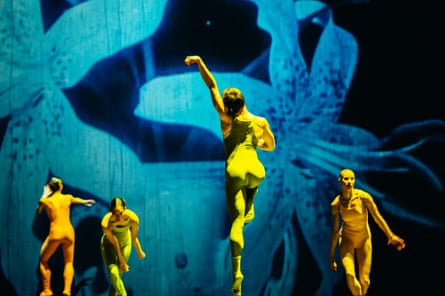
Several sections feel like rehearsal games that have not been transformed into a compelling whole in performance. But the dancers’ precision is showcased in a second half set to Hanna Kulenty’s GG Concerto, harpsichordist Gośka Isphording sending the dancers into pinballing, glitching sequences as they bounce, hop, bend and spin in turn. Performed in muted candy-colour costumes, these are pick’n’mix routines befitting the title, but while some sequences fizz the overall result is never as fun as perhaps intended, nor as beautiful as the flower videos that continually threaten to upstage it.
Elsewhere at the festival, petals fill the stage in Please Hold My Hand by Compagnie Tiuri, the Dutch group which creates work for performers with and without disabilities. Its artistic director, Jordy Dik, has crafted a resonant dance-theatre response to shocking statistics about femicide in his homeland and around the world. It is delivered by a cast of four women within the fringe curtains of Loura Sita van Krimpen’s boudoir-style set, established as a safe space yet invaded by violent episodes as the piece unfolds.
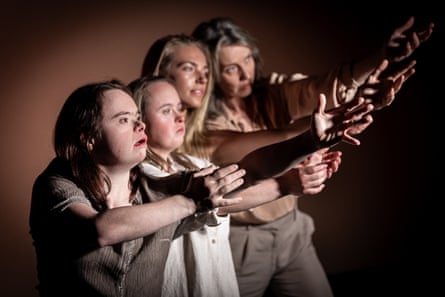
It opens with a tender ritual: one woman washes herself, joined by others who brush her hair and dress her. Only slowly does the impact of what may have happened before the scene sink in. A sense of trauma hangs over this tribute to togetherness, as the dancers shield each other, lend their bodies for support in a duet of alternating back bends or simply clean up after each other. But there is abundant joy here, too, as they twirl with silken movements. Red petals are scattered from an upturned umbrella, piling up like autumn leaves. As bodies are dragged through them, the patterns can resemble smeared blood.
The piece cleverly plays with romantic gesture and cliche, as partners share caresses and sweep each other off their feet, before the movement evokes coercive control instead. Gaiety is often a step away from brutality, an embrace turning into a grip; the lights are dimmed for a scene in which a woman is punched and kicked in the stomach. Dik reminds us that women’s attackers have frequently been their partners.
In a scene akin to Ontroerend Goed’s Sirens, the women take turns at a microphone to ape everyday sexism and abusive threats, their tone veering from sly to sinister (“This stays between us, right?”). There is a steely grace to the performances by Andrea Beugger, Margriet Jacobs, Sabine van Riel and Annemieke Mooij and an overall healing quality in Dik’s appeal to give people their flowers.
The unnerving blend of material – now horrifying, now humorous, elegant then messy, always sensorial, a rich musical collage – is pure Pina Bausch. One dancer’s lipstick kisses on paper are given to the audience and another scene, featuring balloons and hot pants, is more straightforwardly derivative. It provides an oddly abrupt ending to the piece, which has an activist coda outlining global statistics of violence against women and asking us to illuminate tealight candles for the women we love.
Dik’s short piece Live, Live, All We Can Do Is Live – a boyband mini-concert, featuring one dancer’s memories of his dreams to become a Spice Girl – is included in the festival’s HubClub programme, presented by Introdans. An inclusive platform for disabled and non-disabled talent, HubClub is styled as an irreverent cabaret, with five short works (mostly fragments from existing pieces) sandwiched between an overture and a finale. These dancers are introduced in spangly evening wear, gathered around – and even under – a dining table, cigarettes dangling from lips.
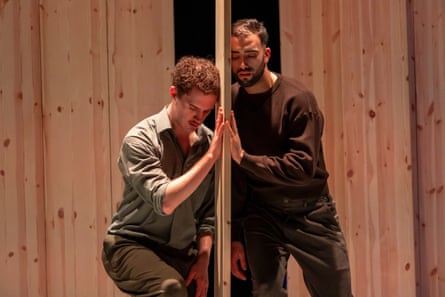
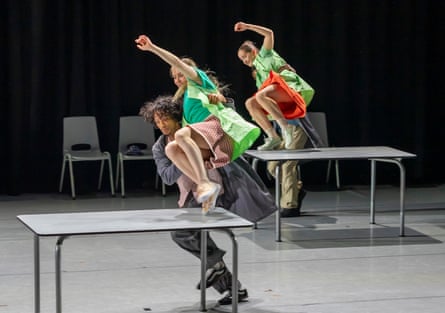
The scene changes between each segment are handled with wit and invention. For Fernando Melo’s nifty piece The Longest Distance Between Two Points, that table is stripped bare, its long planks becoming partners for the cast and even used as impromptu stages for them, held at various angles. Steve Reich’s Music for Pieces of Wood adds pace as plank-carrying dancers circle each other to create human-made borders that appear almost out of thin air in a piece that is free-flowing and claustrophobic as it becomes a parable about division and confined identities. In the wrong hands, these structures oppress; in others, they provide support. It’s deceptively simple, surprisingly moving when two yearning men are separated by a wall and is – beware splinters! – performed without gloves or socks by a deft company. The potentially lumbering concept proves instead extremely malleable.
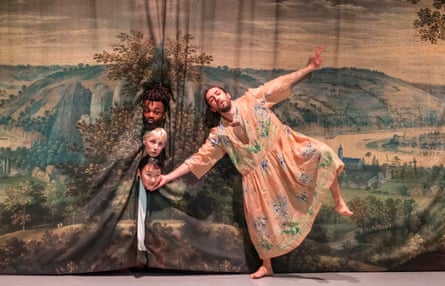
Two pieces in HubClub reveal Inbal Pinto’s gift for quirky choreography with a troubling undercurrent. Salty Pink is a seaside folly, with pelvis-thrusting bathers stretching out against a bucolic backdrop and seeking picture-postcard fun, their ruddy demeanour cracking to reveal despair. Boulevard of Broken Dreams, featuring a Foley sound artist, has a circus spirit and trompe l’oeil effects, as a floaty dress is pulled on and off each dancer, taking on a different meaning each time. The costume becomes almost as charged a symbol as the red dress in Bausch’s Rite of Spring, sparking joy, jealousy and fury at different turns, depending on the combination of wearer and observers. This disrobing and dressing is done with smooth grace, Pinto’s call for communal respect and liberty as understated as Melo’s.
Conny Janssen’s Manoeuvres is short and sweet: an escapist tea break in a drab canteen for a group of workers. To a medley of golden oldies, they are first seen daydreaming – reading a novel or building a castle from sugarcubes. Then they are dancing in their seats, up on tabletops, sharing loose-hipped rock’n’roll duets or scampering across the floor. Percussion is provided by spoons and cups. Pointedly, they turn to look at the clock on the wall: how will you choose to spend your time off? It’s an irresistible 10 minutes that you don’t want to end – much like the last dancer, still lost in movement as the cleaners pack up around him.
HubClub’s party spirit is matched by Gauthier Dance’s exuberant if inconsistent FireWorks, conceived to celebrate 40 years of Theaterhaus Stuttgart, where the company is based, and now relaunched for Holland Dance festival’s 20th jubilee. Artistic director Eric Gauthier is the antithesis of lofty pretension: he has an eye for crowd-pleasing concepts and a knack for opening up the artform. Bouncing on to stage in a leather jacket, he gives a showman’s introduction to an evening whose logistics are dizzying: the 16 dancers and a charismatic, eight-strong young company deliver more than a dozen short works including Gauthier’s own jokey ABC of dance, a whistlestop solo encapsulating key positions, choreographers and other essentials.
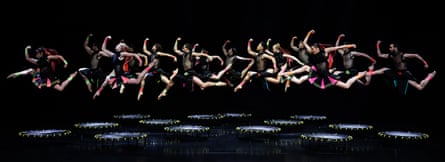
It all adds up to 150 minutes yet flies by and the evening culminates in an eye-popping Bolero performed on trampolines that suggests Gauthier is also an aficionado of DanceTok. Tonight’s audience can’t keep their cameraphones in their pockets as it builds steam. The concept may seem ridiculous but it is infectious fun, each dancer’s bounce accentuating the insistent repetition of the sultry rhythms. Andonis Foniadakis’s choreography is transformed into a tongue-in-cheek exercise class as dancer after dancer arrives on stage with their own trampoline to join in, the increasing spectacle of endurance adding to Ravel’s epic crescendo.
In this daisy-chain of performances on a bright red stage, the music choices are as eclectic as the dance styles: Dominique Dumais’s corps pulsating to Laurie Anderson’s O Superman, Marco Goecke (of the dog faeces attack on a critic) fusing a solo and duet to Mercedes Sosa, or the summery fun of Benjamin Millepied performed by a bright athleisure-clad crew to Oscar Peterson.
Johan Inger’s A Thousand Thoughts melds the Kronos Quartet’s ominous Bells and its version of the traditional Swedish folk music Tusen Tankar for a haunting duet with a fairytale quality, the dancers joining souls (and, in some bewitching floorwork, soles) for movement that is rich in mystery and bracingly pure in its vision of companionship. These snatched minutes together seemingly amount to a lifetime. No less gripping is Virginie Brunelle’s Carousel, to Philip Glass’s music for Les Enfants Terribles, where the central couple’s revolving encounters are scrutinised by the other dancers.
The bright young performers of Gauthier’s Juniors company (at 19-23, older than they sound) are a great match for the playful humour of a Devendra Banhart medley that accompanies Alejandro Cerrudo’s Lickety-Split. These insouciant duets and carefree encounters are a delight, down to one dancer playfully head-butting another’s rear into just the right position. After all, in Gauthier’s alphabet of dance, A is not just for arabesque but also for ass.
-
Holland Dance festival runs until 21 February, with many performances then touring. Chris Wiegand’s trip was provided by the festival.