3 months ago
59
3 months ago
59
Every January, if not earlier, awards narratives leading up to the Oscars take shape. While the specifics of the Academy Award nominations are never known in advance, and can always be counted on for some surprises when they’re actually unveiled, critics and pundits and fans all enter into that final stretch with a pretty good idea of who won’t be nominated.
Some of this is because of the endless spitballing. But the “won’t” list is also easy to compile because it ultimately houses almost everyone who acted in a movie over the past year. Twenty performances are selected for the Oscars annually, and given the other high-profile awards bodies with additional preferences, category numbers and a never-complete overlap with the Academy, let’s say about 40 are in the broader competition of real possibilities. But there are so many more great performances every year than that, across all sizes, scopes and genres.
They’re not all in equally great movies, and they don’t all fit into the Academy’s collective imagination of what constitutes the best work of any given year. Even as that organization has grown a bit more adventurous, there will always be individual performances that simply didn’t have much of a chance for any number of reasons: release date, box office, critical support, genre biases and so on. But it doesn’t have to be that way! It’s possible to buck the status quo, whether it’s as an awards voter looking beyond the most-hyped contenders, or simply as a viewer looking for something interesting to watch on a Friday night. So read this rundown of the year’s overlooked-by-awards performances, then, as suggestions for last-minute consideration from Academy members – or, more likely, recommendations from looking at great acting from some different angles before settling in for the usual annual horserace.
Oona Chaplin, Avatar: Fire and Ash
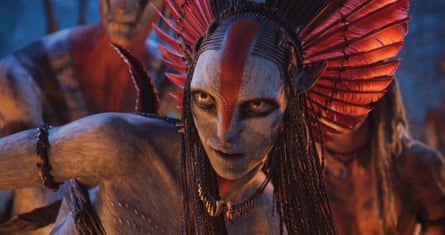
Here’s a silver lining of the Academy’s longtime resistance to the idea of nominating a motion-capture performance: just think of how impossible it will ever be for some generative AI nonsense to make it to the virtual podium! In the meantime, though, it’s a shame that the nuances of performance capture have long been consigned to the visual effects category, rather than acting. Avatar mastermind James Cameron has tried to emphasize this distinction in some of his promotional material for Fire and Ash, the third installment of the series, and plenty of critics have rightly pointed out that last year’s best supporting actress Zoe Saldaña gives a more fleshed-out performance in these movies, where not so much as a centimeter of her actual real-life flesh is shown on screen. Now that Saldaña has her Oscar, we can at least mix things up and advocate for Oona Chaplin, who gives an intensely physical motion-capture performance as Varang, the complicated but unhinged baddie (in both senses of the word) from Avatar: Fire and Ash. As leader of the aggressive Mangkwan clan, Varang is both menacing and weirdly seductive, depending on the kind of charisma that can’t be summoned by a mere click of the mouse. Chaplin – yes, granddaughter of the legendary Charlie Chaplin – gives Varang a distinct personality through movement alone, with her battle-ready posture, confident strut and fiery snarls. Chaplin helps create one of the most captivating (and secretly lovable) villains of the year, and even through the digital makeup, you can see she’s having a blast doing it.
Kirsten Dunst, Roofman
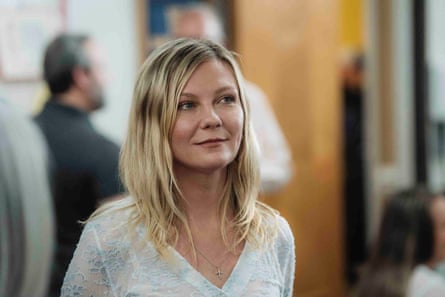
So many acting honorees are (somewhat understandably) spotlighted for their high-difficulty virtuosity, whether imitating a real person, conveying superhuman degrees of suffering or disguising their familiar faces with transformative makeup. In Roofman, Kirsten Dust doesn’t do any of that. More than just about anyone on this list, she’s more or less just playing a normal person: a Toys”R”Us employee, single mom and generally nice lady who falls in love with a charming guy (Channing Tatum) who’s secretly a fugitive from prison living in the store where she works. The movie is a showcase for Tatum, yet Dunst never plays as if she’s filling a thankless love-interest role; her struggles, disappointments and small-scale joys all radiate from her face without too much exposition walking us through it. In particular, the scene where she first decides to ask Tatum out on a date is a miniature masterpiece in making multiple emotions legible while maintaining a relative placid surface. It’s some of the best, truest, least fussy acting in a big-studio movie this year.
Ralph Fiennes, 28 Years Later
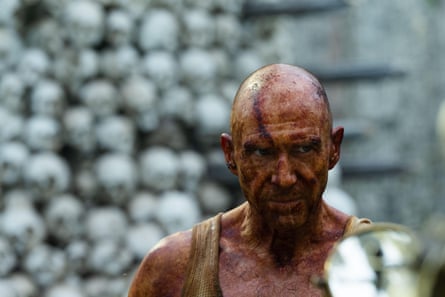
He looks like a deranged butcher, covered in dried blood, and his rumor-based reputation during the first hour-plus of 28 Years Later matches up with the ominous glimpses we get of his isolated form. But when Dr Ian Kelson (Ralph Fiennes) is eventually introduced, it turns out he’s a thoughtful, soft-spoken, sensitive man –and what looks like dried blood is actually just iodine, used to repel the infected zombies roaming the English countryside where he continues to make a home. Fiennes has plenty of experience playing unhinged villains, and doubtless could have been a memorable one in Danny Boyle’s long-gap zombie sequel. What he does instead in 28 Years Later, guiding young hero Spike (Alfie Williams) through the death of his cancer-stricken mother (Jodie Comer), is far more surprising and moving. Kelson doesn’t speak much about his own backstory; he exists mostly in the movie’s here and now, whether or not building a monument to the dead – infected and not – is tenable in the long term. Fiennes does the same in his performance, using his flawless sense of gentle authority to walk the audience through a horror-movie climax about accepting death, rather than fleeing in terror.
Danielle Deadwyler, The Woman in the Yard, and Tatiana Maslany, Keeper
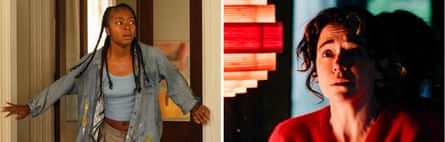
Speaking of horror: with Frankenstein and Sinners both in play for multiple awards categories, the genre is poised to continue its surprising resurgence at the Oscars this year. But it still often takes an all-hands-on-deck super-production to break through a horror bias, and movies like Keeper and The Woman in the Yard are too thornily small-scale to garner that kind of mass acclaim. They both feature a psychologically tortured woman at the center, confined to a limited location and haunted by forces she doesn’t entirely understand. Maslany is a woman cautiously entering her second year in a romantic relationship, holding the screen as she starts to wonder whether she’s losing her mind. Oz Perkins’ movie purposely doesn’t give her a surfeit of specific history, and Maslany stays wonderfully focused in the moment. Deadwyler, on the other hand, has plenty of backstory to contend with as a woman near-paralyzed by grief following the death of her husband. At home with her two children, she’s confronted by a ghostly, veiled figure in the front yard, and as she attempts to figure out what it’s there for, Deadwyler gives a wrenching performance of just barely getting by. In high-risk material that could easily fall into bad-taste territory, Deadwyler keeps it unflinchingly honest.
Dylan O’Brien, Twinless

Michael B Jordan is expected to receive a much-deserved Oscar nomination for clearly delineating the pair of identical twins he plays in Sinners. Dylan O’Brien’s double act in Twinless isn’t nearly so balanced; one twin, Roman, has essentially just a single sequence, and we spend the rest of the movie in close proximity to Rocky, who is racked with grief over Roman’s recent death. Even if we never saw Roman, though, O’Brien would deserve attention for his turn as the rough-edged but sweet-natured Rocky, who develops a friendship with a fellow member of a support group for people who have lost their twins. O’Brien has to play plenty of qualities that it would be easy to caricature; Rocky is tough, emotionally confused and not exactly quick-witted. Yet the actor never succumbs to broadness, delivering writer-director-costar James Sweeney’s dialogue with guileless, sometimes heartbreaking charm. When we do get that brief look at Roman, it only confirms the fullness of O’Brien’s makeup-free transformation.
Keanu Reeves, Good Fortune
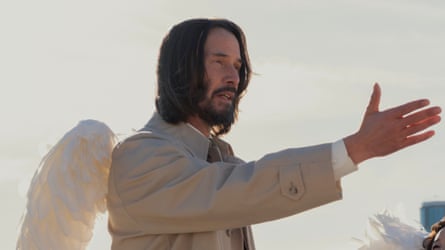
In the nearly 40 years since Keanu Reeves ascended to stardom playing half of a duo whose combined brainpower probably amounted to one dumb teenager in Bill & Ted’s Excellent Adventure, he’s more than proven his stealth versatility. (His action roles alone show more range than plenty of Oscar winners.) It’s another measure of his skill that he’s able to return to a bumbling dumb-guy role in Good Fortune and spin something completely different from it. Reeves has long possessed an otherworldly quality, and he flaunts it to comic ends as Gabriel, a low-level guardian angel reaching beyond his station. In executing his thin plan help a poor guy (Aziz Ansari) realize how good he has it by switching him with a rich guy (Seth Rogen), Gabriel clearly isn’t a top-tier celestial intellect. But Reeves never loses sight of Gabriel’s puppyish desire to help; he plays him more daft than dumb, which makes the performance even funnier as he embarks on his own fish-out-of-water journey. The way he innocently asks to tag along and crash with an impoverished Rogen is somehow both adorable and hilarious; the way he describes his eventual love for those around him in his newly humanized life is emotional without turning sappy. Reeves turns Gabriel’s failure into a state of grace.
Jeffrey Wright, Highest 2 Lowest
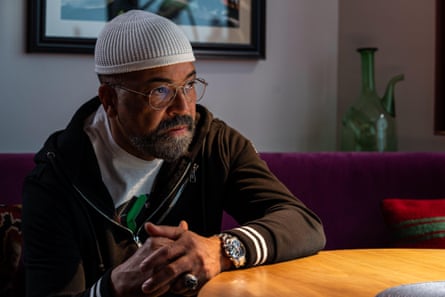
What are the lines between sidekick, close confidante and employee? It’s a question some wealthy folks probably don’t ask themselves often enough, and while it’s not the central question of Spike Lee’s Highest 2 Lowest, it’s an angle on the story that’s impossible to ignore every time Jeffrey Wright is on screen. Wright’s Paul Christopher is the longtime driver for music mogul David King (Denzel Washington), as well as an ex-con; their sons are best friends, which is how Paul’s kid winds up mistakenly taken by kidnappers looking to hold David’s kid for ransom. They ransom the wrong son anyway, sending David into a dilemma that has Paul questioning his place at David’s side. Wright is often well-cast as brainy types, as in his work for Wes Anderson (he was in The Phoenician Scheme earlier this year). He’s equally effective here as a man whose livelihood depends on a wealthy friend – and maybe on the increasingly difficult task of ignoring the many millions of dollars separating the two of them.
Amanda Seyfried, pretty much everything

Amanda Seyfried’s work as the title Shaker in The Testament of Ann Lee probably counts as one of the aforementioned 40-or-so performances in the serious awards mix. Then again, she seems to be moving toward the outskirts of this year’s contenders, without recognition from the Sag’s actor awards or the Baftas. That alone would be a shame, because Seyfried is monumental in the role. Unmoored after giving birth to four children who die before age one, her Ann Lee possesses herself with purpose, devoting her life to an offshoot of Quakerism that forbids any sexual contact, even within marriage. It also features testimony in the form of vigorous hymns and accompanying dances, where Seyfried’s lovely voice turns in something at once ecstatic and desperate.
But even if Seyfried does count as fully considered in Ann Lee, she offered two other terrific performances in 2025 for good measure. In the little-seen but worthwhile drama Seven Veils, she’s an opera director grappling with past abuses and a crumbling marriage. She looks perpetually moments away from screaming in frustration, though she mostly keeps that energy bottled up, roiling behind her signature saucer eyes. And in the much-seen, very silly but highly entertaining The Housemaid, she riffs on gothic gaslighting tropes, as well as superficial suburban-mom perfection, with movie-star glee as a woman who appears to be the unhinged boss from hell. Awards are obviously for specific performances, not a full year’s CV, but Seyfried’s trio of 2025 roles complement and accentuate each other so well that any one of them is worthy of recognition.