3 months ago
70
3 months ago
70
Key events Show key events only Please turn on JavaScript to use this feature
AstraZeneca predicts more strong sales and profit growth in 2026
Britain’s biggest drugmaker AstraZeneca has forecast more strong sales and profit growth this year, on the back of its cancer treatments and newer drugs, as it expands in the US and China.
The FTSE 100 company’s share price rose by more than 2% in early trading.
Pascal Soriot, chief executive since 2012 who has rebuilt the company’s drugs pipeline and turned AZ into the UK’s most valuable listed business, is steering it towards a target of $80bn in annual sales by 2030, despite price cuts in the US and shifting tariff and healthcare policies.
The drugmaker is pushing strongly into the US and China, its top two markets, with $50bn and $15bn investments respectively over the coming years. It listed its shares in New York and they began trading on 2 February, but kept its main listing in London.
While Soriot has reiterated AZ’s commitment to the UK, it has had a prickly relationship with the UK government of late, with a long-running row between industry and ministers over drug pricing and access to new drugs on the NHS.
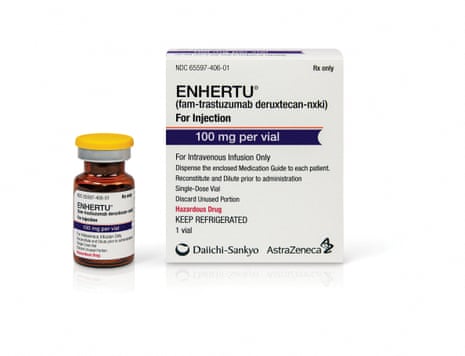
For example, AZ’s breast cancer infusion Enhertu has not been recommend for use on the NHS in England and Wales by NICE ( National Institute for Health and Care Excellence), the body that assesses new drugs for cost effectivenesss.
The drugmaker scrapped a planned £450m expansion of its vaccine site in Speke near Liverpool a year ago, and paused another £200m investment in Cambridge in September.
The company is predicting that 2026 revenue will grow by a mid-to-high single-digit percentage at constant currency rates, and core profit growth of a low double-digit percentage.
In 2025, sales rose 8% to $58.7bn while profits were up 11%, in line with expectations. Sales in the fourth quarter rose 2% to $15.5bn, slightly better than analysts had expected.
Sales of cancer drugs rose 20% to $7bn in the quarter, but revenue from cardiovascular drugs fell 6% to $3.05bn, party due to generic competition.
Soriot said the drugmaker now has 16 blockbuster medicines.
The momentum across our company is continuing in 2026 and we are looking forward to the results of more than 20 Phase 3 trial [late-stage] readouts this year. We have more than 100 Phase 3 studies ongoing.
Introduction: Global stocks reach record highs; BP annual profits slump 16%
Good morning, and welcome to our rolling coverage of business, the financial markets and the world economy.
Global stocks hit a new record in Asian trade, led by a three-day rally in Tokyo where the Nikkei jumped to a fresh peak, after Japan’s conservative governing coalition strengthened its grip on power.
Sanae Takaichi’s Liberal Democratic party (LDP) secured a comprehensive victory in Sunday’s election. The Nikkei jumped 2.3% to a new all-time high, and the yen rose for a second day.
The gains pushed the MSCI All-Country World Index 0.2% higher to a new record.
The dollar slipped in Asian trade, and is now flat against a basket of other major currencies.
Ipek Ozkardeskaya, senior analyst at Swissquote, said:
So, the US dollar kicked off the week on the back foot, and upcoming US data from today through Friday will determine whether the pressure continues or whether the greenback finds some relief.
US retail sales today are expected to show slowing growth in December — not great news for the most festive month of the year. On Wednesday, the official jobs report is expected to come in soft, with around 70k non-farm job additions, a steady unemployment rate and slower wage growth at 3.6%.
On Friday, the consumer prices index is seen easing to 2.5% from 2.7% previously. If soft labour data is combined with cooling inflation, US [bond] yields and the dollar could remain under pressure — supporting gold, other metals, Bitcoin and equities, particularly small-, mid-cap and value stocks.
BP has posted a 16% drop in annual profits, with earnings hit in the final three months of 2025 because of sharply lower oil prices.
The FTSE 100 firm reported underlying replacement cost profits – its preferred measure – of $7.5bn (£5.5bn) for 2025, down from $8.9bn in 2024.
It came after fourth-quarter profits plunged 30% quarter-on-quarter to $1.5bn, but were up nearly 30% from the same quarter in 2024. BP said it was putting its share buyback programme on hold to strengthen its balance sheet, to invest in oil and gas opportunities.
Carol Howle, who is running the oil giant on an interim basis until its new chief executive Meg O’Neill starts in April, said:
We are reducing capital expenditure for 2026 to the lower end of the guidance range, while continuing to drive down our cost base. We are also taking decisive action to high-grade our portfolio and strengthen our company, including the execution of our $20bn disposal programme and the decision to suspend the share buyback and fully allocate excess cash to our balance sheet.
O’Neill has been described as a “hard-nosed” outsider who will head BP’s pivot away from green energy.
The Agenda
-
9.45am GMT: UK Treasury committee to question Treasury and housing ministers on affordability of home ownership
-
1.30pm GMT: US Retail sales for December
-
2.45pm GMT: UK Business and trade committee hearing on US-UK trade deal