2 months ago
67
2 months ago
67
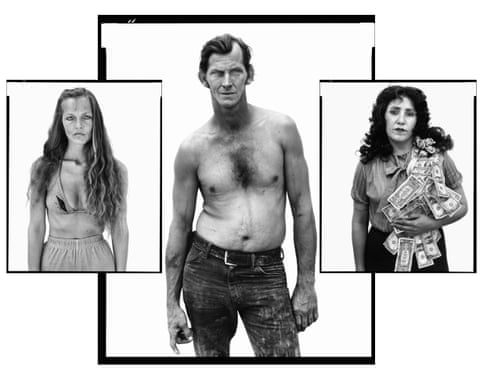
From crying miners to birthday girls via a body therapist and a meat packer, portraits from Richard Avedon’s celebrated series In the American West are on show in a new exhibition curated by his granddaughter
Face off … Charlene, Billy and Petra pose for Richard Avedon Photograph: Richard AvedonTue 27 Jan 2026 08.00 CET
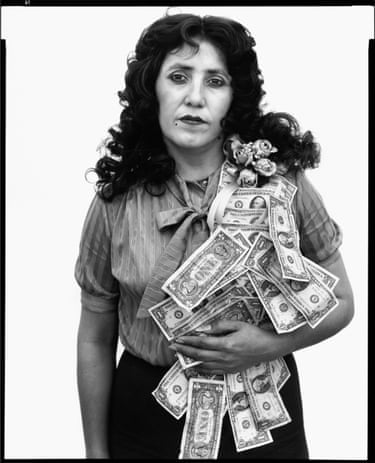
Petra Alvarado, factory worker, El Paso, Texas, 1982
Richard Avedon: Facing West is an exhibition of rare prints from the photographic series In the American West (1979–84). It includes works that have not been shown since their debut in 1985. Shown here is Petra, photographed on her birthday, posing with money given to her by family and friends to mark the occasion. Richard Avedon: Facing West is at Gagosian Grosvenor Hill, London, until 14 March. All photographs: Richard Avedon. Images curated by his granddaughter Caroline Avedon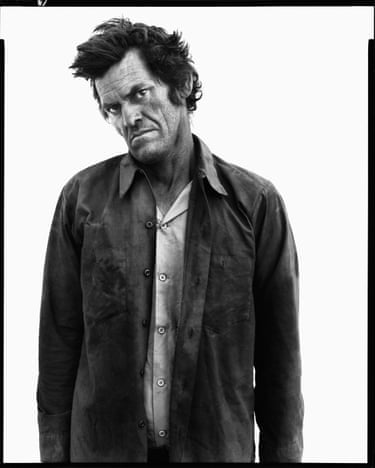
James Kimberlin, drifter, Hobbs, New Mexico, 1980
At the time of its debut in 1985, Avedon was well known for fashion photography, portraits of people in power and his work on the civil rights movement. These images, which picture the heart and soul of hardscrabble, working class America, represented a significant new development. Of this image, his granddaughter Caroline Avedon, the exhibition’s curator, says: ‘Kimberlin is intensely present and confrontational in his portrait, meeting the viewer with a directness that feels almost unsettling’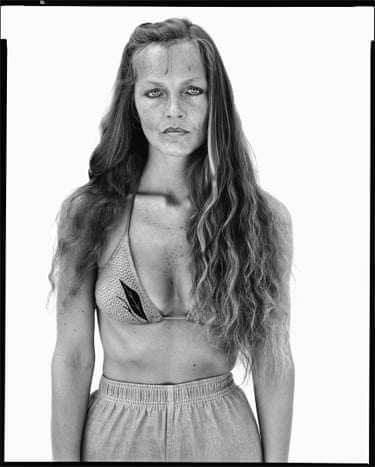
Charlene Van Tighem, physical therapist, Augusta, Montana, 1983
Caroline Avedon:‘When the series was first shown, at the Amon Carter Museum in Fort Worth, Texas, this was one of 10 images chosen to be printed at monumental scale and displayed on the museum’s façade. What strikes me about Charlene is the contrast between her striking physical presence and the distance in her eyes. She appears to be looking behind the camera and to the side. As a physical therapist, she would have been especially in tune with the body, but it’s as if her mind is in a very different place to her own body’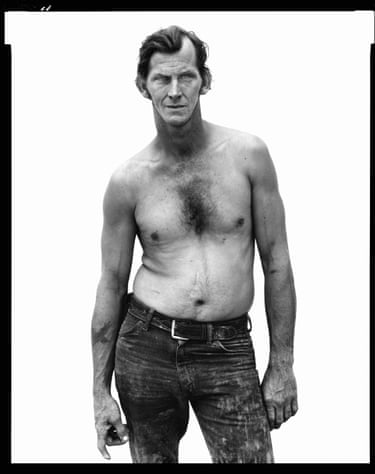
Billy Mudd, trucker, Alto, Texas, 1981
Richard Avedon said of this work: ‘There’s an interesting thing about Billy Mudd’s picture that worried me. His hand in the photograph naturally looks like David’s by Michelangelo. And I thought, “I don’t like art references in photographs.” But the picture was so beautiful, and the shape of his face like a mask, and his piercing blue eyes, that I thought, “Well, I’ll just have to forget about the hand”’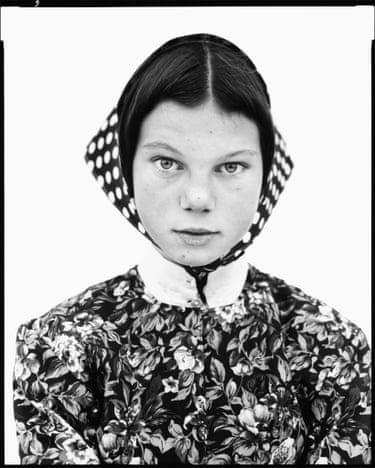
Freida Kleinsasser, 13-year-old, Hutterite colony, Montana, 1983
Caroline Avedon:‘Freida was not included in the original 1985 exhibition, and several Hutterite (a communal, Anabaptist Christian group) subjects were also absent from that first presentation. Although model releases were signed, no clear explanation was recorded at the time’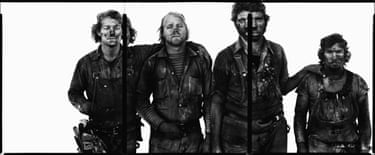
Roger Tims, Jim Duncan, Leonard Markley and Don Belak, coal miners, Reliance, Wyoming, 1979
For the coal miners’ portraits, Avedon began the sitting just after the men had showered and rushed out of the bathhouse at the end of a shift. ‘As I was photographing, a tear came down Roger’s cheek. I thought, “I don’t know what’s happening here but I must respect it, and not lose the truth of the moment by the slightest intrusion.” So I said nothing. Afterwards, he looked up and he said, “I like it down there.” I asked “Why?” And he said, “Because nobody can get to me”’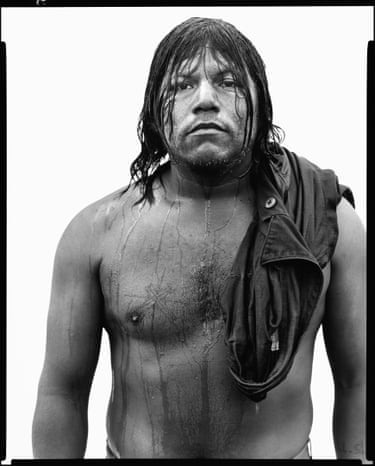
Unidentified migrant worker, Eagle Pass, Texas, 1979
In the American West is a body of portraiture about individual identity. With one exception, the subjects are named. But this man’s release form records him simply as ‘unidentified’. Here, that absence of a name becomes part of how the image is read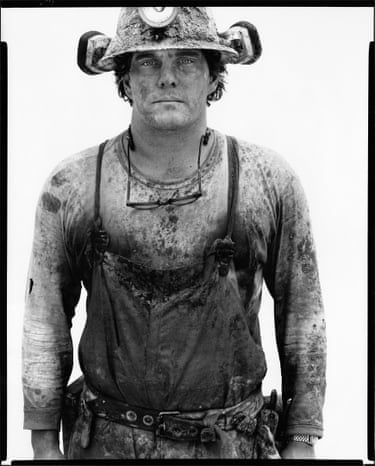
Joe Dobosz, uranium miner, Church Rock, New Mexico, 1979
A uranium miner, Joe Dobosz, appears open and familiar in his portrait. Shown alongside the unidentified migrant worker, his portrait brings into focus a tension between visibility and erasure, and underscores the anonymity and precarity of undocumented labour in America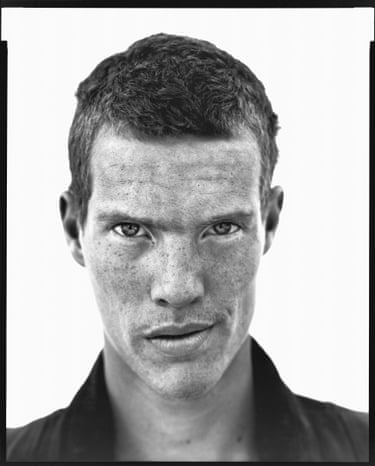
Robert Dixon, meat packer, Aurora, Colorado, 1983
Caroline Avedon: ‘Robert is so enigmatic. At different times, his appearance has conveyed completely different moods to me, and I’ve seen the same reaction from many other people. Is he smiling, smirking or sneering. Is he a playful joker or something more intimidating? Either way, this ambiguity is part of what makes this image so powerful’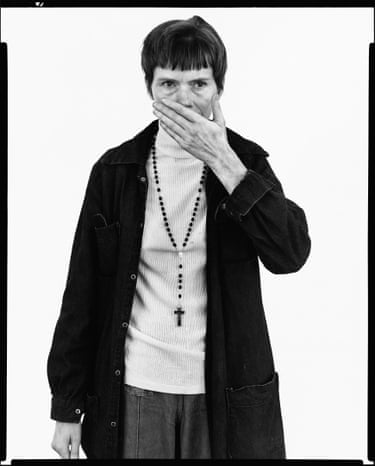
Rochelle Justin, patient, State Hospital, Las Vegas, New Mexico, 1980
Rochelle later said the portrait ‘captured exactly how I felt – that no one heard me.’ Reflecting on the series in 1985, Avedon said, ‘To be seen is to be heard … this body of work now belongs to the people who are in it … it’s between them and you.’ Nowhere does that exchange feel more present than here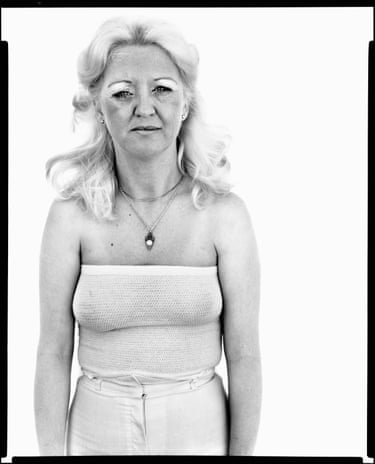
Carol Crittendon, bartender, Butte, Montana, 1981
Avedon spent five years, from 1979 to 1984, travelling to 21 US states. He conducted more than 1,000 sittings, finally producing 126 editioned images, 21 of which are on view in London. Of this image, Caroline Avedon says: ‘Carol appears exhausted and distant in her portrait; only moments earlier she looked very different. The contrast reveals Avedon’s interest in the moment when the mask slips, and how much can shift in an instant’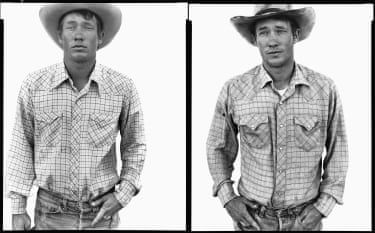
Richard Wheatcroft, rancher, Jordan, Montana, 1981 and 1983
Photographed on separate occasions, in 1981 and 1983, Wheatcroft’s diptych is a rare instance of time unfolding within the series. At first glance little appears to change, but subtle shifts in posture and expression reveal the quiet accumulation of lived experience. Avedon photographed Richard six times in total, a process that led to a close relationship with him and his familyExplore more on these topics