3 months ago
63
3 months ago
63
“Has a footballer ever been sent off but still won player of the match?” asked Jimmy Clark. The short answer is yes, quite a few. We’ll kick off with a couple of recent examples.
“In 2024 Anthony Gordon was shown a second yellow card for Newcastle against West Ham just as the TNT commentary team were declaring him the player of the match,” writes Tom Reed. You can see the moment in question in this video (around 2:50), as Gordon is dismissed after kicking the ball away. Perhaps the substitute Harvey Barnes, who scored twice in the 4-3 comeback win, would have been a better choice.
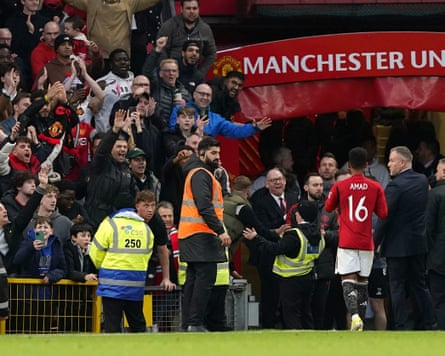
Another 4-3 victory, nominated by Chai from Atlanta. “In Manchester United’s epic FA Cup quarter-final against Liverpool in 2024, an already-booked Amad Diallo scored the winner in the dying minutes of extra time. He ripped off his shirt in celebration and was subsequently booked, resulting in a red card. Amad was later voted by fans as the player of the match.”
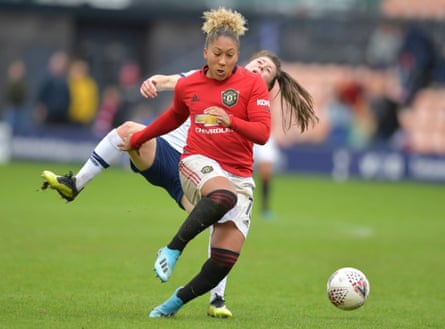
Another United player (at the time, anyway): “While playing for Manchester United, Lauren James was sent off for a foul that took place just as the BBC commentary team announced her as player of the match,” writes Eddy Reynolds. It happened during the 3-0 Women’s Super League victory over Spurs back in October 2019, with the forward sent off after two late yellow cards.
Back to Tom Reed, and the magic of the Cup. “In 2006, Lee Steele scored both goals for Chester City at Bury in the FA Cup second round, and also picked up two yellow cards – the second for jumping in the crowd to celebrate. After a 2-2 draw, Chester lost the replay but were reinstated when Bury were expelled for fielding an ineligible player. Chester went on to play Ipswich in the third round, with forward Jonathan Walters catching the eye, to the extent that Ipswich signed him for £100,000.”
All excellent shouts, but this one takes the biscuit. “In the 2020 Spanish Super Cup final against Atlético, Real Madrid’s Federico Valverde earned the player of the match award because of a red card,” writes Andrea Parapini. “With the game goalless late on, Valverde hacked down Álvaro Morata to stop him running through on goal.”
Andrea explains: “Real went on to win 4-1 on penalties and Luis Enrique, who was the Spain head coach at the time, gave Valverde the award.” The Uruguayan midfielder’s dark-arts masterclass also led to Madrid fans calling for a statue, and even earned grudging respect from Diego Simeone, game forced to recognise game.
Symmetrical goalfests
“Magdeburg won 5-4 at Greuther Fürth last week, avenging a 5-4 home defeat in August,” wrote Jason Smith. “Have there been more than 18 goals in two teams’ league meetings in a season, and are there other examples of unusual repeat scores?”
“This specific scoreline has not happened before in both teams’ meeting in an English league season,” begins Chris Roe. “There is one example from English league history with more goals in symmetrical results. It came from Division Two in 1960-61 when Charlton and Plymouth played on consecutive days, each winning 6-4 on home turf.”
As Chris points out, these fixtures were part of an unusually high-scoring run of games between the two sides. “From 1959-60 to 1962-63 the teams’ eight matches produced 60 goals, which is a Football League record.” The full result list (with Charlton’s score first): 4-6, 5-2, 6-4, 4-6, 1-2, 3-1, 1-6, 6-3.
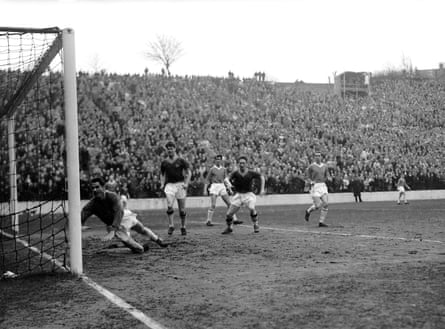
Chris offers two other symmetrical examples of note: Torquay 7-2 Millwall and Millwall 7-2 Torquay in Division Three (South) 1956-57, and Aston Villa 6-2 Blackpool, Blackpool 6-2 Aston Villa in Division One back in 1932-33.
Also worth a mention purely on aggregate score is the classic Charlton v Huddersfield in 1957-58. “In addition to the famous 7-6 Charlton win, when they recovered from 5-1 down with 10 men, the teams drew 3-3 at Huddersfield earlier in the season,” says Tim Green. “They also met in the FA Cup that season, Charlton winning the replay 1-0 after a 2-2 draw – a total of 24 goals in four matches.”
Impressive, but it doesn’t quite match the free-scoring Addicks’ double-header with Argyle. To improve on 20 aggregate goals, we have to cross the North Sea. “In the 1983-84 Eredivisie season, Utrecht beat Excelsior 7-4 in September,” notes Stephan Wijnen, and a few others. “In the return game in February, Excelsior beat Utrecht 7-4.”
Symmetrical scores and 22 goals on aggregate – I think we have a winner. You can watch highlights of Excelsior’s revenge mission here.
Roux’s the boss
Following on from our extensive two-part look at players who made 97-99% of their appearances for one club, Ed Ricketts suggests an almost-one-club manager.
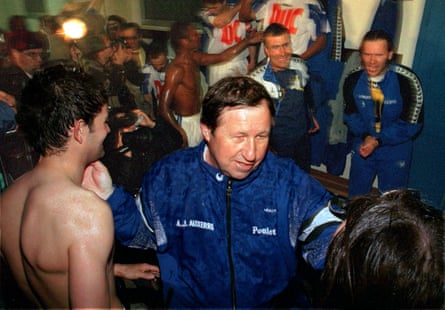
“May I humbly nominate the legendary Guy Roux, who managed Auxerre for 1,747 matches over 44 years from 1961 to 2005, and then came out of retirement to take charge of Lens for seven matches in 2007?” offers Ed, who even does the maths for us. “That means 99.60% of his matches as manager were with Auxerre.”
Scottish two-club title winners
“Hearts’ challenge to the Old Firm has us pondering: how many players have won the title with more than one club in Scotland in the last 40 years (since but not including Fergie’s Aberdeen). We can think of only Kenny Miller and Mo Johnston, with Craig Gordon being a potential third this season. Any others?” ask Rory and Paddy.
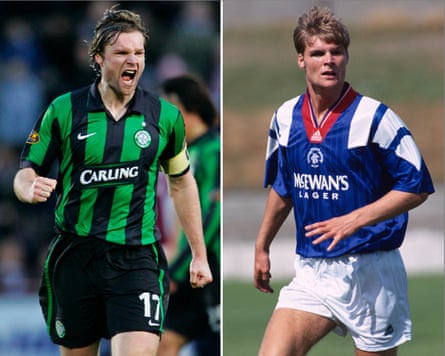
As mentioned, the sharp-shooting pair of Mo Johnston (Celtic, 1985-86; Rangers, 1989-90 and 1990-91) and Kenny Miller (Celtic, 2005-06; Rangers 2008-09, 2009-10 and 2010-11) have won the title with both Old Firm clubs. The only other men we can find did their work at the other end of the field.
The back-up goalkeeper Mark Brown was part of the Rangers squad that lifted the title in the 1999-2000 season, though he made only one appearance in the league. He later joined Celtic and played his part in their triumphs of 2006-07 (one game) and 2007-08 (eight games).
Steven Pressley was also part of Celtic’s championship-winning squads between 2006 and 2008, though like Brown, he was rarely first choice. The defender played a similar role at Rangers before that, appearing at least once in their four successive title wins between 1991-92 and 1994-95. Pressley’s best season at Ibrox was 1993-94, when he appeared in exactly half their 44 league games.
Knowledge archive
“After six games, Erling Haaland is single-handedly ahead of 14 Premier League teams on goals scored,” wrote Shaun Forster in September 2022. “When was the last time a player finished the season with more goals than an entire team?”
To update our original answer for the Premier League era, it has happened in nine Premier League seasons, most recently in 2024-25. In 2017-18, Mohamed Salah outscored three teams in his first Liverpool season, while Haaland ended up outscoring two sides in that 2022-23 campaign. As it stands this term, Haaland and Brentford’s Igor Thiago have scored more than hapless Wolves.
-
2002-03 Ruud van Nistelrooy 25, Thierry Henry 24, James Beattie 23; Sunderland 21
-
2005-06 Henry 27; Sunderland 26
-
2007-08 Cristiano Ronaldo 31, Fernando Torres 24, Emmanuel Adebayor 24; Derby 20
-
2013-14 Luis Suárez 31; Norwich 28
-
2016-17 Kane 29; Middlesbrough 27
-
2017-18 Salah 32, Kane 30; West Brom 31, Swansea 28, Huddersfield 28
-
2020-21 Kane 23, Salah 22; Sheffield United 20
-
2022-23 Erling Haaland 36; Everton 34, Wolves 31
-
2024-25 Salah 29; Southampton 26
-
2025-26 Haaland 22, Igor Thiago 17; Wolves 16
A larger top division meant that before 1992, such solo scoring feats were rare; even Dixie Dean did not outscore any teams in his 60-goal 1927-28 season. In 1983-84, though, Ian Rush (32 goals) outscored the bottom club, Wolves (27), while Everton’s Bob Latchford notched 30 to Leicester’s 26 in 1977-78. Finally, back in 1971-72, Francis Lee outscored relegated Huddersfield by six goals, 33 to 27.
Can you help?
“With Sean Dyche being sacked by Nottingham Forest, and the club now appointing their fourth manager of the season, it got me thinking: what’s the most number of permenent bosses a club has had in one season?” asks Derek Robertson.
“In Napoli’s 2-2 draw with Roma on Sunday, there were only three corners in total. How many matches have had fewer? And has a match ever played out without any corners at all?” asks Mykyta Shchehlov.
“Before awarding his man-of-the-match award to Pedro Neto at Friday’s FA Cup game at Hull, Alan Shearer commented that no one could possibly not get the award after scoring a hat-trick,” notes Geraint Lewis. “Has this ever happened, and what were the circumstances?”
“Nigel Clough has been in charge of Burton (twice), Sheffield United, Derby and Mansfield in his long managerial career,” begins Gregg Bakowski. “It strikes me that he’s barely needed to leave his Derbyshire home throughout. Who is the most well-travelled (most clubs) non-travelling player or manager in football?”
“What is the earliest point in a season that all defending champions have been eliminated?” poses Des Hinton-Beales. “That includes the league, FA Cup, League Cup (or other countries’ equivalents) and the Champions League.”
-
Mail us with your questions and answers