1 month ago
59
1 month ago
59
The rebellion in India of the young, led by the Cockroach Janta party (CJP), unfolded against a backdrop of large, abstract, geometrical structures – arcs, planes, hemispheres – that together make up an observatory called Jantar Mantar, built in the early 18th century to refine almanacs and tell time. Jantar Mantar has been a byword for political protest for decades: it marks the space that the Delhi police assigns to the politically disgruntled so they can vent in a contained way. But it had never before hosted a political insurgency that started from scratch and forced the Indian state to back down in less than eight weeks.
When its founder, Abhijeet Dipke, brought the CJP to Jantar Mantar, it was a social media hashtag with 20 million followers. While he was studying in Boston, Dipke took the remarks of chief justice Surya Kant, who is accused of referring to the swathes of unemployed young people and activists as “parasites” and “cockroaches”, and turned them into a here-we-come meme. When he brought the CJP home to Delhi on 6 June to make it real, people were intrigued. Given the mostly dismal fate of civil society movements during prime minister Narendra Modi’s time in office, no one anticipated the David and Goliath contest that came to a head last Saturday.
Like other political tourists, I visited Jantar Mantar on 6 June out of curiosity. On that inaugural day it was modestly crowded and not that different from the dozens of demos I had attended over 50 years. The one difference was how young these so-called cockroaches were. I had seen young people mobilise against Modi’s government at close quarters before when the students of Jamia Millia Islamia, the university I taught in, came out against a pernicious citizenship bill. Their courage and idealism was defeated by a combination of police repression and organised rioting. This government’s willingness to use police brutality, vigilante violence and a pliant judiciary to snuff out protest hung over the fledgling CJP campaign like a shadow.
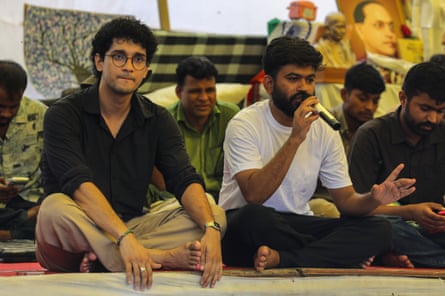
But when I returned a month and a half later on 20 July, the scheduled day for the march to parliament, Jantar Mantar was unrecognisable. A hunger strike had raised the political temperature of the protest. The government had forcibly removed the main hunger striker, Sonam Wangchuk, from the site and detained him in a hospital. The calculation was that his absence would defuse the tension and demoralise the protesters. That didn’t happen.
There were tens of thousands of people crammed into the barricaded space and thousands of police officers in attendance. The government had underestimated the size of the crowd that poured in by bus, train and car from Delhi and beyond. In the afternoon the Delhi police force and its masters compounded its miscalculation by attacking this giant gathering of young people with lathis (bamboo sticks) and teargas.
This tableau of brutality was shocking enough in real life, but in the hands of young digital natives, whose phone cameras were extensions of themselves, it became a gush of online content that brought the violent drama of this confrontation into every home. The callous violence of the police and the raging, mocking, laughing defiance of the young protesters played out on every mobile phone.
The cockroaches won where other protesters, not unlike them, such as Jamia’s students, had lost. They won, in part, because they weren’t visibly Muslim. There were Muslims among them, but this was a protest about the corruption of competitive examinations, an issue that concerns every middle-class family in India. It couldn’t easily be tarred as an anti-national conspiracy in the way that the struggle for secular citizenship led by Jamia’s mainly Muslim students was. This didn’t stop India’s mostly tame mainstream media from trying, but the scandal of the medical school examination was so egregious that no one gave them a hearing.
Also, this was in the heart of New Delhi, a stone’s throw from parliament. Once the government had made, from its point of view, the cardinal error of letting gen Z occupy the commanding heights of the capital, every day of the protest produced hundreds of new episodes of a national drama – a digital Mahabharat – in which the vulnerable and charismatic children of light faced off against the armed and uniformed enforcers of darkness. Bharatiya Janata party governments have sanctioned massive police violence against minorities in India’s borderlands, in Manipur, Assam and Kashmir. But this was Jantar Mantar, the sacred centre of the republic.
The leaders of the movement, Abhijeet Dipke and Saurav Das, had set themselves up for success by demanding a difficult but doable concession: the sacking of the education minister. It was difficult because Modi had never dismissed a cabinet minister in response to political pressure; this stubbornness was central to his strongman persona. It was doable because there were precedents in the history of the republic for a minister taking responsibility for a disaster and resigning.
Modi did everything he could to wriggle out of this standoff. He even produced a comically inept Instagram video promising fast-track courts to address the corruption in the examination system. When that didn’t work, his government capitulated and Dharmendra Pradhan, the education minister, departed. There was an assembly election scheduled in Uttar Pradesh next year and Modi knew that the BJP would haemorrhage political support if the Jantar Mantar impasse wasn’t resolved.
after newsletter promotion
The quarrel that some commentators on the left have with the CJP is that Pradhan’s dismissal was a symbolic victory but not a substantial one. Pralhad Joshi, the man who has replaced Pradhan as education minister, is not an improvement. Like Pradhan he is a member of the Rashtriya Swayamsevak Sangh, the BJP’s far-right parent body. He publicly defended the premature release in 2022 of 11 men convicted for rape in the notorious Bilkis Bano gang-rape case.
The CJP’s argument is that Pradhan was always a proxy for Modi. The point of the protest was to diminish Modi by forcing him to back down publicly. Also, it isn’t clear what a systemic victory would look like or how it would be achieved.
The striking thing about the CJP’s leadership is its youth and poise. Zohran Mamdani, the youthful mayor of New York, now seems a template. He is 35. Dipke, the CJP’s Dalit leader, is 30 years old. Ashutosh Ranka, who negotiated the end of the protest with the BJP’s leadership, is about the same age. Das, the other negotiator and spokesperson, is all of 26. Neha Bora, the president of a leftwing student organisation, the All-India Students’ Association, is 25. It’s hard to know how their politics will evolve. What they have in common is eloquence, message discipline, all-round unflappability and the potential to leave a legacy. They may be an enduring problem for this government. Jantar Mantar may have just produced an echelon of homegrown Mamdanis.
-
Mukul Kesavan is an essayist and author based in Delhi