3 months ago
58
3 months ago
58
Without wanting to sound tediously Scrooge-like, the German-style markets that have become seasonal fixtures in many British cities over the last few decades never make me feel particularly festive. What’s remotely Christmassy – or German – about Dubai-chocolate churros and Korean fried chicken, I grumble as I drag the dog (who enjoys all such things) around their perimeters.
Hamburg’s markets, however, which I was myself dragged around last weekend, are a very different story. For a start, the city has many of them, mainly fairly small – and some, such as the “erotic Christmas market” in St Pauli, with a particular theme. What they all have in common is the range of food and drink on offer … though let’s gloss hurriedly over the phallic gingerbread shapes on sale at St Pauli in favour of the eye-opening range of glühwein (white, rosé, kirsch-spiked, blueberry-flavoured), which was far more appealing.
Though I am familiar with it as a concept – mulled wine with an umlaut in it – from now on I shall insist that everyone refers to Henry Dimbleby’s white version as Weißer Glühwein in tribute (if you’d prefer to delegate the mulling, Joanne Gould tips Waitrose’s mulled rosé as one of her festive favourites). I also enjoyed eierlikör, which is essentially eggnog; if you, like me, enjoy getting drunk on custard, it’s worth making your own – and my recipe can be given a more Germanic feeling by using brandy and white rum instead of the whisky, and replacing the nutmeg with vanilla extract. (You probably don’t need instructions on how to make a boozy hot chocolate, but here’s some guidance from Tony Naylor anyway.)
The food in Hamburg quickly became as familiar as the drinks menu. Naturally, there were bratwurst grilled over an open flame, often accompanied by an avalanche of the country’s beloved curry sauce, and sides of salmon (Hamburg is very much a fish-eating city), but also käsespätzle (Yotam Ottolenghi has a deliciously cheesy-looking recipe) and the wonderfully-named kartoffelpuffer potato pancakes, plus more recent innovations such as handbrot, or dough balls stuffed with various fillings that almost always involve cheese – and, more weirdly, crumble. (You can’t get away from crumble at the moment, but none of it looks as good as the school stuff to me.)
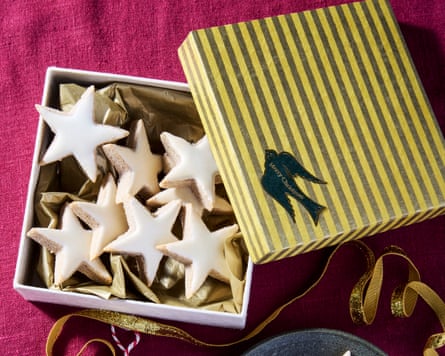
Although most people seemed to be there to eat, drink and be merry, the point of these markets is ostensibly shopping and, perhaps unsurprisingly, the food stalls were my favourites. Christmas cookies are a big deal in Germany; Luisa Weiss has some lovely ideas, while Anna Jones put her own stamp on some citrus, honey and almond lebkuchen; and just last weekend Meera Sodha shared her friend’s grandma’s recipe for zimtsterne. I brought a selection home, along with some solid, marzipan-stuffed stollen bites, which my stodgy northern heart will always prefer to panettone. Stollen is also considerably easier to make at home: Dan Lepard has a good quick recipe involving sour cherries and quark, though, if you’re not in a hurry (and this is not a time of year for hurrying), you might prefer Falko Burkert’s more traditional take.
Lastly, if anyone has advice on recreating the huge chocolate rumkugeln I saw but didn’t have time to try, please send it my way. In the meantime, Frohe Weihnachten; wishing you all a delicious and joyous December, however you’re spending it.
My week in food
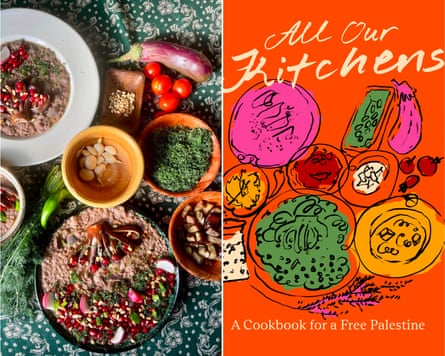
A time for giving | Christmas, like so many religious festivals, is a time for giving – whether or not you celebrate, you might wish to share the love where it’s really needed by investing £10 in All Our Kitchens, a new digital cookbook featuring recipes from the likes of Sami Tamimi, Noor Murad and Andi Oliver, along with other professional and home cooks from across the UK, Ireland and Palestine. All profits go directly to Gaza Soup Kitchen and the Zaynab Project, two charities working to feed people on the ground in Gaza, where the situation is still desperate. Download it here.
Mmmmmmarzipan | I was disappointed not to see more marzipan on offer in Hamburg (it’s a speciality of nearby Lübeck). Happily, however, the latest Kitchen Projects newsletter on Substack is a deep dive into all things almond paste-related from Camilla Wynne, including a recipe that sounds far superior to versions I’ve made, as well as many inspirational pictures of cute marzipan potatoes and devilled eggs and doughnuts.
Skaus or scouse? | Hamburg is famous less for its hamburgers than the dishes that reflect and celebrate its maritime heritage. Fish sandwiches are the fast food of choice at all times of day and night, while comfort food is served in the form of labskaus, a salt beef and potato hash turned unnervingly red with beetroot juice and served with a fried egg, pickles and the inevitable rollmop. If the name sounds familiar, it is because this sailors’ favourite is also enjoyed in stew form in Liverpool, where it’s known as lobscouse, commonly shortened to scouse. My recipe does not, however, include herring.
Saluti! | Raising a glass to chef Giancarlo Caldesi, whose contribution to Italian cuisine and culinary culture in the UK was recognised by the Italian government with the title “Ufficiale”, which is roughly equivalent to a British knighthood. Celebrate with the Caldesis’ (gluten-free!) chocolate and almond torte.