3 hours ago
17
3 hours ago
17
The setting for perhaps the country’s biggest exercise in public debate was quintessential rural India: fields of green paddy, a pond, a temple. On a normal day, as dusk falls in the village of Ajgara, in Uttar Pradesh, people gather beside the pond to chat about the price of crops, the weather, or the theft of a goat.
But for more than a month, metaphysics and ethical dilemmas replaced the usual topics. Is it permissible to use deceit to defeat an evil enemy? Is a lie justified to save a life? What is the nature of reality?
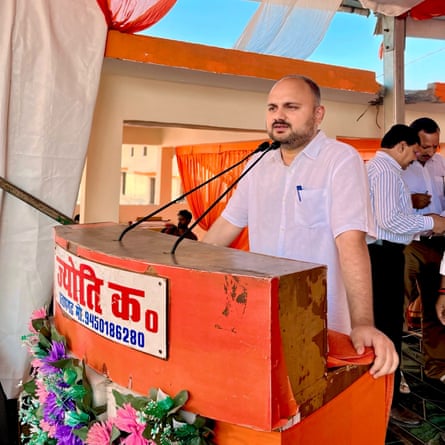
The debating tournament was the brainchild of Abhishek Pandey, district magistrate of Pratapgarh district in Uttar Pradesh. When he took up the post two years ago, he knew the area was rich in archaeological treasures connected to the ancient Indian epic, the Mahabharata.
Throughout the text, Yudhishthira, one of the central characters, debates the nature of human existence. In Ajgara he answers a string of philosophical questions to save the lives of his four brothers.
Pandey, 35, like most Indians, grew up on this story and was proud of the intellectual depth of the dialogues. When he attended Oxford University on a fellowship, he admired the debating society, which has a 200-year-long history. But India’s tradition of sophisticated public debate is much older, going back more than 3,000 years.
Pandey started to question why the tradition had not survived. “Indians have celebrated certain traditions for centuries,” Pandey says. “Why have we ceased to celebrate the legacy of debate and questioning?” Was it possible to revive this noble tradition, particularly when it was a vital component of a democracy?
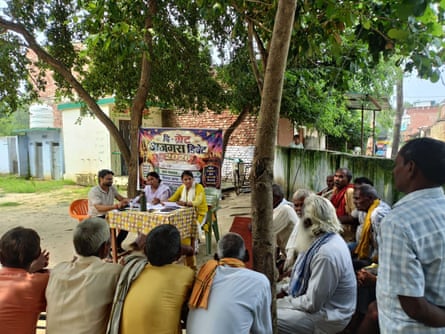
He decided that the annual fair held in Ajgara in September would be a good time to stage the event. In the run-up to the fair, Pandey and his team arranged 1,500 debates across the district.
Age and education were no bar. The youngest participant was a 10-year-old schoolboy, the oldest an 80-year-old farmer. In debating for and against a motion, participants were judged on reasoning and moral clarity.
The overwhelming public response dumbfounded Pandey. Thousands of people participated in multiple rounds, and were whittled down to eight finalists – two women and six men.
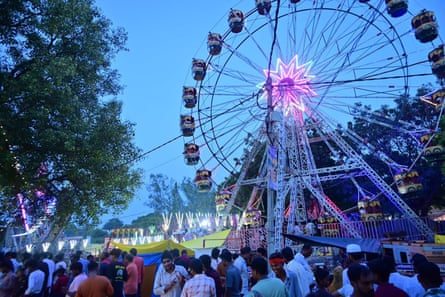
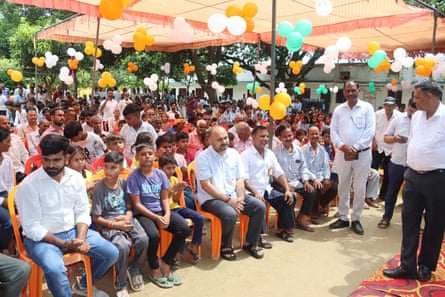
While villagers milled around, enjoying the food, watching folk theatre, buying local crafts and taking a ride on a ferris wheel, a silence descended inside the debating tent.
The finale of the Great Ajgara Debate 2026 on 17 September lasted about six hours.
One topic was women’s rights. A finalist, Vivek Singh, argued that women might have equality on paper but society’s expectations of them impeded the exercise of these rights.
Another, Prajjwal Shukla, 24, argued that the real question was not what role society assigned to women but who had the authority to make those choices. Whether a woman chose a career, household responsibilities, or both, should be her choice and hers alone, he said.
“What amazed me the most was not the intellectual quality of the debates (which was great), but the atmosphere. Everyone listened respectfully, patiently, without interrupting. No one got personal. People sat for hours,” says Pandey.
Marx’s adage that history repeats itself, first as tragedy and then as farce, is a perfect description of how debate in India has descended from the sublime to the farcical.
In television studio debates everyone shouts at the same time. No one can finish a point. Personal abuse and gibes fly while the anchor whips them into ever greater frenzies.
Sadhana Dwivedi, one of the two women to progress into the last round of the Great Ajgara Debate, despises this new format.
“People need to learn to listen, to understand there may be value in another person’s point of view,” she says. “In a democracy, it is crucial for all opinions to be aired so that we can get to the truth.”
The turnout was a good demonstration of the thesis posited in economist Amartya Sen’s book The Argumentative Indian that India had a rich tradition of questioning authority and entertaining heterodoxy.
It is only in recent years that dissent has been suppressed, notably by the ruling Hindu nationalist Bharatiya Janata party, which values conformity.
“It’s ironic, because the BJP wants to recreate a Hindu state but is not even acquainted with the traditions of ancient Hindu civilisation, such as that of debate and being open to different ideas,” says author and commentator Parsa Venkateshwar Rao Jnr.
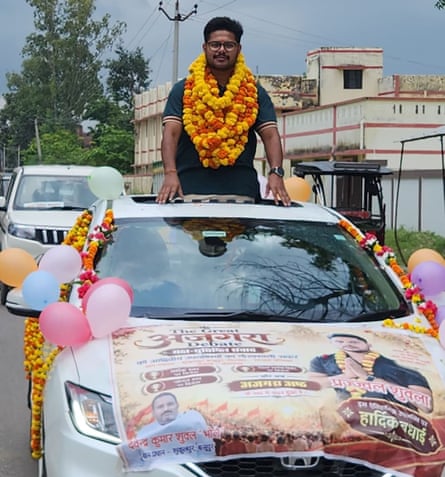
At the end of the tournament, the eight finalists were garlanded and driven around in an open-top car to much cheering, feted as “intellectual heroes”. The winner was Shukla, who is preparing to sit exams to enter the civil service.
“I can’t believe I am the winner of a debate that took place at the exact same spot as in the Mahabharata all those centuries ago. I participated just because I wanted to hear other people’s thoughts,” he says.
Pandey is still processing the public enthusiasm. “My deputy asked me if we should get some police deployment because the turnout everywhere was so big, but I laughed and said no. That would be a sad affair.”
He hopes to spread the event across other Indian states and perhaps nationwide. “We have to inculcate a culture of debate. It’s the hallmark of a democracy.”
Meanwhile, he has planted his flag. The inscription on the stone slab he has installed at the site reads: “The Great Ajgara Debate. First Debate 3152 BC: Yudhishthira. Second Debate 2026: Prajjwal Shukla.”