2 hours ago
5
2 hours ago
5
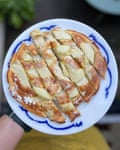
Schmarrn, or schmarren, Anja Dunk writes, is “peasant food at its best: filling, simple and comforting”. The usual English translation, pancake, a dish we generally associate with delicate desserts is, I think, somewhat misleading; schmarren, as it’s also spelled, bears very little resemblance to a thin, lacy crepe, and instead sits somewhere between our own plump, rich Shrove Tuesday numbers and a batter pudding. Indeed, you’ll find it on the sweets section of restaurant and cafe menus, but in Germany, Dunk reports in her book Strudel, Noodles and Dumplings, it “passes as a main meal, not dessert, because it is very filling and not particularly sweet in flavour”, and also, I suspect, because “it takes 10 minutes to make from start to finish” and is therefore a brilliantly quick supper. (“Quite frankly,” she adds,” as a mother, I find this recipe a godsend.”)
Austro-Hungarian in origin, it’s eaten in both Germany and Austria, and there are many variations, including kaiserschmarren (studded with rum-soaked raisins), savoury potato schmarren, semolina schmarren and bread schmarren, though fruit, often apples, but also stone fruit or berries, seems to be the most common pairing. Whether you’re serving this as a main course (it goes very well with sausages) or afterwards, it’s a very handy addition to the repertoire, especially when paired with soured cream or ice-cream.
The batter
All the batters I try are made with the same basic ingredients: eggs, flour and milk. Where this differs from a standard pancake, or indeed a batter pudding, though, is that the whites are whisked and then folded into the batter, to give a kind of souffle effect that prevents this undeniably hearty dish tipping over into full-scale heaviness. That said, the ratios of each ingredient are of course important. Alfons Schuhbeck’s recipe in The German Cookbook includes more than twice as much flour as almost every other recipe I try, and more milk, too, yielding a flat, dense result that, while tasty, lacks the lightness of the others. Ernest R Schulz of Larchmont, NY, who sent his recipe to the New York Times in 1980 in outraged response to food editor Craig Claiborne’s description of a kaiserschmarren as a rolled crepe, is the only one to use a similar quantity of milk to flour, which makes for a very liquid batter that’s deliciously smooth to eat, but difficult to turn in the pan.
My testers express a marked preference for the more egg-heavy recipes from Dunk and the Discover SüdTirol website, which prove lighter and fluffier, and have a richer flavour; the latter uses an equal proportion of milk and cream, which is even nicer, though if you don’t have cream in the house, just add more milk. There’s also the question of how hard to beat those egg whites – Dunk goes for stiff, Schuhbeck for soft and Hinnerk von Bargen, author of the Culinary Institute of America’s Street Foods book, for medium peaks. I find the stiffer the meringue, the harder it is to incorporate evenly, and the more air it seems to lose in the pan, so I’ve gone for a soft, creamy foam.
The flavourings
As Dunk makes clear, this is not an especially sweet dish; most recipes use barely a teaspoon of sugar, though Schuhbeck and von Bargen are both a little more generous. Judge your audience and sweeten accordingly, bearing in mind that it will be dusted with icing sugar before serving.
Though you can leave it at that, as Schulz did (one must sadly assume, as he was 70 when he sent in his recipe, that he is probably no longer with us), most people add a little something extra. Vanilla is common – whether in the form of vanilla sugar, fresh seeds or extract – as is lemon zest. Schuhbeck adds cinnamon and rum and von Bargen kirschwasser, all of which are excellent combinations, though I’ve stuck with the zest and saved the cinnamon for the topping.
The fruit
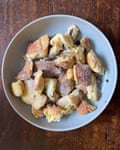
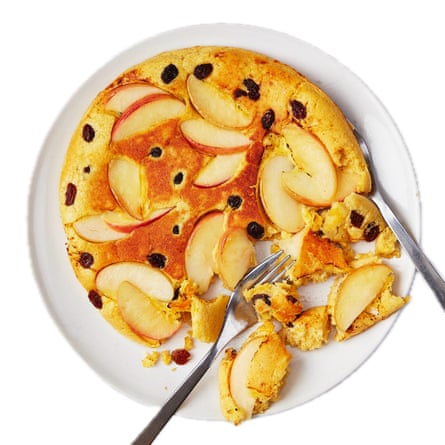
Both Schultz and von Bargen serve the apples in compote form alongside the schmarrn, which works well, but it’s even nicer (and far quicker) to incorporate them into the pancake – any eating variety will do (cooking apples will break down and dilute the batter, so are better stewed and served as an accompaniment). I don’t think there’s any need to remove the peel, whatever shape you’re cutting them into; you can grate the apples, as Dunk does, or cut them into small pieces, as in the SüdTirol recipe, but we all like them best in Schuhbeck’s slightly chunkier wedges, which look prettier and make the fruit feel more like the star of the show. Arranging them on top of the batter, as he suggests, rather than folding them in, gives them the chance to caramelise slightly, too.
Some recipes, including Dunk and Schulz’s, incorporate raisins as well, which, though an apparently controversial addition, are a time-honoured combination with apples. You could substitute another dried fruit, if you like, or leave them out altogether, but those pops of sweetness prove popular in such a plain dish (to make it a kaiserschmarrn, soak them in rum first, as Schulz recommends).
The method
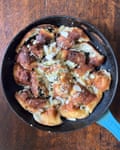
Traditionally, one assumes, this is made on the stovetop, but if you don’t mind turning on the oven, you’ll get a better rise by giving the schmarrn a brief blast of hot air. It will also make life easier; while making the Schultz and von Bargen versions on the stovetop, I realise it’s a very delicate art to achieve a golden, crunchy base on both sides and a fluffy interior all the way through without burning anything. If you’d prefer to use the hob, simply cook the second side in the same manner as the first. Either way, don’t worry if you break the pancake while turning it over; once cooked, it’s then broken into pieces and tossed with sugar to caramelise anyway. (Schuhbeck does this under the grill, but I find it easier to control the browning if I have my eye on the pan).
Almost everyone except for the SüdTirol cooks it in butter, which clearly tastes far superior to their oil. Also – though you might wish to skip this step if you’re making a quick supper – it’s worth browning that butter first, as per Schuhbeck’s recipe; the nutty notes it gives the dish are delicious with the apples.
The topping
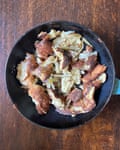
A cloud of icing sugar is a must, and we all like Dunk’s idea of turning it into cinnamon sugar instead (as a cinnamon agnostic, I will refrain from suggesting that nutmeg would be even nicer, but it probably would). We also like Dunk’s crunchy flaked almonds, but both are entirely optional. As with the nutmeg, chopped hazelnuts, pecans or walnuts would make a fine substitute for those not concerned with authenticity, and even those who are should know that this can be served with any sort of fruit compote, and is particularly good with plums.
Perfect apfelschmarrn
Prep 10 min
Cook 15 min
Serves 2-4, depending on appetite
40g butter
90g flour
½ tsp salt
3 eggs
75ml milk
75ml cream (single, whipping or double), or 50ml extra milk
Finely grated zest of ½ unwaxed lemon (optional)
1 tbsp caster sugar
1 dessert apple
25g raisins, or currants or sultanas (optional)
1 tbsp icing sugar
½ tsp ground cinnamon (optional)
Flaked almonds, to finish (optional)
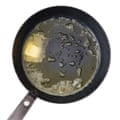
Melt the butter in a medium ovenproof frying pan on a medium-high heat, leave to brown to a pale golden colour, then take off the heat – reheating will continue the browning process. Heat the oven to 220C (200C fan)/425F/gas 7.
Put the flour and salt in a large bowl. Separate the eggs, then put the whites in a large glass or metal bowl and the yolks in a smaller bowl.
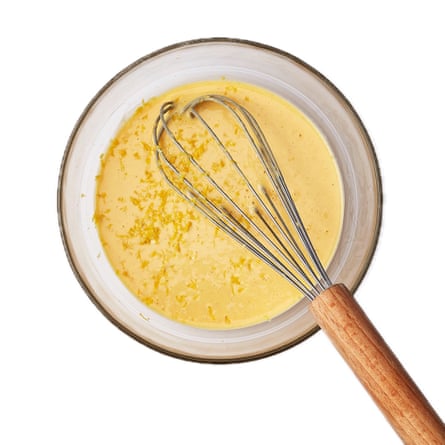
Beat the milk and cream, if using, into the egg yolks, then whisk into the flour to make a smooth batter. Stir in the lemon zest.
Beat the egg whites until foamy, then add the caster sugar and whisk to soft, creamy peaks that hold their shape but flop over at the top. Fold a little of the egg-white mix into the batter to loosen it, then fold in the rest.
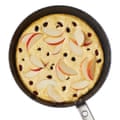
Cut the apple into thin wedges, and remove and discard the core. Pour two tablespoons of the melted butter into a bowl, put the pan back on a medium heat and, once sizzling, pour in the batter. Arrange the apple slices and raisins, if using, on top, then leave to cook to a rich golden brown underneath. Carefully flip over the pancake (don’t worry if it breaks), then put in the hot oven for five minutes.
Meanwhile, mix the icing sugar with the cinnamon, if using. Use two forks to break the pancake into bite-size pieces. Tip out on to a plate or work surface and put the pan back on a medium-high heat with the reserved melted butter. Add the almonds, if using, and lightly toast, then top with the pieces of pancake and sprinkle with most of the sugar. Toss over the heat to coat, then divide between plates. Sprinkle with the remaining sugar and serve hot.
-
Schmarren, schmarrn – however you spell it, please share your wisdom on this homely Germanic mountain favourite. Or do you prefer to enjoy it in the sophisticated coffee houses of Vienna? Sweet or savoury? Fruity or plain? Baked or fried? All tips appreciated!