3 months ago
71
3 months ago
71
For us, what makes the Christmas period so special is how the nature of our celebrations and observances can be profoundly personal and widely shared at the same time. And nothing symbolises this better than the food and drink that fill our tables. In today’s newsletter we explore Christmas food traditions across the diaspora and how they represent our familial identities and wider communal histories.
There isn’t a single route to crafting a Nigerian Christmas table. Traditions vary from family to family, but there are a few staples that you will find at any large, celebratory gathering, regardless of the time of year: mountains of plantain; coleslaw smothered in salad cream or mayonnaise; an array of starters (spring rolls, chicken wings, savoury donut-style puff puff balls, samosas) endearingly known collectively as “small chops”; two types of rice: fried, and the regional favourite jollof. In our home, we have inherited the coloniser’s turkey, but most people choose chicken or beef, either roasted or prepared in a stew.
You will find many similarities on a Ghanaian table. At Morgan’s, “we opt for the centrepiece protein to be chicken, roasted to perfection. Some have been known to enjoy a good leg of lamb.” Elsewhere on the spread, our west African friends enjoy “turkey or chicken gizzards cooked in a flavoursome peppery tomato stew and skewered.”
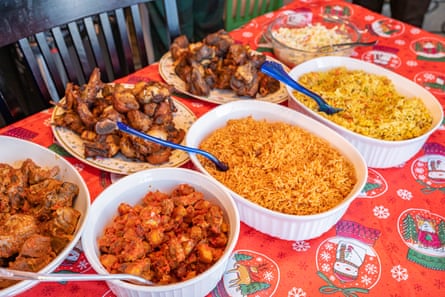
I find it joyful that across west Africa, nations distinguish between your regular, day-to-day jollof and its festive “party jollof” variant, which gets its unique smoky flavour from cooking it in a large pot over an outdoor flame. There isn’t the space to get into whose jollof is better, but Morgan and I both agree that no plate is verified without a side of our absurd salads that feature anything and everything between *holds breath*: lettuce, tomatoes, cucumber, carrots, and onions, mixed with proteins like boiled eggs, sardines, or corned beef, baked beans, and all bound with a dressing (in Nigeria it’s really a drowning) of salad cream, mayonnaise or ketchup.
Side dishes are also essential for a Black British community that does embrace traditional British Christmas fare, but also need dishes that offer a little spice and a taste of their roots. Next to the classic trimmings of parsnips, carrots, and (maybe) brussels sprouts that surround the central roast, you will find mac and cheese, rice and peas, plantains, stews, and soups.
“We use that to celebrate the community that we engage with in our home away from home,” Morgan adds. “Space has always been made during these gatherings to celebrate the things we take for granted, too. For me and many others, the presence of a well-cooked Fufu, a boiled and pounded dough made from cassava root, dipped in aponkye nkra kra, a spicy goat meat soup, makes that possible.” Across the Atlantic, some of these ingredients play a shared festive role but in different forms. On a table in Brazil, cassava appears again. Farofa has smoked bacon, salty Calabrese sausage, sweet carrots, briny, salty olives, and aromatic onions and garlic. It is served with feijao (beans), meats and rice. The cassava flour is toasted and mixed with various flavourings, such as fat (oil or butter), pork and garlic. In Brazil, it’s used as a stuffing for their Christmas turkey called Farofa de Natal.

Across the diaspora, once you’re filled up to your heart’s content, washing down the enjoyment usually comes in the form of a hibiscus-based drink: known as sorrel in the Caribbean, bissap rouge in Senegal, sobolo in Ghana, zobo in Nigeria, and agua de Jamaica, jugo de Jamaica, or rosa de Jamaica throughout much of Latin America.
The hibiscus plant, often called roselle, is indigenous to continental Africa but now thrives in tropical regions of the western Hemisphere. Hibiscus-based beverages are made by steeping the plant’s flowers; once harvested and deseeded, they can be used fresh or dried in recipes ranging from jams and cordials to tea-style drinks like sorrel. These hibiscus beverages carry deep historical significance throughout the diaspora. From the early 1500s, the transatlantic slave trade brought not only enslaved Africans, but also livestock and plants such as hibiscus, to the Americas. Because the climates of Latin America, the Caribbean, and the American south closely resembled those of west Africa, plants like sorrel took root, becoming integral to the culinary traditions of these regions.
Of all the variations, sorrel is a particularly festive main event in the Caribbean. Sobolo, also called roselle juice , is made from the flowers of the roselle plant, a variety of hibiscus. The resulting deep red-purple drink is often infused with pineapple and ginger, giving it a tangy flavour. Many of these hibiscus drinks can be enjoyed hot or cold and are sometimes mixed with spirits, typically sweetened with simple syrup, sugar, or honey. Recipes often include spices and aromatics such as cloves, ginger, allspice, star anise or mint. Some versions add citrus notes via lemon or orange. For authentic Ghanaian preparation, hwentia (also known as grains of selim or negro pepper), a popular west African spice, is essential, whereas angostura bitters are more commonly used in Trinidadian versions.
African American gatherings feature “red drink,” which refers to a range of sweet, ruby-coloured drinks enjoyed not only during Juneteenth but also during the festive period. Even though some versions of red drink may not contain roselle, the concept is believed to be a descendant of west Africa’s long hibiscus-flavoured history.
It is important to remember that many of these traditions did not begin with the introduction of Christianity and Christmas. Across west Africa and the Caribbean, there is evidence of pre-colonial festivals where the gathering of food and community play a dominant role, from the Caribbean’s Mas parades to Nigeria’s New Yam festival and Ghana’s Aboakyer festival. The way we gather, together, has always been central to understanding exactly who we are. And there’s no better time of year to remember that.