3 months ago
85
3 months ago
85
Above my grandma’s bed hung a framed black‑and-white photograph of my dad. As a small child I quietly admired it; his luminous eyes, dark hair and gentle smile. He embodied a tender yet spirited early adulthood, staring into the future. Handsome and seeking.
As I grew older, I would discover that it was not, in fact, a photograph of my dad but of a man called Elvis Presley. Apparently he was very famous. My grandma had been a lifelong fan. My parents laughed – an adorable mistake – but I felt a hot pulse of humiliation.
Ten years later, over a family breakfast, it was mentioned in passing that the same grandmother was not blood-related to us. We shared her surname but not her genes. I was sipping orange juice when a swell of disorientation surged over me. It was another detail that the rest of the family apparently knew but had never told me; they thought “I already knew”.
The biology mattered less to me than the secret. Dad had been adopted, it turned out. A classic affliction of the 1950s, in which young, unmarried couples were forced to give away their newborn babies. We were not to talk about it with him. “As far as he’s concerned his adoptive parents were his parents,” Mum told me. “He didn’t want to upset them by going looking for anyone.”
But I was always curious. I grew up, went to university and sustained a career in curiosity: making investigative documentaries for television, and moonlighting as a ghostwriter. The story of where my dad came from – and therefore where my siblings and I all came from – fascinated me.
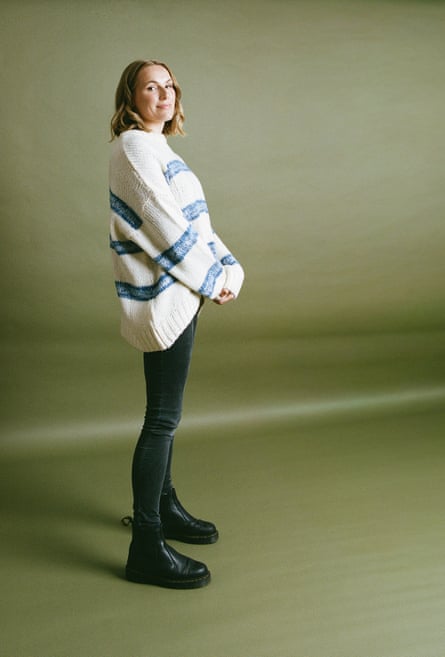
Another decade passed, but my curiosity remained. When I saw an advert for a DNA website called 23andMe in December 2016, I signed up to its Christmas offer straight away. It was perfect – I could discreetly find out more without needing to ask Dad. The transaction was simple: send off some saliva in the post and six weeks later the results would appear on my phone as a full genetic ancestry and personal health profile.
One day I mentioned it to Mum in passing.
“Are you sure you want to know?” she asked.
I had not told her that my purchase had been triggered by an interest in Dad’s side of the family.
“Yeah, why not?” I replied.
“You might find out something you wish you hadn’t.”
I thought Mum was concerned about me finding a faulty gene, perhaps a predisposition to Parkinson’s or a certain cancer. It didn’t cross my mind that she might be talking about anything else.
Six weeks later, the results came back. European ancestors: 95% from the United Kingdom and Ireland. Boring. I had no close DNA relatives on the site. I was slightly more prone to late-onset Alzheimer’s. Oh well. I told my family at our next gathering and showed them the maps and pie charts on my phone.
“Cool,” they said, and that was it.
Three years later, I logged on to the website again, clicked on a button, and everything changed.
Irony, in its broadest sense, is the juxtaposition of an expectation and an opposing reality. I had signed up to the DNA website to discover more about my dad’s origins and our shared ancestry, but it revealed that he was not my biological father.
The new person had appeared right at the top of the page listing “DNA relatives”. Lucy. Half-sister. 27.9% DNA shared. I stared at the screen. It made no sense. I didn’t have a half-sister. It must be a mistake. I Googled “Wrong DNA match”. The answers? “Very rare”, “99.9% accurate”, “Possible but unlikely”.
I clicked on Lucy’s profile.
“Birth Year 1990. Location, England. As an IVF child (‘made’ in Nottingham Queen’s Medical Centre, UK) I would love to find my biological dad.”
We were born six months apart. I read the words again. I was even more confused.
I had known since I was a teenager that my siblings and I were conceived by in vitro fertilisation. There are four of us in total: Tim, me, Joe and Ruth, in that order. The latter three of us being triplets born on the same day.
Perhaps my dad had donated some leftover sperm during the IVF process for another family to use? Or maybe there had been a mix-up in the lab?
I went outside, into the February-chilled streets, and called Mum.
“Hello darling, what’s up?” she answered in her usual cheery tone.
“Hello, so something really weird has just happened,” I said.
“You know I did that DNA test a while ago?”
“Yeah.”
“Well, I’ve just logged on and clicked on something and it says I have a half-sister.”
“What?” she said, surprised.
“Yeah. I don’t really understand. It says she’s on the paternal side.”
There was a long pause from both of us.
“Are you there?” I asked.
“Yes, it’s just that you’ve dropped a bit of a bombshell on me and I’m not sure what to say.”
I could feel her shock thrumming through the phone.
“Are you sure it’s a half-sister?” Mum asked. “She might be an aunt or cousin from Dad’s side of the family that we don’t know about, because he was adopted.”
“Yeah, maybe. I’ll do some more research and find out.”
We said goodbye, hung up, and I got straight back on to the internet. I discovered that, on average, full siblings share around 50% of their DNA and half-siblings around 25%. Other relations that share a quarter of your DNA include a grandparent, aunt, uncle, niece or nephew. But Lucy was only six months older than me. One possibility, the internet said, was that we were double first cousins, meaning our fathers were brothers and our mothers were sisters. It seemed wildly unlikely.
I decided to message Lucy on the website.
Hi Lucy, hope you’re well. This DNA result comes as a bit of a surprise! I think it’s possible we could also be 1st cousins or aunt/niece, so it would be good to swap more information. Can I ask what you know about your biological dad?
Lucy replied swiftly.
Hello! My dad was a sperm donor. As far as I know they tried to match my dad (the man who raised me) to the donor so apparently he was a young medical student, 6 foot 3 with green eyes. Not sure how true that is but my twin sister (not identical) and I are both green grey eyes and 5 foot 8ish. Amazing to have a new blood relative! Was your dad a sperm donor? I’d love to hear more. Thank you for getting in touch :)
I took a screenshot of the message and sent it to Mum.
“This is so confusing. So now I’m worried that the young medical student’s sperm got mixed up with Dad’s. Or … am I not related to Dad?”
Two blue ticks. Mum had read the messages. Four minutes passed.
“Lol you OK? You there?”
“Dad and I need time to digest the info and work out all the implications – so can we talk it over at the weekend?”
Her tone felt serious now. My heart raced.
Three days later, I boarded a train to my parents’ house in Nottinghamshire. Mum picked me up from the station and, after some mundane chat about the journey, I couldn’t wait any longer. “So are we going to talk about it?” “I’m not going to discuss it now,” she replied, curtly.
It was late when we arrived home so I went straight to bed, feeling disturbed by her abruptness; fearing what was coming.
I didn’t sleep well and in the morning I made cups of tea and coaxed Mum and Dad into the living room. Mum closed the door behind us and locked it. Dread stirred in my gut.
“Can you just tell me what’s going on?” I asked.
Dad perched his elbow on the armrest, hiding his face with his hand. Mum sighed into the thickening air.
“When we went for fertility treatment for my blocked fallopian tubes,” she began, “they also discovered that Dad’s sperm wasn’t viable.”
She stared blankly ahead. I could tell how hard it was for her to say these words aloud.
“It was a double whammy of bad news,” she continued. “And so the clinic offered us a sperm donor.”
My heart sank. I had my answer, finally.
“No one else has ever known. It was just me, Dad and the hospital staff,” Mum said, “and they encouraged us not to tell anyone.”
I fixated on the ornaments above the fireplace – two golden brass dogs, one on either side, stoutly perched there since before we were born. I didn’t know what to say, so I just nodded. It was a relief to be sitting in the truth, dank and disappointing though it was.
Mum motioned her eyes over to Dad who was sobbing underneath his cloistered hand. I stood up and moved towards him, arching my body over his convulsing frame. I’d only seen him cry like this once before in my life, when his mum had died 20 years earlier.
“It’s OK, Dad,” I muffled into his shoulder, gripping his arm.
He placed his hand on top of mine but said nothing.
I was appalled that my stupid curiosity had done this.
“I’m sorry,” I said, my belly knotting around this unfamiliar territory. “It doesn’t change anything.”
Dad was still bent over and shaking. Mum still stared vacantly ahead. I had trodden on a landmine that I didn’t know was there.
“So, did you pick him out of a catalogue or something?” I asked, not able to bear the silence.
“We just let the hospital choose,” Mum replied.
“Lucy, the half-sister, said he was a young medical student, 6ft with green eyes.”
Neither of them said anything.
“We never thought you’d find out,” Mum said. “How were we to know that DNA websites would exist one day?”
I nodded slowly.
“We’ll have to tell everyone now,” Dad murmured, eventually.
“No, wait,” I interjected. I looked at the floor. “I don’t know if we should.”
Dad lifted his head.
“I wish I hadn’t found out,” I said, hoping it would comfort him, though I still meant it. “We don’t need to tell them.”
The thought of breaking three more hearts was too much to bear.
A few moments passed. I had so many questions but didn’t know how to ask them without upsetting Dad even more. I was still my mother’s biological daughter; they had fixed her fertility problem but not his. An invisible line had been drawn between us, and I hated it.
“So we won’t tell them, then?” Dad confirmed.
I nodded.
I continued messaging my half-sister Lucy and she told me more about her twin sister, Libby. One Sunday the three of us met for a roast dinner at a pub in east London. I was nervous walking in, but Lucy and Libby were friendly, funny and easy to talk to. We noticed we all had the same colour hair and were about the same height; Lucy just slightly taller. I was amazed to discover that Libby lived in Dalston, just down the road from my flat. We were born in Nottingham but had somehow ended up living less than two miles apart.
We took photographs, and drank cocktails into the evening. When the time came to pay the bill, each of us put down the same debit card, and I took a picture of our three purple cards lined up together in the little dish.
Nine months later, in early 2020, I was at work when I received a flurry of messages from them both.
“It’s happened! We found him!”
The sperm donor had signed up to the same DNA website and we were matched. I couldn’t believe it.
Lucy messaged him and he replied straight away. She sent us a screenshot:
Hi Lucy, from the results I have received today it appears that I am your biological father and also your twin sister Libby. I studied for my PhD at the University of Nottingham. Here is my email. I hope you have had an interesting life.
Two hours later, Lucy forwarded some photos the donor had sent of himself when he was younger. They had scraped a few more facts from his profile, including his birth year, revealing that he had been in his early 20s when he donated, and Lucy had also asked him some questions. He had a 20-year-old daughter of his own, he said. His mother studied psychology, “just like one of the twins in St Petersburg”. Twins? Russia? Apparently we had international half-siblings, too. It was a lot to take in.
Libby sent a picture of the profile photo attached to his email address. He looked a bit like my dad when he was younger. Libby and Lucy said he didn’t look anything like their dad.
Soon, Libby and Lucy had an email chain with him and were asking lots of questions. Everything from “What’s your favourite cocktail?” to “Is your second toe longer than your big toe?” I was still in shock. It felt like a step too far to contact him myself.
Within a few months the Covid pandemic shut down the world. Almost overnight I lost my job, broke up with my boyfriend, and moved back in with my parents. It wasn’t quite what I had envisioned for my 28-year-old self.
For more than a year the family secret had been mentally tugging at me and to quieten it down I had decided to donate my own eggs to a stranger. I weighed up the pros and cons and decided it would be worth it to help someone else, as well as a fitting form of closure for me.
In an ideal world I would have waited until I’d had my own children before donating, but I didn’t want to risk being too old, as egg donors must be under the age of 35. Ultimately, I figured if I was just washing my eggs down the toilet every month, someone else might as well be using them.
I found an egg donation agency online and sent them an email. A nice lady called me back the next day and we had a long chat over the phone. She said that of all the donors she had spoken to over the years, it sounded like I had the most in-depth understanding and empathy for the recipients because of my own story. The next step, she said, was to send me an at-home blood test kit to check my AMH level (anti-Müllerian hormone) as it is a good indicator of how many eggs you have left.
By this point, I had already been diagnosed with endometriosis, like my mum, and was approaching 30, so I also saw donating as a chance to get a fertility MOT.
Since all my TV work had fallen through due to the pandemic and I was relying on a couple of small ghostwriting jobs for the foreseeable, it was a bonus that I would get paid £750 in expenses to donate.
A couple of weeks after I’d posted back the sample, the woman from the egg donor agency called again. She told me my AMH level was on the low side but enough to donate. Next I would have to fill out an online profile – to give them a sense of “my personality and character” – and upload two photographs, a recent one and another from when I was a small child. Only the agency would see the current photo, to help them match me appearance-wise, while the picture of me as a child would be seen by my recipient family.
Within a few weeks, I was matched. The recipient was informed about my endometriosis diagnosis and decided to continue with the match. Because of the laws around anonymity, they couldn’t tell me anything other than that the recipient was a single woman in her 40s.
“You have a lot in common,” the woman said. “If you knew each other I have no doubt you’d be friends.”
When I signed up to become an egg donor, I was asked for a detailed family medical history on both sides, including grandparents. I realised I would need to ask the donor some questions, but I felt conflicted about contacting him.
I believed I had a right to know about my health history, yet the act of extracting that information felt like a betrayal of my dad. I wanted Mum’s opinion, but she didn’t know I was donating my eggs, or that the donor had joined the website. I cornered her one day while she was doing chores.
“You know … the whole sperm donor thing,” I said. She stopped, briefly, and looked at me, before removing a pillowcase.
“Yes.”
I paused, my heart pattering. “I thought you should know that he recently signed up to the DNA website … so I know who he is.”
I showed her the photographs and she didn’t say much. There were two pictures of him in his 20s, neither of which was particularly clear. One was from a side angle and I could see he had quite a prominent chin, like me, but other than that he just looked like a generic white man with brown hair in a white T-shirt, drinking beer with his friends. He didn’t look particularly similar to me or my siblings. His recent photo was more pixelated. A generic middle-aged man with a mildly receding hairline.
“Do you know when he started donating?” Mum asked.
“No,” I replied. “Why?”
“Well, it’s just that I don’t know if they used the same donor for Tim or not.”
“Oh,” I said, stunned. “They didn’t tell you?”
“No, we just let them get on with it.”
I held back from commenting on how crazy I thought it was not to ask something so important.
“I could ask him,” I said. “I have his email. But I didn’t want to contact him without checking with you first.”
“I’m not going to stop you from doing anything,” she said.
“OK, thank you. I know it’s a bit tricky with Dad. I don’t want to bring it up again if it’s difficult for him. But I’ve also decided … ” I hesitated. “Well, it’s just a bit more complicated because … ” I was more nervous about this part of the conversation; I didn’t want her to react badly.
“I’ve decided to donate my own eggs,” I continued. “And they won’t let me do it unless I have a full health history from both sets of parents and grandparents.”
Mum’s eyes widened and her shoulders dropped forward. She sat down on the unmade bed.
“I haven’t told you until now because I didn’t know if they’d want my eggs and also because I didn’t want anyone to try and change my mind,” I breathed.
‘Right,” Mum said. Everything about her softened: her body, her voice. “As I said, I’m not going to stop you from doing anything you want to do.”
I felt an ache of empathy. It was another hit of unexpected news. First, that the biological father of her children was no longer anonymous, and then that I was donating her first biological grandchild to a stranger.
In my first email to Rodney (his choice of pseudonym, taken from the lyrics of a 1979 song called Duchess by the Stranglers), I asked when he started donating, to try to decipher if he had also been the donor for my older brother.
He replied that my brother would have a different biological father because his donations began some time after Tim was born. “Most of the donors would have been medical students,” Rodney said. “A few years later a group of us from the chemistry department started donating, too. In the month Tim was born, I had just started at the University of Nottingham.”
I felt sad reading his email. It turned out that Tim was a half-sibling, too.
Rodney agreed to speak to me on a video call. My first question was why. Why does a young man choose to donate his sperm to strangers?
“I thought that helping others and getting paid for it was pretty cool,” he said.
He’d heard about sperm donation through a friend. Rodney became part of a group of regular donors who called themselves Frank’s Wank Bank, while others were what he called “loner donors”. I cringed.
“Do you remember how much you got paid?” I asked.
“It was a tenner, which was a lot then. If I went to the right bar, I could get 20 pints for that.”
While TS Eliot measured out his life with coffee spoons, it appears that mine was measured out with lager pints.
“How often did you donate?”
“Two to three times a week for around four or five years,” he replied. “So that’s at least a few litres of sperm.”
I cringed again, wishing I hadn’t asked. He explained that they could produce the sample on site in a designated room or at home, but they needed to get it to the lab within an hour. He said he would usually do it at home and get a taxi or bus.
“If the bus broke down we’d have to leg it.” There was more jeopardy to my conception than I had imagined.
At the time Rodney donated, sperm donors had no other option but to be anonymous. Official record-keeping only began with the establishment of the Human Fertilisation and Embryology Authority (HFEA) in August 1991, two months after I was born.
In 2005 the UK law changed – anyone conceived from a donation made after April 2005 now has a right to identifiable information about their donor when they turn 18. But as only a small number of pre-2005 donors have registered as identifiable with the HFEA, it’s a rare thing to be directly connected with your donor. If Rodney had not voluntarily signed up to 23andMe or the HFEA database, it’s likely I would never have known who he was.
Since the day he connected with us online, Rodney has been generous with his time and answered any questions my half-siblings and I have had. He has shown an interest in our lives and emails to wish us Happy Birthday and Merry Christmas. I am grateful for his openness. But at the same time I find myself noticeably agitated when his messages arrive in my inbox. I am glad to know his identity and also quietly furious that he exists. I feel like my life has been trespassed on. One day, out of the blue, a middle-aged man knocked on my door and put a stake in the ground that read “father”. But that’s not what he is. I already have a father, I don’t need another one.
Of the six half-siblings I am aware of, several are estranged from or bereaved by their dads, so Rodney’s presence in their lives might feel different. Two of them have even met him for a pint, but I know that will never be me.
During our early emails, Rodney mentioned how “proud” he was and how he could see a little of himself in all of us. It was a nice sentiment, but it made my stomach turn. He has not been responsible for anything that any of us have achieved in our lives and yet here he was, revelling in pride at the well‑rounded adults we had become.
But that’s what was agreed, I remind myself. It’s what everyone wanted. It’s not Rodney’s fault. He did a kind and generous thing. But Rodney’s genetic proximity to me feels like a betrayal of my parents, a fissure in my identity. I begrudge all this while also feeling grateful for the opportunity to exist. I know my parents must be grateful, too, even if they don’t know how to show it.
Rodney donated because he wanted to help people. Yes, he got paid to do it, but so did I when I donated my eggs. The money was for the inconvenience, but it doesn’t replace the altruism. His donation – and mine in turn, directly inspired by his – has allowed some families to have hope and, for the lucky ones, to wake up each morning and watch their children grow.
“The gift of life is the ultimate thing that you can give,” Rodney told me, and I agree.
I woke up on Christmas morning 2022 and started crying. It was like a geyser had suddenly erupted in my head. A few months earlier I had made the decision to tell my siblings the truth, and the perfect opportunity had presented itself. We had all arranged to meet at my brother Tim’s house a few days after Christmas. Our parents wouldn’t be there, which was important; I didn’t want anyone to have to worry about Mum and Dad’s feelings on top of their own.
After 1,401 days of keeping the secret, it was time.
Tim and his wife, Gina, had booked a meal at a local pub. “Before we go out,” I said, after we had gathered in their living room, “I’ve got something I want to talk to everyone about.”
“Oh God,” my brother Joe mumbled. The room fell silent. Everyone looked at me.
I told them the whole story, paused and waited for the outpouring. The screams, the gasps, the tears. But none came. Just a few murmurs of surprise. Everyone was still looking at me and listening intently. “And I know that’s very unexpected to hear,” I continued, “and obviously it doesn’t change anything. Dad is Dad. And Mum and Dad really, really, really wanted us.” There were whispers of agreement. “And we’ve had such a great, happy family and childhood.”
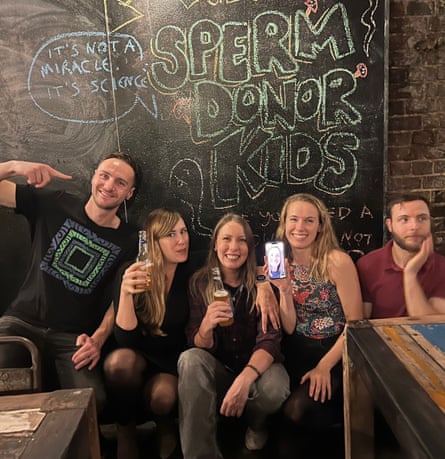
“Thanks for telling us, Bex, you’ve been sitting on that,” my sister Ruth said, eventually. “It must have been such a burden.”
“That’s a lot for one person to carry,” added Gina. “It’s a massive thing.”
“So did they use the same sperm donor for everyone?” Tim asked, and my heart dropped. I knew this would be one of the first questions.
“OK, so I’ve obviously only done the DNA test myself, but, as far as I’m aware, I think us three have the same donor and Tim has a different donor.”
Tim looked down. I hated the thought of othering him, as if us being triplets wasn’t enough.
I told them about Lucy getting in contact and meeting Libby, too. I told them about the donor joining the DNA website a year later. They asked questions and I did my best to answer them. Nobody seemed traumatised. I felt relieved, and uneasy. Perhaps it would be a slow burn and the emotion would ignite later.
“Oh, I’ve got something for everyone,” I suddenly remembered. “I made coasters with photos of the four of us and you can each choose one to keep.”
Tim, Ruth and Joe gathered around and looked at the coasters on the table. Four different photos of us as children, together. One in front of Stonehenge, one at Land’s End, one in our kitchen and another re-enacting The Lion King on “pride rock” at Cheddar Gorge.
“This is just to remind us that we’re all in it together, OK?” I said, as we hugged. “We always have each other.”
“I think we should tell Mum and Dad that we know,” said Tim, and Ruth and Joe nodded. “It’s best not to have any more secrets.”
Three years after donating my eggs, I realised I could apply to find out if any child had been born from my donation. I emailed the HFEA in 2024 but their backlog was long and a year later I was still waiting for a reply, so I decided to contact the clinic directly. The next day they emailed back. In 2022 my recipient had given birth to a baby girl.
Somewhere out there is a toddler, biologically related to me, but not mine. A little girl who was so wanted and will be so loved. I am delighted, though there is another emotion swirling in there, too. I’m not sure I can name it – it’s something between bittersweet and bereft. It is a feeling of things coming full circle and of the swooning, cyclical nature of life. I wonder at what age she might have the conversation with her family. I wonder if she will ever contact me.