2 months ago
64
2 months ago
64
The latest series of The Traitors, which ended last week on a nail-biting finale, featured some of the usual characters – from guileless extroverts to wannabe Columbos endlessly observing fellow contestants for the slightest flicker of treachery. But one faithful stood out for her quiet determination, despite a ceaseless onslaught of suspicion and accusation. That person was Jade Scott, and I wasn’t at all surprised when, quite early on in the series, she revealed she was a keen gamer.
“Minecraft was my way in, when I was 15,” she says. “I made loads of friends at school playing that.” From this innocent introduction, however, she moved on to darker titles: the first-person shooter Counter-Strike: Global Offensive and the multiplayer battle-arena game Dota. “That’s where my interest in strategy gaming really kicked in,” she says.
The Traitors is, after all, a game in a way that other reality TV shows aren’t. It’s heavily inspired by the parlour game variously known as werewolf or mafia, in which participants use social deduction skills to identify a murderer in their midst. Indeed, the original version of the show, the Dutch series De Verraders, emerged after the first Covid lockdown, during which hundreds of thousands of people had discovered the multiplayer online game Among Us, in which a group of players have to carry out menial tasks on a spaceship while working out which of them is a killer. So a video game player would have an advantage in The Traitors, right?
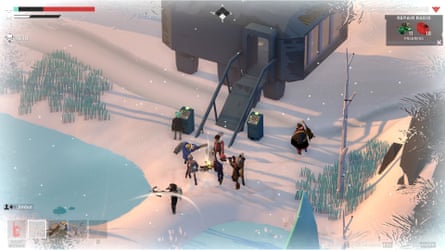
In the year up to appearing on the show Scott had been playing two indie games based around social deduction: the survival adventure Project Winter and the office satire, Dale & Dawson Stationery Supplies. Both require groups of players to carry out a range of tasks in a high-tension environment, while a select few are there to sabotage progress. The honest workers must discover and unmask the miscreants before it’s too late. She was, effectively, in training to be a faithful.
“I always wanted to go in as a faithful,” she confirms. “My opinion has changed on this since leaving the castle, but I always thought the game was way harder for the faithfuls and I like playing games on a harder setting. As a faithful you’re trying to solve who the traitors are, but as a traitor, I thought you lost out on that puzzle-solving aspect. My strategy was to go in and immediately garner some suspicion, because that way you’re protected from murder … I just didn’t realise how much suspicion I would get!”
Indeed, Scott was a constant target of accusations and suspicion. It was difficult. With gaming, you sit behind a screen, and communicating via Discord, so you just start talking and build friendly relationships with people, but with The Traitors, you have nothing to hide behind. It was a very different environment in which to think about strategy and how I communicate with people.”
So did the tactics she’d learned playing games such as Project Winter and Dale & Dawson immediately fall apart? “I was quite good at defending myself at the roundtable,” she says. “A lot of that came out of the practice I got with social deception games. The second you approach the table with some logic and reasoning, and say, ‘I understand why you think that, but I have done nothing to suggest it’, they have nothing to argue with. I also didn’t feel I had anything to prove to anyone – I think, when you’re on the defensive, it makes it worse if you go around and try to mingle. I was thinking, if I go up and speak to this person does it just look like I’m trying to get in their good books?”
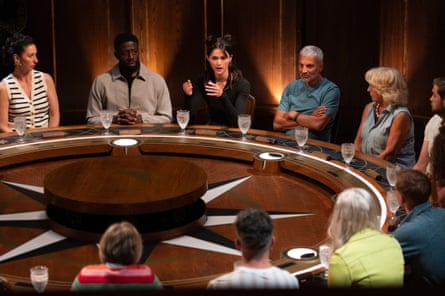
One aspect Scott definitely took from playing strategy sims was observing the mechanics of the game and making notes. “I had different formats,” she says. “Every day I had a sort of traffic light system of how I felt about each person. Green indicated who I thought was a faithful, although you’re never 100 per cent sure – and inevitably those people would just get murdered! Red was who I was more convinced was a traitor at that point. I also wrote everyone’s names on a piece of paper and then I’d draw lines between them, based on who I saw having conversations – a bit like those cork boards TV detectives use, with the red lines between photos. I’ve alluded to this previously, but I’d stare and stare at that page and the only contestants I hadn’t drawn lines between were Rachel and Stephen. I was so busy working out ways to defend myself … you just miss the obvious, don’t you?”
Since leaving The Traitors castle, Scott says she hasn’t played a social deduction game – perhaps she’s done with fielding other people’s suspicions. Now she’s moved on to games such as Outer Wilds and Blue Prince, which pitch you against strange puzzling environments rather than other human beings. There’s been another interesting effect of her time on The Traitors, though. Currently studying for a PhD, she thinks her experiences at the sharp end of the roundtable have been extremely useful for one particular aspect. “Something I’ve been really apprehensive about, and I think a lot of PhD students are the same, is the viva,” she says. “You literally sit in a room with examiners and have to defend your thesis. Well, I’ve really learned how to defend myself and argue a point!”