3 months ago
66
3 months ago
66
I always think that the most stylish woman in a room is the one who looks the most comfortable. She might be nonchalant in a pair of wide trousers and a loose white shirt, or stroll in casually wearing the butter-soft leather loafers she’s had for years. It was a longing to be more like one of those women, as opposed to one who fell over regularly in public because I couldn’t balance in platforms, which made me give up wearing heels for good in 2012. So it was a natural progression, a decade later, to shunning another wardrobe constraint that was making me fidget in social situations: the waistband.
I’m about to turn 49 and in the past eight years I’ve been fluctuating between sizes 10 and 14, which is hardly surprising when you consider that the average British woman may change dress size a whopping 31 times in her adult life. I attribute my own yo-yo-ing partly to the hormonal changes that a body in its 40s inevitably goes through, but I should also acknowledge that during lockdown, I developed a taste for the elasticated tracksuit bottoms that working from home allowed, as well as a macaroni cheese, or two, each week.
By the time I needed to go back to the office, none of my favourite trousers fit properly any more. I hated that these clothes I once loved were making me feel bad about myself, but my longing for comfort meant I would spend all day regretting it if I tried to squeeze into them. So I bit the bullet and – after a dalliance with the prairie dresses of the great cottagecore movement of 2021 – sold them, investing in a few pairs that fit not only my new, fuller self, but other future selves that might decide to present themselves.
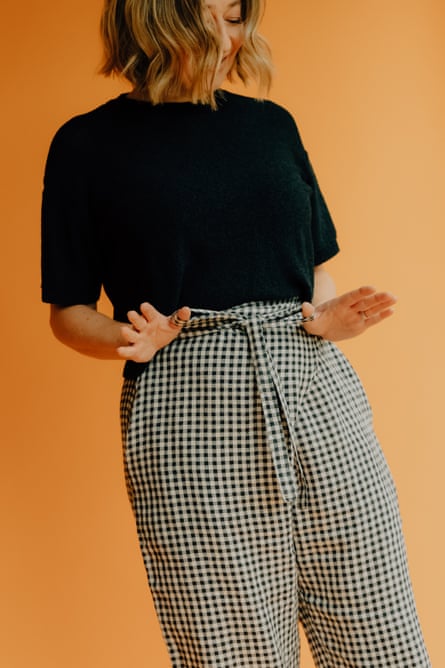
My gateway to adjustability was a tad more chic than the bog-standard elastic waists of the lockdown years: a pair of balloon leg trousers with an elasticated waist in linen gingham rather than grey jersey. But there are plenty of options out there. I love this unisex style from Wawwa; with their balloon legs and generous drawstring, they deliver comfort with the added bonus that they are sustainably made-to-order in Manchester.
For even more flexibility, it’s possible – but a little harder – to find trousers with buckles and straps or wrap designs that are even more adjustable. I found a pair with a crossover design from a local maker and they’ve seen me through three dress sizes over the past four years. Les Animaux’s Fisherman pants, which are made in Margate, are only available in one size, but thanks to the option to tie them multiple ways, they fit pretty much anyone, including pregnant women; some couples have even gone halves on a pair to share. They come in three lengths and the brand offers lifetime repairs. Founder Lisa Jackson thinks all brands should be thinking about taking a similar route, because “having this trouser in one size is very economical for us”.
Initially, adjustable waists were championed by smaller independent designers, but now the high street has begun to follow suit, with 2025’s insatiable appetite for baggy trousers helping to facilitate the movement. Toast currently has a range of smart elastic waist barrel leg trousers in linen, cord and even quilted, which would be great for work, and Cos is among many brands that have introduced tailored wide-leg trousers with a discreet part-elasticated waistband that is only visible from the back. Uniqlo has taken the same covert approach to jeans and even Levi’s, whose original jeans featured an adjustable cinch in the 1870s, has recently reintroduced the style. Another way to adjust is with cinching buckles or drawstrings on the side of the trousers, a popular menswear design feature that is making a comeback at modern tailoring brands including Batch LDN, Acre & Row and With Nothing Underneath.
While adjustable trousers are undoubtedly comfy, it’s often down to more than just added stretch at the waist. Sometimes, it is also about their ability to sit at different points on the body on different people, rather than, as with a standard pair of trousers, being designed to sit at the same point across multiple different body shapes. Many trousers in the 26-year-old influencer Molly-Mae Hague’s fashion line Maebe, for instance, come with a concealed adjustable waistband designed to allow the wearer to choose just how high or low they sit on the body. Sadly, the majority are also made from virgin polyester.
Naomi Pike, commissioning editor at Elle UK, is an advocate for body diversity in the fashion industry. She thinks adaptive waistbands could be a good solution, and not just for our fluctuating bodies. “They acknowledge that not all figures are the same shape,” she says. “You might have a smaller waist measurement than most people your clothing size, so this would accommodate diverse body types. Fashion often forgets that there are different shapes as brands choose to focus their inclusivity efforts on size, as opposed to shape. This feels like a step in that direction of acknowledgment.”
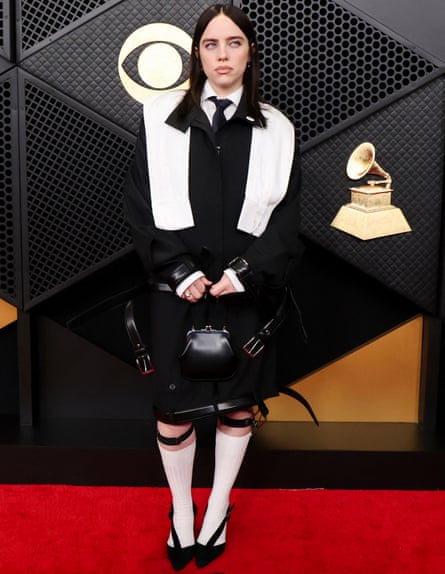
In 2026, oversized clothes read so much more current and chic than their tighter-fitting cousins – for evidence, see the singer Billie Eilish’s oversized Grammys ensemble, which was made from an upcycled pair of wool trousers by the Stockholm-based brand Hodakova, compared with Lauren Sánchez’s fitted, outdated-looking suits at Paris haute couture week last month. But while adjustable trousers lend themselves to this oversized moment, because the majority of styles feature a wide, loose leg, the joy of adjustable waists is that you don’t necessarily need to choose between two silhouettes. Get the baggy look and/or nip in at the waist, depending on how you feel that day. Or even that time of day.
For me, at 5ft 3in, simply nipping in the oversized clothing du jour with a belt isn’t a solution, since I am generally swamped by all of the excess material. I’m much happier with a tighter top half and looser leg, and a more structured option than a drawstring to cinch in or let out the waist area as I see fit.
If all of this seems very modern – I’m admittedly writing about adjustable waists as if they’re some kind of sartorial epiphany – they’re not. Flexibility was being embraced hundreds of years ago. “This is a radical move in recent fashion, but not in fashion history,” says the fashion historian Serena Dyer. “Historically, women’s waistbands were fundamentally flexible. In the 18th century, petticoats included adjustable ties, allowing for adjustment around weight gain and pregnancy. We often assume fashions of the past were uncomfortable and rigid, but it’s the fixed sizes of mass production that have created the uncomfortable and inflexible waistband.”
Our comfortable waists actually have a lot to thank sport for, because drawstring waists didn’t really come into their own until the invention of the tracksuit in the 1930s.
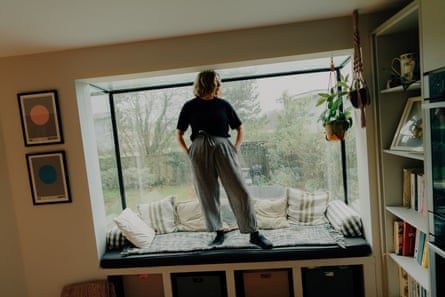
If this level of adaptive clothing was more widely available, it would perhaps also help to tackle the industry’s returns problem. The practice of “bracketing” (buying multiple sizes with the intention of returning most of them) has heavy costs: financially for brands, and environmentally if the returned items are never resold and sent to landfill. Retailers including Zara, H&M and Asos now charge for returns. “Many of us are between sizes so need to purchase multiple sizes to figure out which is right,” says Pike. “I once ordered a dress in four different sizes as I was unsure how it would fit, but also how I wanted it to fit. I’m not sure [adaptive sizing is] a perfect solution but it’s certainly much better than smaller, binary sizing.”
My new trouser collection has made me realise that by choosing designs with flexible waistband sizes, I not only save money in the long run and am therefore being more sustainable, but I feel much better about myself. The size of my middle can vary wildly on any given day, time of the month or season. I no longer need to feel as if I’m losing my mojo when this happens. I don’t want to micromanage my body, but this way, I can regain control of my style.
Furthermore, as Dyer points out, clothes that morph can help us feel better prepared in a volatile world. “When the world feels unpredictable, we gravitate toward clothing that offers longevity and personal agency,” she says, noting that “adaptability and adjustability suddenly became essential in a post-pandemic world”. In this landscape, “an adjustable waistband is, in many ways, a micro-strategy for survival in a macro-world that demands constant flexibility”.
It might sound highfalutin, but as a middle-aged freelancer who could be writing on the sofa one day and heading into town for an important meeting the next, I now have a wardrobe that caters for whatever life – or my waistline – might throw at me.