3 months ago
59
3 months ago
59
‘I can’t bear being without him’
Ruby Wax
Alan was my best friend, my brother and my everything. I don’t stop thinking about him. For me, there’s no replacement; I just have a void. If I could speak to him I’d say: “Come back, because I can’t really bear being without you.”
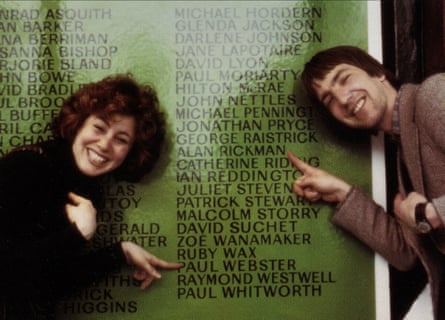
We saw each other or spoke every day since 1980. I was a third party in the marriage, but Rima was never jealous. When we met for the first time, he let me stay at his house. He was in bed and I just jumped up and down on his body with excitement, but it wasn’t sexual. Then we both got into the RSC and rented a house together we called Shakespeare Sauna.
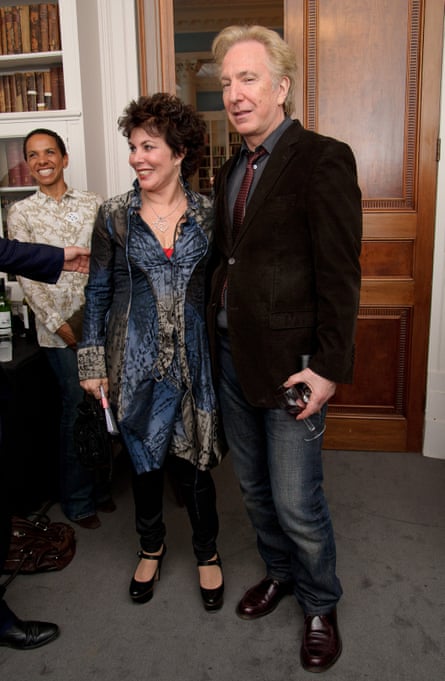
We had a pet tortoise, Betty, who I got into every RSC show, which made Alan scream. We’d dress her up – that’s the kind of sense of humour he had. But then I made her ride a bicycle, and had her walk across Gower Street, and got reported to the RSPCA, who took her away.
There isn’t a day that goes by when I don’t see something he would find hilarious. I did everything for Alan; if I could make him laugh that was like winning an Oscar. He steered my career for the first 30 years and I think I’d be doing much better now if he was still around. I don’t have anybody like that I can trust.
Nobody was a better critic of your acting. He was a genius who could see into the heart of a performance and know instinctively what about the person was getting in the way. He could see your ego and wanted to edit it. Some people couldn’t take it because he could do it with cruelty – he was intolerant if people weren’t listening. But he was always right.
He used to tell me to not look desperate when I was doing comedy and tell me I was smiling as if I wanted everyone to love me. When he directed my shows he’d do my comedy for me in the right way and clean the floor. He wasn’t gay, but he delivered lines in high, high camp. And then I’d sort of sadly imitate him.
It was such a deep connection. He wanted to take care of me and would defend me against my parents who were vicious. He’d tell them I had talent, which they didn’t believe, but they listened to him and they let me continue. Each time I’d get off the plane from visiting them in Chicago I’d perform for Alan what they’d said and done to me. He would bend over laughing. That was the only time he didn’t give me notes. He’d just say it was brilliant.
Alan was godfather to my children and they’re bereft, because he steered them too. At school, my daughter Maddie was really shy, hardly spoke. In plays, she’d be in the back, playing a leaf. Alan told her: “You have to go to clown school.” At the time I thought: why is he doing this to me? But now, she’s a comedian. He opened her up like a can. He would’ve been so proud that my daughters are comedians but he would have given them endless notes.
It was such a privilege to have known him for so long, back when he was raw, before he was famous. I could see the gold when he was just doing Shakespeare. I wish he wasn’t only remembered by kids for being Snape. I’d begged him to do films, but he kept turning them down, saying he’d be stereotyped. And, lo and behold, he ended up a stereotype for a lot of people.
Nowadays, I see people trying to imitate him, but they can’t pull it off. Nobody gets close to Alan. There are people who are ethereal or male or female or a certain age or a certain type. He was something totally unique. Alan was unreal.
‘There was always dinner’
Lindsay Duncan
Death often feels like an aberration. In Alan’s case, it was a hell of an aberration. Surely he wouldn’t allow it? Of course, even he couldn’t control this one, or could he? Famously, he chose every detail of his funeral. Of course he did. Was it good? You bet it was. He wouldn’t have died until it was perfect.
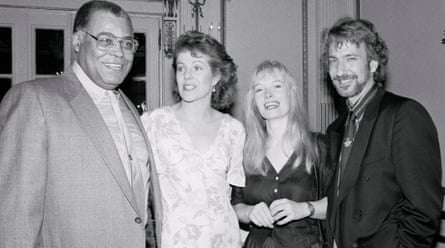
Alan loved a good time. He loved making a good time for other people. His dressing rooms were always a party. There were politicians, movie stars, old friends, new friends and plenty of wine, elegantly poured by Alan. Then there was dinner. Always dinner. If anyone looked as though they might be going home alone, they were scooped up and nervous maître d’s learned that the huge cachet of having Alan Rickman in their restaurant was accompanied by a hasty adjustment to the size of the table.
Fame really suited Alan. He joyfully shared all the upsides with his friends. Those many dinners were paid for by him and objections were met with a little smile and “I’ve got two words to say to you: Harry. Potter”. He could be imperious. He could be cross. Once, at a cast dinner, he got into a political row and called his understudy a Tory cunt. The next day, barely controlling his face, he just said: “Oops …” He did apologise.
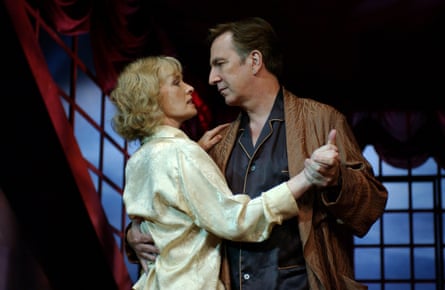
Listen to Alan performing Revolutionary Witness, and Tom Waits’s Take It With Me and Uptown Funk – again. Some of his funeral soundtrack. Think, cry, laugh and party. That’s Alan. A magnificent man.
‘It was one of the worst nights of his life’
Richard Curtis
It’s a pretty open secret that when three of us had the final vote for who should play the lead in Four Weddings and a Funeral, I was out-voted. I wanted Alan Rickman. Hugh Grant got the part. My reasoning was that Hugh was a bit too handsome and annoying, but mainly I voted for Alan because I’d so loved him in a film called Close My Eyes. In the years that followed Four Weddings, with each new film Alan did, from Sense and Sensibility to An Awfully Big Adventure to Galaxy Quest, I kept seeing reasons why I might have been right. He had such a wonderful softness and depth next to his stern, scarier side. And a great sense of comedy.
But I did also always think he was a bit out of my league, so it was such a thrill when he agreed to be in Love Actually 10 years later. I thought he was wonderful in the film, and a huge part of the power of Emma Thompson weeping to Joni Mitchell in the bedroom is because Alan has been so believable; a million miles from the cliched cad the character could have been. He’s extraordinary in the scene where Emma faces him with what he’s done. He made it easy for me during the filming – it was my first film as director – and I was surprised by how friendly he was, and unsurprised by how pitch-perfect his performance was.
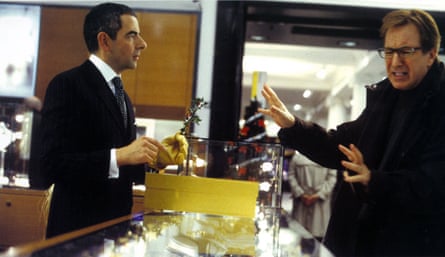
I’m sure Alan wouldn’t mind me talking about the only tricky night we had. It was the scene where Rowan Atkinson is wrapping a present for him in a department store, very slowly. First we shot Alan, who did his work swiftly and exquisitely. Then we turned the camera on Rowan. Rowan, being a close friend of mine and having about 10 different stages to remember, took his time, often stopped and chatted with me in the middle of takes, us keeping the camera running while he worked out what to do with rosebuds and sticks of lavender, breaking out of character, practising. I’ll never forget Alan’s agony as, total professional that he was, he kept up his supportive and nervous performance for 12 minute takes, never dropping out of character for a moment as we chatted and dithered. He described it as one of the worst nights of his life.
It is heart-breaking how many wonderful years and wonderful performances of his we’ve missed.
‘We gobbled blueberry pie and cheered each other on’
Sigourney Weaver
Ten years … it seems so much longer. An eternity since we last heard Alan’s gorgeous laugh boom out. I first saw him in Les Liaisons Dangereuses on Broadway; so convincing in his wickedness I assumed it was the real him … yes, and I’m an actor.
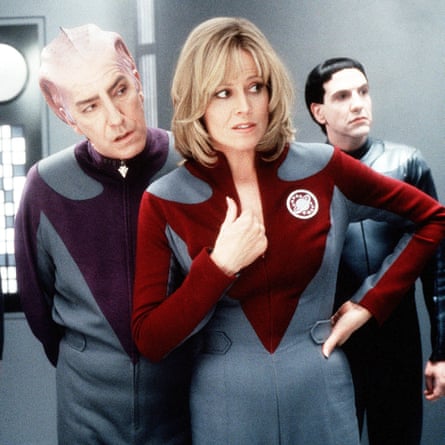
Years later we met for real on the film Galaxy Quest. Here was this sublimely playful man who surrendered utterly to portraying a washed up TV hack, seething with petty jealousy and clawing at his giant shell-cap. His character grounded us all. Tim Allen made us laugh so hard all day long, and no one more so than Alan. Our stomachs ached at the end of every day.
Shortly afterwards, Alan asked me to do Snow Cake with him: a romantic lead for him and for me the challenge of playing an autistic woman called Linda. I was so astonished that he could imagine me as Linda, I researched it for a full year so I wouldn’t let him down. We shot it way up in Wawa, Canada, gobbling blueberry pie and cheering each other on. When Linda would veer out of her lane, Alan would say firmly: “I do not improvise.”
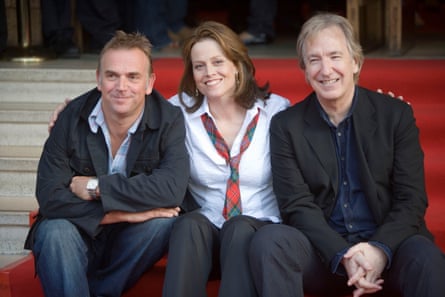
I made the idiot mistake of thinking this brilliant friend wouldbe with us for ever. At Mike Nichols’ memorial in November 2015, he came up to me with his wife, Rima. I threw my arms around him and said: “Hey, we’re going to do another Galaxy Quest!” He looked at me quietly and said: “We’ll see.” I said: “What do you mean? It’s gonna be so much fun.” He squeezed my shoulders, looked down and said very gently: “We’ll see.” He was gone two months later, for ever to be missed.
‘There was nothing flaky about him. No nonsense, no rubbish’
Brian Cox
I can’t believe it’s been 10 years since we lost Alan. His death was such a shock. My father died of pancreatic cancer when I was eight – and my first wife’s father also died of the same disease. With Alan, I first felt guilty, because we hadn’t been in touch for a while. And then I wondered: what’s going to happen? How will the world be now Alan’s gone? Because he had this way of making people feel easy. He could take their cares away. It was an incredible gift.
I worked with Alan on his first TV show: Thérèse Raquin in 1980. He immediately had a solidity and clarity about him, as well that amazing gravity and integrity. He’d started as a graphic artist, which had left him with a very fine visual sense, and also a real discipline. His standards were very high. Alan might have appeared laid-back but he was endlessly driven, very firm, totally reliable. There was nothing flaky about him. No nonsense. No rubbish.
Everyone knew he was an extraordinary actor, but as we became friends, I realised what an extraordinary person he was, too. I had such respect for Alan. So many people relied on him. He was so kind and supportive to those who were struggling: he’d seek them out and sort them out. Listen to problems without presumption and gently come up with solutions.
He had an incredible generosity of spirit, as well as a commitment to serving his community and being present in people’s lives. His death made me conscious of the need to keep in touch with people and see them often. A presence such as his is missed for a long time. I still occasionally think: oh, I’d like to talk to Alan about this. Then I remember he’s not here any more. I loved his acting, but as a man I loved him even more.
‘I nearly broke his back’
Sharleen Spiteri
When we planned the video for Texas’s In Demand in 2000, the director had the idea I would dance the tango with someone. I said I didn’t want it to be with some random gorgeous man because that’d just be soulless – it needed to be someone you thought would dance the tango. Then [composer] Michael Kamen walked in and said he was just off the phone with Alan Rickman, who was a big fan of Texas. Everybody looked at each other and went: “Now there’s somebody that would dance the tango.” Alan agreed, and even cancelled the first week of his annual holiday in Italy to do it.
We shot the video overnight and it was so, so cold. Most of the shoot was driving around in a Bentley but then we did the tango in a petrol station about 5am. I was in this backless Valentino dress and high heels, freezing my bollocks off. Alan was in a suit. The crew had giant puffer coats. At one point the director shouted: “Shar! Throw him against the petrol pump like you’re about to fuck his brains out!” I did. Then about two seconds after the bit that’s in the video, he slid very slowly back down the petrol pump. I’d got so excited I nearly broke his back.
Fifteen years later, Texas had a song, Start a Family, I thought would make a good duet. I phoned Alan and said: “How do you fancy singing on a record?” And he went: “Oh, good God …” in that wonderful drawling voice of his. In the end, most of it was more speaking than singing, but he did break into a little bit of melody in places. It was great watching him interpret the music. And we had an absolute laugh filming the video: putting on our very serious faces, then giggling between takes.
He was so naughty and mischievous and always had a serious glint in his eye. We had the best time together. But I really loved that he – like me – also took the work very seriously. It wasn’t about being famous or where you’re seen or who you’re seen with. It was about being privileged enough to be doing the thing you’d dreamed of, with creative people.
He was so generous with his time and love and friendship, and always very giving with people who were just coming up: exchanging contacts and connecting people and giving them chances. I loved it because I met so many people through him. I’ve never been so close to someone so famous.
Whenever he’d ring me on speakerphone in my car and someone else was with me their eyes would nearly pop out of their head. That amazing voice! The depth and richness and annunciation. I remember my daughter and her friends being in the car when they were about seven and had just got into Harry Potter. When Alan rang they lost their minds: “Oh my God! It’s Snape!”
There’s a part of my mind in which I think he’s still at the end of the phone. He was on TV all over Christmas; I’d have it on in the background and suddenly I’d hear his voice. That bit of him stays alive. It was a really lovely and warm and comforting feeling. At the supermarket last week, a stranger hugged me and said: “You danced with Alan Rickman! You’re the luckiest woman on the planet!” I was like: you know what? I am pretty damn lucky.
‘He might be alarmed at today’s tyranny’
Ian Rickson

Alan was unafraid to express his radical political perspective. And he was unashamedly a believer in the arts.
In holding both of these two positions he also articulated the interdependence of culture and meaning. He embraced his craft, and particularly the role of theatre as a political medium.
He might be alarmed at how much more tyranny and inequality there is now, and also how much harder people feel it is to speak out about it. And with his working-class origins I know he’d worry about the increasing elitism in the business.
So when I remember him it emboldens me to fight for what I believe in, and relish the privilege I have in getting to make theatre.
‘Praise from Alan counted far more than a critic’s review’
Harriet Walter
Alan was never a nobody. Even when he was an unknown 32-year-old, when I first met him in the bar at the old Bush theatre, he seemed like somebody. “Oh, I’ve heard about you,” he drawled in that beautiful voice. His searchlight gaze had fallen on me and for that moment he made me feel like somebody.
The first play I did with him was The Seagull at the Royal Court. I didn’t have to act Nina’s fascination with Trigorin. We also did a restoration comedy together. He was brilliantly funny both on and off stage. I don’t think he was easy to direct. He was too much of a director himself. You wanted to do your best for him. Praise from Alan, even then, counted far more than any critic’s review.
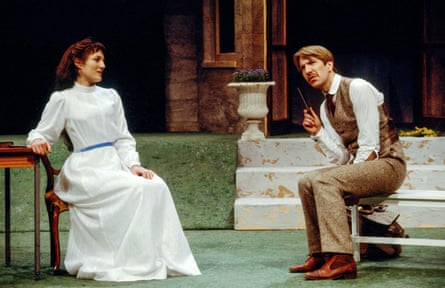
I remember a phone call with him around that time, gossiping about any jobs we had been offered. I had plumped gratefully for the first thing that came my way, while Alan recited a list of roles he had turned down. He was paring down his choices with what I soon learned was an acute sense of where he was heading and where he was supposed to be. If this sounds offensive, it wasn’t. He was a rocket that was perfectly prepared but hadn’t yet been launched. When the part of Obadiah Slope in Barchester Chronicles came his way he recognised his moment and he pounced.
Then there was Les Liaisons Dangereuses and then there was Die Hard playing Bruce Willis’s nemesis. Wow! My old mate Alan had become a film star – a fully fledged Somebody – and he took to that status as the proverbial duck to water.
His generosity and kindness were legendary as was his brilliant sense of humour – a unique combination of wry sophistication and silliness that is evident in many of his film roles. When I worked with him again in Sense and Sensibility, although our characters didn’t meet we spent plenty of social time on location.
Alan took care of me, made sure I dined with him and the top cast at the top tier hotel restaurant and paid for the cab back to my not quite top tier hotel some 10 miles away. He threw a birthday party for me in the year my partner died from cancer. He knew it would be a hard one for me.
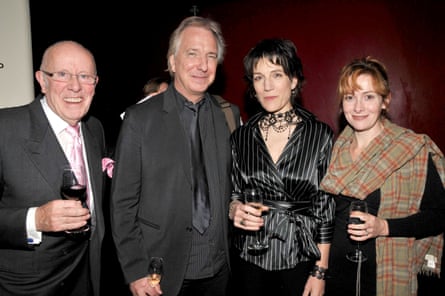
Alan elevated friendship to an art form. His friends grew in number throughout his extraordinary career but he never dropped his old pals in favour of more starry ones. He was unusually loyal. I marvelled at how he managed to see nearly all of our performances and wine and dine us afterwards. Stardom didn’t change him because he had always been a star, albeit a very well-grounded one.
So much has happened in the world in the 10 years since he died. I miss his piercing intelligence now more than ever. It is terribly sad for all of us that he has gone but I am almost happy for him that he left when he did.
‘He queued for breakfast in his Snape costume and wig’
Tom Felton
When I think about Alan a smile always comes to my face. I was lucky enough to work with him for 11 years at Leavesden studios on Harry Potter.
I remember how intimidated I was when I first saw him. Not because of his portrayal of the seemingly evil Professor Snape but because he was the only cast member I actually recognised.
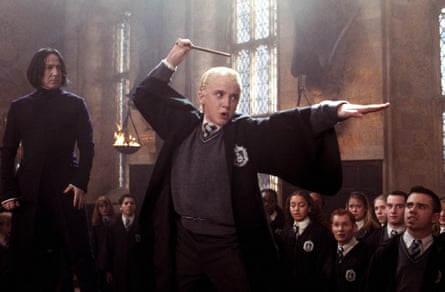
As an 11-year-old, I had no idea who Sir Richard Harris or Dame Maggie Smith were, but Alan was big time! Seeing the man who’d played that brilliantly villainous role as the Sheriff of Nottingham in Robin Hood: Prince of Thieves seated at the end of the Headteacher’s table in Hogwarts’ Great Hall was very memorable.
He was nothing but kind, genuine, seemingly unfazed by anything happening around us and always had time for everyone. I learned just as much – if not more – from Alan off-camera as I did when we were filming.
He could have had his food delivered to his trailer, like most of the cast (including me). Instead, he queued up for his own breakfast and lunch, head to toe in his Snape costume and wig, holding a plastic tray and waiting his turn in the usually very long line behind a carpenter, set decorator, burly cameraman and Gringotts goblin – an image I will never forget. I didn’t realise it then, but I think now Alan’s silent message was: “We’re all in this together. Equally.”
I remember the night shoot when Hagrid’s hut was set on fire. It was about 4am and freezing cold. We stood together on a grassy bank, Helena Bonham Carter and Robbie Coltrane battling behind us. Alan didn’t utter a word. I finally mustered the courage to ask him: “You alright, Alan? How you feeling?” About 10 seconds after I’d spoken he turned his head to me and replied slowly: “I’ve peaked.” He then turned his head back with the tiniest hint of a smile and a twinkle in his eye.
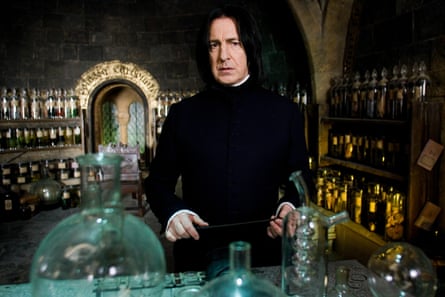
He taught me a great deal about charity. He would often have half a dozen people visit the studio each day, and would claim they were his cousins or friends. Really, he was offering terminally ill children and their families a chance to see behind the curtains. He also taught me that children don’t want to meet actors, but the characters they play.
I would usually greet a nine-year-old visitor by saying: “Hello, how’s it going mate?” which would usually freak them out: “Why is Draco being so happy?!” Alan would sneer at them in front of their parents, then tell them to tuck their shirts in and clip them round the ear. Full Snape. Charming, disarming and a delight to watch. He never smiled. But when I look back, I think he probably was inside.
‘He kind of loved you – in a way that wasn’t creepy’
Anna Chancellor
I must have met Alan before I became his employee, but he wasn’t my friend. So when he cast me in Creditors, which he directed, I was amazed and incredibly flattered because anyone would have worked for Alan.
It was a golden time: just the three of us in the cast – me, Tom Burke and Owen Teale. Alan hardly ever directed so he didn’t have the weariness of a lot of jobbing directors. He was very inspired and wanted to translate what had and hadn’t worked for him as an actor to us. He’d start by asking you for any ideas you had about the play, your part, anyone else’s part, the costumes, and write them down in his very beautiful handwriting. No thought was unnecessary or wrong. And that doesn’t sound very radical, but actually it’s not common.
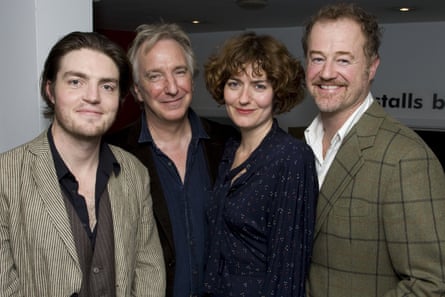
Most directors aren’t actors. And Alan felt so personally about things that had gone well, and very deeply about things that hadn’t. He was very sensitive about times he’d felt sort of shamed. So he kept saying to us three: “You are all just perfect.”
He was also a hard taskmaster. He clearly understood that there are rules and mechanics and techniques, which he’d thought very deeply about. For instance: you shouldn’t start one sentence on the same pitch as you finished the one before. He knew his own failings as an actor; that sometimes his voice could be ponderous and drop at the end. He didn’t want you to do that.
What he hated most of all was if you indicated to an audience what you were thinking before you thought it, with ums and oohs and ahhs. He called them “trampolines”. He didn’t want you trampolining; he wanted you to come in bang, snap, sharp with clarity of thought.
He once lined us all up and said: “Anna, this is what you do,” and ran his hands through his hair. “That is your habit. And when you bend down you sort of stick your arse in the air. Don’t do that.” I think a lot of directors wouldn’t say that to you; they might feel it was stepping a bit beyond their remit.
He was stricter with the guys. As an actress, I felt so seen by him and so appreciated. His care was a turning point for me. I just adored him. He kind of loved you, in a way that wasn’t creepy. He was very interested in you and very clear about what you and only you could bring. He made you feel like you had what no one else had.
The play transferred from the Donmar to New York, where it was much better received. Alan was there every night and after the show he would open the dressing room door and in would walk Al Pacino or Liam Neeson or Susan Sarandon. It was a dream. I’ve known people with money but I’ve never known anyone pick up a bill like Alan. He was the most generous person I’ve ever met. If your friend was in town, he’d pay for their ticket and then book you into one of Keith McNally’s fabulous restaurants.
One day I woke with the most unbelievable headache. I couldn’t see. I rang Alan and he said to come over. When I got to his flat I was sick everywhere. We went to hospital and Alan sat with me as they went through all my medical history, so it became a different sort of relationship.
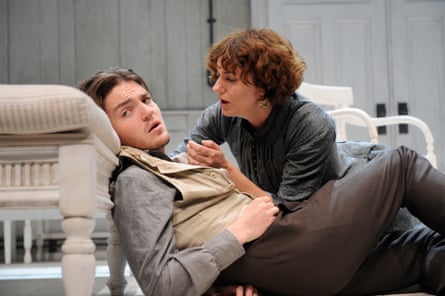
In order to test for viral meningitis – which is what I had – I had a lumber puncture, which leaked, so Alan and I went to a special clinic where they take blood from your arm and they put it back into your body and it forms a plaster over the hole. The doctor told us that I should avoid sudden, loud movements in case the blood clot dislodge.
I said: “Oh, really? Because, Alan, what about when I really scream at the end of the play?” And he went: “Don’t worry, we can just come back and get another plaster.” That’s what you sign up for as an actor: if you’re unwell, you still go on.
I went to see Alan a lot when he was in hospital, but still as my mentor, not my friend. Then, in 2024, I went to Mexico for the day of the dead to scatter the ashes of my daughter, Poppy, and randomly met Ruby Wax on the plane. I said she should print out a picture of Alan, and we made an impromptu shrine in one of these huge, beautiful cemeteries in Oaxaca. We lit candles and we told stories and it was very moving. Alan would have loved it.
‘I could not reconcile myself to his absence’
Helena Kennedy KC

Ten years ago; it does not seem possible. His death was such a theft from us; this brilliant, gorgeous actor, who had so much more to give, was suddenly gone. Although I was one of the close friends who was privy to Alan’s illness and visited him as he faded, I could not reconcile myself to his absence.
Alan was undoubtedly one of Britain’s greatest actors. His distinctive languid voice and his sublime ability to embody the characters he played made him truly exceptional. So many of his stage and film performances were breathtaking. My good fortune was that I also knew his other attributes, as a keen fighter for the good of the world, with a strong sense of injustice. It was no surprise that Alan with Katharine Viner created the very moving play My Name is Rachel Corrie, about the young American activist who was killed while peacefully opposing house demolitions in Gaza, or that his last film, Eye in the Sky, was about the moral responsibility governments bear regarding their use of drones.
Alan was such a vivid presence in my life and played such an important role in so many of our family events – the dinners where he insisted that Harry Potter was paying; the fundraisers for my husband’s medical research foundation; Saving Faces; the thrill for my children of knowing the Sheriff of Nottingham and then Severus Snape! We relished the holiday where he and his wife, Rima, joined us in Cape Cod and were beach bums like the rest of us.
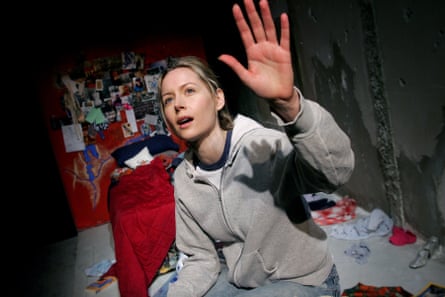
What countless people in the arts and beyond will remember about Alan was his kindness, his fostering of the talents of others, his financial aid to those who needed help. He was generous of his time, of his heart, and of his encouragement. He was a giant in his profession and a prince among men.
‘I was fascinated by his subtle, attractive air of melancholy’
Heike Makatsch
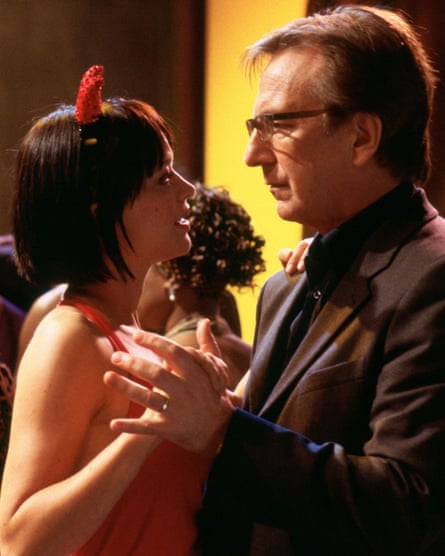
Even though it feels a lifetime ago, I still remember vividly the few days of filming I was lucky enough to share with Alan on Love Actually. I felt a little out of place, and at times shy, surrounded by such well-known, top-of-the-list actors whose warm and layered performances I had long admired from afar.
To this day, I remain grateful for the generosity with which Alan made me feel welcome on set, always stepping in with quiet support whenever nerves threatened to get the better of me. He was gentle, witty, helpful, and wonderfully modest, appearing during shooting breaks with instant coffee and biscuits, only to impress me moments later with his acting skills and perfectly timed double-takes. I was fascinated by the subtle, attractive air of melancholy that seemed to follow him everywhere.
And when filming Love Actually came to an end, he sent a bouquet of flowers to my doorstep, with a note saying how much he had appreciated his mistress, Mia. I was really chuffed. Looking back, I wish I had allowed myself to enjoy his company more, instead of placing him on a pedestal he never chose to stand on.
‘Alan told Jimmy Kimmel: “No, it’s more of a dick flick”’
Stephen Rea
Elegant, stylish, sophisticated. A glorious actor. Tremendously perceptive about performance. When he saw a show he could give notes that only a great actor would have observed. In a warm and generous manner.
He lived up to the original identity of his name – Rickman – princely, regal. And he was famed for his wit. Interviewed by Jimmy Kimmel: “So this is a chick flick?” Alan replied: “No, it’s more of a dick flick.”
And when he received an award for his performance as the Sheriff of Nottingham, he remarked that every time he looked at it he would realise “subtlety isn’t everything”. Hilarious. Classy. Forever missed.
‘That a man so incredible chose to stay in touch made me feel special’
Kevin Smith
In 1997, Alan got in touch to say he’d really liked Chasing Amy and to ask what we were doing next. So I got to work with a man whose work I’d always appreciated so much that if it wasn’t released in the US, I’d seek it out in specialist video stores.
One day on Dogma, I saw him and Jason Mewes sitting on the church steps together, deeply engaged in conversation. I remember thinking: “What the fuck could these two possibly have to say to one another?” I sidled up to Alan later and said: “If Jason is bothering you, please let me know.” He said: “Jason Mewes could never bother me. He’s an American icon and an absolute true original.” It was beautiful to hear him say that.
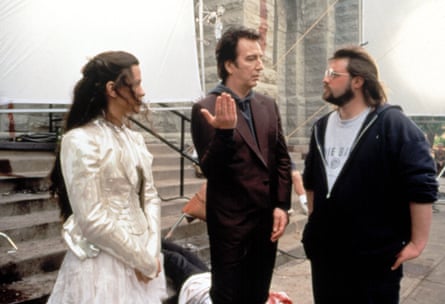
After the movie, we stayed in touch. Whenever I was in the UK, I’d get a call saying: “Kevin, it’s Alan. You’re in my country. I’m taking you to lunch.” And the same thing when he was in the US: “Kevin, it’s Alan. I’m in your country. You’re taking me to lunch.”
When I played the O2, Alan and Rima came to the show and then drove back into town with me and my wife, Jen. Alan said he’d finally cracked and got an apartment in New York. I said: “That sounds great!” He said: “Maybe not, because it’s in the same building as my friend.” I said: “Even better!” He said: “Well, my friend is Ralph Fiennes, and if Harry Potter fans ever find out Voldemort and Snape live in the same building, they’ll burn it down.”
After the Empire film awards one night, we all went out together with Matt Damon and his wife, Luciana. We had dinner and then about 1am took a picture together on London Bridge. I still have it on my laptop. It was a blissful time.
I always thought Alan was nice and courteous and political. But after he died, it occurred to me he wasn’t just being professionally polite or British. He went out of his way to maintain a friendship. If he’d wanted, he never would have had to interact with me again. That a man as incredible as Alan chose to do so made me feel special. Very rarely do you meet somebody that exceptional. That guy, for whatever reason, liked me! I carry that as a badge of honour.
‘He paid for the whole wrap party’
Randall Miller and Jody Savin
We did not know Alan, but we knew he would be exquisite as the lead in our 2007 film, Nobel Son, about an egocentric professor whose son is kidnapped. So we made an offer to his US and UK agents. But when the Americans rejected our scale offer [for minimum pay], we thought that was the end of it. Two weeks later, we arrived home to a message on our answering machine from Alan himself. His UK agents had passed the script on to him, and he had read it.
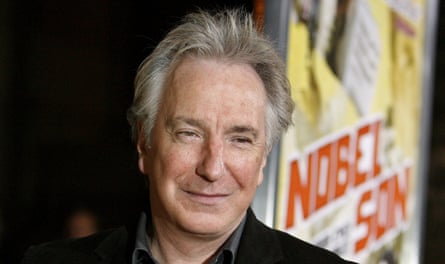
“Thank you for being real writers,” he said. It was the best telephone message of our careers. He thanked us for offering him the part but feared he had scheduling conflicts. So we overhauled our shooting schedule to make it work. And he was, of course, brilliant: always that actor who raised everyone’s game and challenged us all to be the best we could be.
At the conclusion of the shoot, he asked about the wrap party. When we confessed we were completely out of funds, he wrote a cheque and paid for it himself. That was Alan – generous, inclusive and fun.
We went on to make two more films with Alan: Bottle Shock in 2008 and CBGB in 2013. We shot Bottle Shock in Napa in the height of summer and Alan was stuffed into a three-piece wool suit and driving a tiny Gremlin with no air conditioning. He never complained. In the scene, the car gets a flat tyre. He gets out and yells “Knickers!” and kicks the wheel. But then he inadvertently slipped and did a Charlie Brown fall on his rump. Still in character, he popped right up and got on with the scene. The accident made the scene sing.
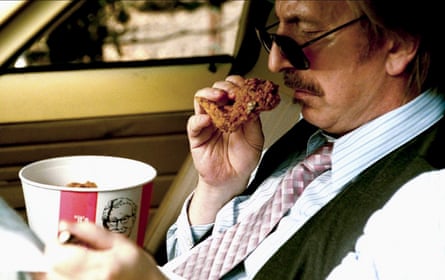
Alan was ill during the making of CBGB, but we never knew. He was our muse, a great friend and an exacting collaborator. He made us all better. He lives on in our hearts and films, and we miss him dearly.
‘Alan become this ghost that had haunted my childhood’
Neil Jordan
People said I wanted to cement Éamon de Valera’s status as a villain and so I cast the villain from Die Hard. I didn’t. I cast Alan Rickman in Michael Collins because he was one of the best actors of his generation. He was also tall, rather gaunt, had a prominent nose and looked remarkably like the taoiseach, Uachtarán, (President, Il Duce, Caudillo choose your translation) that seemed to dominate Irish life from the 1920s onward.
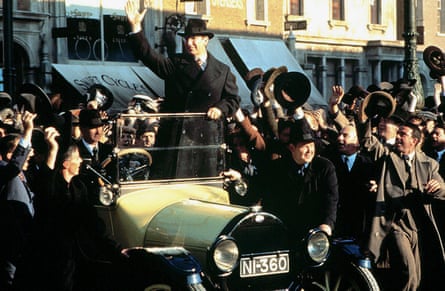
But nothing could have prepared me for my first encounter with Alan as De Valera, in a trailer (he had his own, rather small) behind the set of O’Connell Street we had built on the grounds of a disused institution. The General Post Office from which he would emerge in the film, bruised and battered but unbowed, was one 10th smaller than the original. He was listening to tapes of that voice I remembered from my childhood which every múinteoir (teacher) I ever had seemed to imitate. He was dressed in a long gaberdine coat with one of those high necked strangulation collars, the pair of wire-rimmed glasses that seemed to never leave the prominent bump on De Valera’s nose. Alan’s nose seemed to have expanded itself in imitation. He was clutching a copy of the actual Anglo-Irish Treaty which he was about to denunciate, in De Valera’s actual words. And there were 5,000 extras, waiting below for his entrance.
Alan thought at the time I had arranged things this way to force the performance from him. I hadn’t. The schedule was so tight, the huge extras calls so complicated, it had to be that way. But I saw him walk out, mount the wooden podium behind the huge Irish flag and become this ghost that had haunted my childhood.
“The volunteers would have to wade through Irish blood, through the blood of the soldiers of the Irish government and through, perhaps, the blood of some members of this government in order to get Irish freedom.”
It was chilling. The wind whipped the enormous flag behind him. Five thousand people below, in cloth caps and borrowed shawls, roared in agreement. A civil war was the only answer.
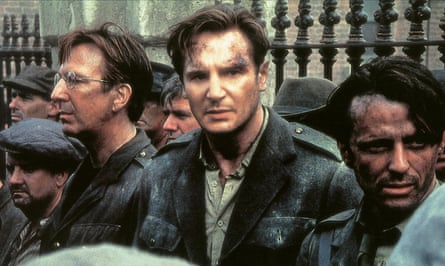
The voice, high and wheedling, was note perfect. I began imagining a sequel, that moment, on this extraordinary, contradictory figure. Alan Rickman head to head with Winston Churchill, who described these encounters as “trying to pick up mercury with a fork”. But historical epics don’t get sequels. De Valera, unlike Michael Collins, wouldn’t be sanctified by an early death. He would be burdened with guiding this republic, with all of its contradictions and failings, into the future.
But Alan could have made every detail worth it.
‘In hospital he wanted laughter and gossip’
Frances Barber
What can I say that everyone else that knew him hasn’t already eulogised? The most loving, generous man in the world, with such charm he made everyone weak at the knees. Such wit, such a sense of humour and kindness that surpassed anything I had ever witnessed before.
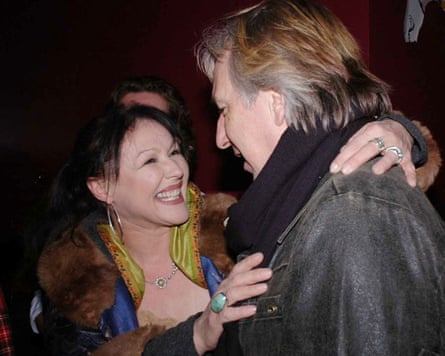
I first met him at the Bush theatre, upstairs in a tiny space above a pub in 1980. I had just left university and begun my first ever job at the same theatre. I’d never been there before and wanted to see what was in store. I’ll never forget that drawl that had everyone captivated and his famous presence. He had me at: “Hellllooooo, my name’s Alan Rickman, and who might you be?” I guess I fell in love with him on the spot and was in total awe. I remained in awe of him for his whole life. ]
He and his devoted, wonderful partner Rima – who he idolised – came to everything I ever did. He had quite a lot of pithy notes after the shows, but always positive suggestions to help me be better. Alan always wanted everyone to be better, not because he thought he knew best, but because he loved his friends and wanted the best for them.
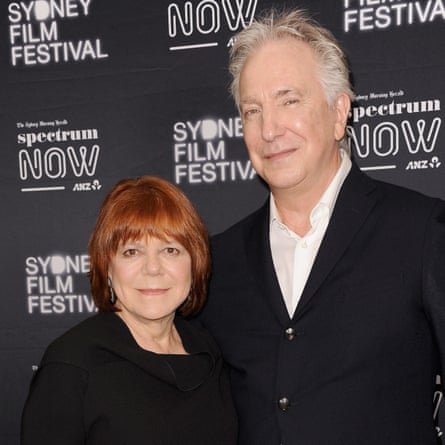
Even when he was so ill in hospital, he didn’t want to talk about himself; he wanted us to make him laugh and fill him in with the latest gossip. Life without Alan isn’t the same, but his memory will forever live on. I’m a very lucky woman to have had him in my life. And I still have Rima, and that means so much as they were always together.
I imagine Alan is giving notes even now to whoever’s up there with him, in that famous voice, with that twinkle in his eye. I just loved him, simple as that really.