2 weeks ago
55
2 weeks ago
55
Erykah Badu needs the lights down low. The singer, producer, actor and registered doula shuffles into a private room at London’s Soho hotel and quietly asks for some changes to the atmosphere: lights dimmed, soft seat. A green juice would be great.
As it turns out, Badu was out last night with Dave Chappelle, sitting with the comedian at a grand piano and playing songs into the wee hours. She looks mischievous when she thinks about the impromptu party, but declines to go into detail about what, exactly, went on. Instead, the 55-year-old smiles at me, eyes wide, her gold teeth glinting in the low light: “Oh yes,” she says slowly and quietly, like some kind of mysterious warlock. “It was a late one …”
Meeting Badu, in other words, is everything you want it to be and more. She and I are here to talk about Before the World Blows: The Abi and Alan Experiment, a collaborative record with famed underground producer the Alchemist. It’s Badu’s first full-length project since the release of 2015’s But You Caint Use My Phone mixtape, and its dense, layered sound feels like an internet-fried take on her era-defining New Amerykah albums, from 2008 and 2010.
It’s surprising, I suggest, that she has taken so long between records, given how much she analyses the world around her. She says that’s the point. “Procrastinating and living, learning and stuff – that gives you stuff to write about,” she says. “It’s important to gather the data, upload as much as I can. I don’t have a choice. But when the thing gets kind of full, I download it through writing music.”
Badu has been a star since 1997, when the release of her debut album, Baduizm, announced her as one of the leading lights of what music industry executive Kedar Massenburg called “neo soul”, a new wave of alternative soul and R&B. In the years since, a handful of wild, boundary-pushing records have made Badu one of the most revered artists in the world. The Alchemist – LA producer Alan Maman – was one of those early fans. In 1997, he was a roadie for Cypress Hill, who were co-headlining the Smokin’ Grooves tour alongside Badu. “I was such a fan – I used to go out in the crowd and watch her show every night,” he says on the phone later. “I never would have thought in a million years that one day I would be making music with her.”
Since then, Maman has produced a number of hits, including Mobb Deep’s 1999 track The Realest, and enjoyed a recent career renaissance in collaborations with underground rappers such as the duos Armand Hammer and Mike & Wiki. A few years ago, while DJing a party, he ran into an old friend named Cold Cris who happened to work for Badu, and told him that working with her was on his bucket list. Two years after that, he got the call that Badu was interested in playing around with his beats. She came to his studio in LA, and the pair, he says, “instantly became friends, and realised how much shit we had in common, in the way we create, the way we think”.
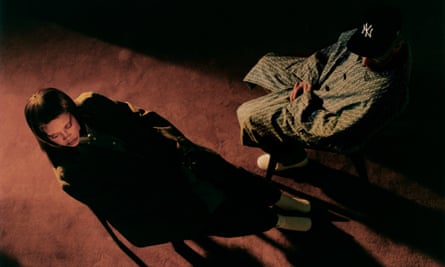
“His compositions are like classical music to me – how he layers chimes and voices and strings and horns,” says Badu. “Our process is the same. The way we build is the same. I don’t know what it is exactly, but it’s a burning, beautiful fire. I get chills when I hear his music.”
Badu was born in Dallas, Texas. Her mother was an actor; her uncle, an avid record collector; Badu’s grandmother bought her her first piano. She still remembers the first artwork she ever made, in a primary school art class: a sculpture of a spaceship made out of a rubber glove, which she called Lady Luna 2. Attending a performing arts high school in Dallas, she was “the first person at school and the last person to leave”, and would spend hours dancing while facing a mirror.
“In the beginning, there was no audience – there was just me and the things I loved – music, painting, dancing,” she says. “I grew up listening to Earth, Wind & Fire, the Emotions, Deniece Williams, Eric Clapton of course, Joni Mitchell, Phoebe Snow, Parliament Funkadelic … they were creating from a place that nothing else came from.”
Badu started making music in earnest when she was a theatre major at Grambling State University in Louisiana after her cousin Robert “Free” Bradford mailed her a cassette tape with beats on it. Their collaboration ended up becoming Baduizm. It was an instant hit – No 2 in the US – and, thanks to Massenburg’s clever marketing, announced Badu as “the queen of neo soul”, a term she quickly rejected. “I was the first one who denied it – I denounced my throne” she says. “I’m an ever-changing vessel, and I just didn’t want to be pigeonholed. When I hear the algorithm today, when I type in Erykah Badu somewhere, I don’t like everything that’s with it, because it limits what I feel.”
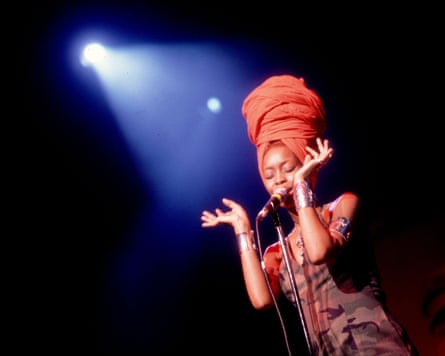
Photograph: Paul Natkin/WireImage
Badu says she had her whole life to write Baduizm; for its follow-up, 2000’s Mama’s Gun, she only had three years, but everything in her life had changed. In 1997, she had a son, Seven, with André 3000; the pair split a year later. “I had a kid. I had a heartbreak. I had a new house. I had money. I could do things for my family members. The expectations were enormous, that I had for myself, but I didn’t feel like I had enough time,” she says. “I had to learn, from Baduizm and Mama’s Gun, to ignore the negative things and the positive things – people who are lifting you up, because you can feel so high that you don’t want to learn anything any more.”
Eventually, Badu was able to re-centre herself by thinking about those artists who had been so formative for her – artists such as Joni Mitchell, who she returns to a couple of times throughout our conversation. “She touches my spirit – the simplicity of scaled-back voice and music, because her voice is a true instrument, with perfect pitch,” she says. “Her emotions are an instrument as well. I can hear the tears and laughter in the music, and because it’s scaled down so beautifully. It’s just a feeling that I have when I listen to her, or sing about her. Think about her. Talk about her.”
Badu became a doula “by accident”. Four years after having Seven, she promised to be with a friend during her birth. “I didn’t know her labour was going to be 52 hours – she soldiered through this thing, and after the 52nd hour, I realised I had not been to sleep. I felt fine. I was the support system, I was the restaurant, and I didn’t have any fear,” she recalls. “That’s when I realised, I am the welcoming committee – my contract was with that baby.”
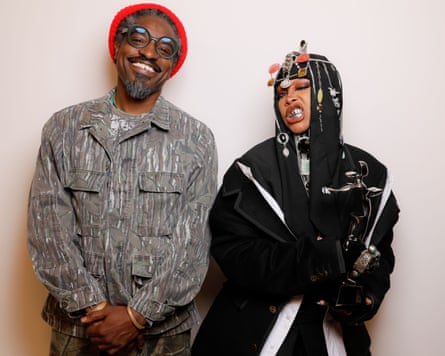
Badu began studying and received her doula certification in 2006. From 2001 to 2023, she supported two mothers a year – because she tours eight months of the year, she was reluctant to take on any more – and coached them through their pregnancies, ensuring they had access to what she calls “the five doctors”: sun, earth, nutrients, exercise and spirit. She has doula’d for celebrity friends including, she tells me, Teyana Taylor and Summer Walker. And she is also an end-of-life doula, sitting “at the bedsides of people who are passing, going the other way – I want to provide the exact same peace.”
I ask if being an end-of-life doula can be distressing, but she says the fact that it’s not for her is why she does it. “It’s another art for me,” she says. “I feel the same way when I’m servicing people on stage, singing. That’s doula work, too. I have the same thing in mind – I want the room to become one living, breathing organism.”
If there is a common thread that runs though many of the songs on Before the World Blows, it’s gender politics: the ways in which men and women interact, screw each other over and take central roles in each other’s lives. Badu has always been interested in this theme, but it feels different this time, as if she is an omniscient narrator, spreading wisdom to the world. “Some of these songs are autobiographical, and some of them are messages I want to give to my daughters” – she has two, Puma (born 2004) and Mars (2009) – “or the daughters of the world, to the people of the world who have to go through these initiations, too.”
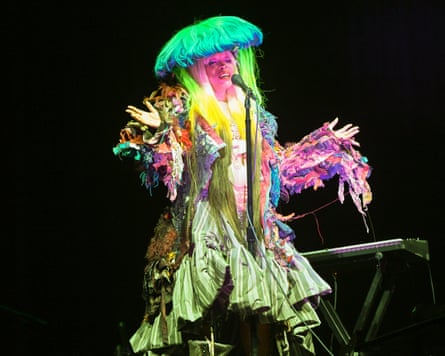
I ask if she sees right now as a particularly fractious moment for heterosexual dating, and she looks at me quizzically. “Your mama had trouble dating, and your grandma, and your great-grandma. You say more fractured – I think more transparent, maybe.” Legs outstretched, bare toes occasionally tickling my thigh by accident, Badu puts forward her theory. “I think we’re so hyper-aware that we notice things that maybe the people before us didn’t notice. The vocabulary we’re using, the definitions that we can put on our inconsistencies and weirdness, narcissism, and the ADHD. The definitions are becoming bigger than who we are.”
That scrutiny means we’re stealing from ourselves, she says. “It doesn’t give us room to create or laugh or be free. It’s hard to find somebody that is accepting you completely because we don’t accept ourselves completely any more. When I was young, you didn’t get the grace of being defined as something. You just got an ass-whooping! And when all you need is an ass-whooping, everybody can straighten up. They’re not giving out enough ass-whoopings no more. We’re pardoning behaviour by defining it, I think.”
Black Box, the album’s final track, is a wild odyssey about phone addiction, and a worthy addition to her canon of phone songs she started with But You Caint Use My Phone. Social media is a constant bugbear for Badu – she loves using it, and is prolific on Instagram, but hates how tied she is to her phone. “It’s the first thing we reach for in the morning – it has become our pseudo-husband and wife – and one thing I do know is that the first thing we do in the morning that gives us dopamine is what we will reach for all day long,” she says. “If we’re able to bypass the phone and go outside and get air and nutrients and all that, that’s what we’re going to keep running back to all day. But we pick this up first. I wanted to speak to that.”
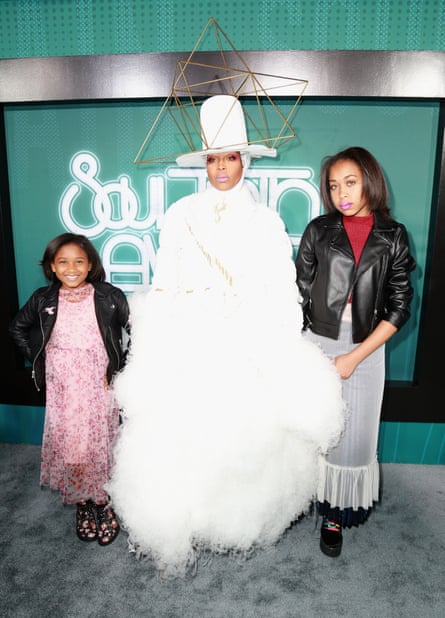
Badu’s children are 17, 22 and 28 – and she sees how they don’t have the same freedom she did, growing up without social media. Everyone is “vibrating at a higher rate” now, she says. “I noticed that it was different when I tried to show my daughters Fred Flintstone – that cartoon is hilarious to me, and they couldn’t resonate with it because it just doesn’t vibrate at the same rate they do.” Even so, she and her daughters, Mars and Puma, still have things in common. “Mars put me on to Faye Webster and Beabadoobee. Mars went backwards and got me listening to Abba! Puma loves musical theatre and Broadway, so she has me listening to Chicago or operas. We share an aux cord in the house, so I don’t have a choice.”
They all love Steve Lacy, too: Badu took her daughters to see him perform in Dallas a few years ago, and this year, they make reciprocal guest appearances on each other’s albums. “We had stuff in common, and mostly sent memes to each other starting out. That’s how you know if you rock with somebody – you have a similar sense of humour,” she says. “You kind of don’t have the same music taste, either, if you don’t have the same sense of humour.”
Before the World Blows includes an interlude by Jay Electronica, the elusive rapper she dated for many years, and the father of Mars. Badu has tended to remain close with her exes – André 3000 contributed a rare, memorable guest verse to But You Caint Use My Phone – so I ask if she has any advice for maintaining ties with former lovers. “You just gotta suck hard. That’s it,” she says, bursting into laughter, her voice rising above a whisper for the first time in our conversation. “They were my friends first, and I think that’s what makes a difference. Watch that be the headline – Erykah remains friends with her exes because she sucks hard!”
Our time is up; Badu gently swings her legs off the couch and stands up. She shuffles over to me and leans in, peering deeply into my eyes. I’m a little scared that she might drop some kind of bombshell – the time and place of my death, for example, or that I was a terrible interviewer – but instead, she just mutters: “You pretty as fuck!” Before I can even respond, she’s gone.