3 months ago
66
3 months ago
66
For all its many charms, Norwich tends to lag behind London on internet-buzzy trends (personally, I count that as among its charms), but it’s not always easy to pinpoint by exactly how long. So I was interested to spot, on a recent trip into the fine city, a woman carrying a Trader Joe’s-branded tote bag.
Trader Joe’s is a US supermarket; it does not operate in the UK, let alone East Anglia. And yet its merchandise – specifically this black-strapped, red-stamped but otherwise unremarkable tote bag – has been increasingly ubiquitous in London this year, as noted by the New York Times in July.
Three months to make it up to Norwich felt about right. But why, I wondered, was the arrival of the Trader Joe’s tote so inevitable in the first place? Tote bags used to generically signal eco-consciousness; now the message has become much more targeted and – naturally, given an online discourse obsessed with categorising people into types and tribes – fraught.
A tote bag is no longer just something you receive for free with a purchase over £40: it’s seen as a personal statement and even a billboard for your individual “brand”. A tote bag from Daunt Books, Shakespeare and Company, the London Review of Books, the New Yorker or Fitzcarraldo Editions may earn you points for reading, but see them detracted for obviousness. Trader Joe’s and Whole Foods impress upon the observer your easy familiarity with North American produce. And a man carrying a Mubi bag risks being marked out as a boorish “film bro” or “performative male”.
It may have started with totes from known brands selling items you at least need to carry, but the craze for merchandising has now spread to lesser-known and even local establishments – and well beyond bags.
Jolene, the north London bakery, sells not just totes but branded hats, socks, scarves and even oilskins. You can cherish the memory of a meal at St John with a tea towel, T-shirt, engraved waiter’s friend, or a pig-shaped pin badge (£5). Greggs, of course, has its own range with Primark, including bum bags, shoes and cycling shorts, as well as a separate jewellery line, featuring 22-carat gold-plated sausage roll earrings (£36) and a signet ring (£48, equivalent to 37 sausage rolls). But for the common man, Yard Sale Pizza sells its own football-style scarf.
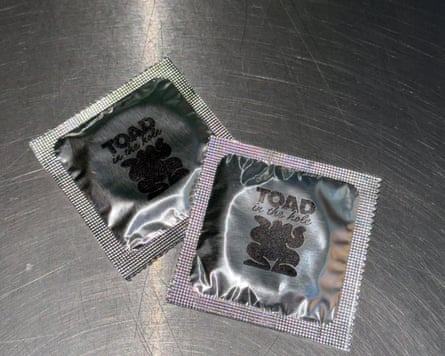
Even just grabbing a sandwich or coffee increasingly presents a chance to upsize your order with a T-shirt or cap to go. The most bizarre merch tie-in I’ve heard of is branded condoms from Camberwell’s buzzy Toad Bakery. It was a Valentine’s Day stunt, and a world-first for a bakery, owner Oliver Costello told me.
From the perennial line outside its doors, Toad has no need for publicity; indeed, Costello said they kept their limited-edition run of “toad in the hole” johnnies fairly low-key, while 100% of the funds went to charity. So what’s the business case for making them?
Partly, it seems, production is driven by demand. “Merch is big now in the bakery world” Costello said. Toad makes T-shirts and caps in large part “because they kept selling out”. Customers are increasingly prepared to travel to such talked-about bakeries, and want a longer-lasting souvenir than a pastry for their efforts.
A tote also cements and extends the street cred that comes with being “in the know” about the latest Instagram-famous establishment: been there, got the croissant. Costello likened it to picking up a T-shirt from a gig: “It’s nice to feel like you can represent them somewhere else.” For musicians in the streaming age, however, merchandise is an important source of revenue. For bakeries, sandwich shops, wine bars and other smaller-scale establishments, tacking on merch doesn’t make much of a dent in the overheads.
Toad already sells the T-shirts that its employees wear as uniform, and intends to partner with local artists on more designs, helping to mint it as a Camberwell institution; its caps are embroidered in nearby Deptford. This reveals merch as a means of displaying postcode pride, signalling your belonging to SE5 v SE10 (let alone north). In the neighbourhood where I used to live in Sydney, a much-loved convenience store now sells shirts bearing a cartoon of the owner’s face; people buy them to show support for his outspoken pro-Palestine stance and funny social media presence.
While merch might not bring in much money, it cements loyalty, may generate word-of-mouth and is typically cheap to produce – making it a low-risk venture for small businesses. An order of 150 custom totes may work out at about £5 a bag; they are readily sold for twice that. (The Times reported on a single customer at Daunt Books spending £120 on totes.)
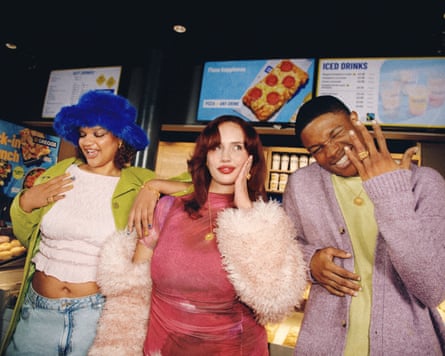
The craze for merch, then, is perhaps best ascribed to the demands on small businesses today to not just provide a product or service, but establish themselves as coherent and even covetable “brands”. Dom’s Subs, which started in Hackney during the pandemic, did a brisk trade in T-shirts and more to customers wanting to support businesses during that challenging time. “From our side, it’s great advertising,” said co-founder Dom Sherington.
In 2021, they even partnered with Carhartt on a T-shirt that sold out in minutes. The collaboration came about because Dom’s Subs frequently supplied sandwiches to the Carhartt office in Hackney Wick. T-shirts have since been spotted for resale for £300, “which is wild,” said Sherington.
For Dom’s Subs, merch has been a “great revenue stream”. The challenge has been keeping up. “It can be really tricky to manage that side of the business as we don’t have a dedicated team,” said Sherington. Though they aspire to launch new products consistently, “Currently we just don’t have the manpower – we’re just a trio of sandwich shops”.
Of course, the market for more branded stuff says most about capitalism. My entrepreneurial-minded friend recently returned from the US with three Trader Joe’s totes, intending to resell them at a profit; he’s still got them, having found Vinted swamped. (At least “they’re nice spacious bags,” he added.)
As much as merch may seem like an easy win for small businesses, it’s also a sideshow, distracting from what they’re really trying to sell and adding to the pressures they face to stay afloat, as much as alleviating them. And for individuals, it might be a stand-in for a kind of cultural cachet that money can’t buy. It’s safer to buy someone a tote from a cult bookshop than it is to select a book you know they’d love. And it’s easier to buy a cap from your local cafe than it is to build a community there.